AQA · GCSE · Biology
Course version: 8461 · Version from Sept 2018
A stem cell is an undifferentiated cell of an organism which is capable of…
Full specification wording
Stem cells: A stem cell is an undifferentiated cell of an organism which is capable of giving rise to many more cells of the same type, and from which certain other cells can arise from differentiation.
A stem cell is unspecialised, meaning it has not yet developed the specific structure and function of a mature cell such as a neurone or red blood cell.
Checked against the AQA 8461 specification (opens in a new tab) on .
- Point 1 of 11
- 3 key terms
Study notes
From the checked teaching notes for this specification point.
The idea
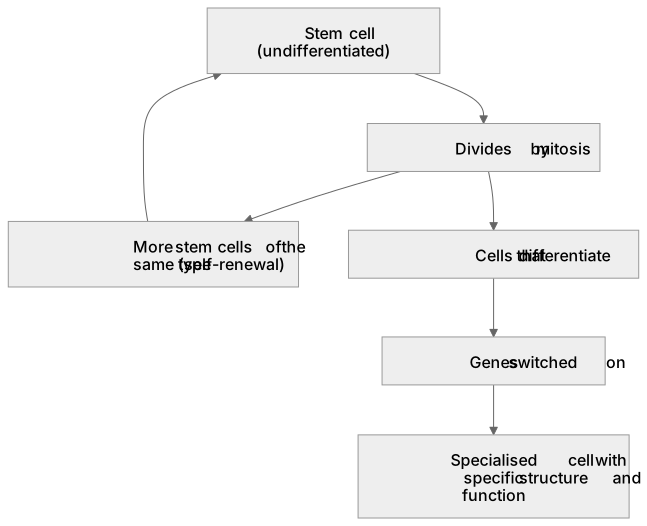
A stem cell is unspecialised, meaning it has not yet developed the specific structure and function of a mature cell such as a neurone or red blood cell. It can divide by mitosis to produce more stem cells of the same type, so the supply is maintained, and it can also produce cells that become specialised through differentiation. Differentiation involves the cell switching on particular genes so it develops the right shape, organelles and proteins for its job. For example, a stem cell in bone marrow can divide to make more stem cells and also give rise to red blood cells that carry oxygen. You should be able to use this definition to identify stem cells in unfamiliar examples and to explain the difference between self-renewal and differentiation.
What earns the marks
- Defines a stem cell as undifferentiated, meaning it has not become specialised.
- States that stem cells can divide to produce many more cells of the same type, maintaining the stem cell population.
- Explains that some cells produced by stem cells differentiate into other cell types with specific functions.
- Uses examples such as bone marrow stem cells forming blood cells or meristem cells forming plant tissues.
- Distinguishes self-renewal from differentiation when describing stem cell behaviour.
Common mistakes and how to put them right
Describing a stem cell as a specialised cell.
Put it right by stating that it is undifferentiated before it differentiates.
Saying stem cells only produce one type of cell.
Put it right by stating that they can produce more stem cells and also other cell types.
Confusing differentiation with cell division.
Put it right by stating that differentiation is the development of specialised features, not the act of dividing.
Exam tips
- Use the word undifferentiated in your definition to show precise understanding.
- Give a named example of a stem cell and the specialised cell it can become.
- When explaining differentiation, refer to genes being switched on or off rather than vague changes.
Try the lesson
The start of the Stem cells: A stem cell is an undifferentiated cell of an organism which is capable of giving rise to many more cells of the same type, and from which certain other cells can arise from differentiation. lesson, made from checked teaching notes for this specification point.
Have a go first
Which term describes a cell that has not yet become specialised for a particular job?
Listen
A stem cell is unspecialised, meaning it has not yet developed the specific structure and function of a mature cell such as a neurone or red blood cell. It can divide by mitosis to produce more stem cells of the same type, so the supply is maintained, and it can also produce cells that become specialised through differentiation. Differentiation involves the cell switching on particular genes so it develops the right shape, organelles and proteins for its job. For example, a stem cell in bone marrow can divide to make more stem cells and also give rise to red blood cells that carry oxygen. You should be able to use this definition to identify stem cells in unfamiliar examples and to explain the difference between self-renewal and differentiation. A strong answer earns marks for these points. Defines a stem cell as undifferentiated, meaning it has not become specialised. States that stem cells can divide to produce many more cells of the same type, maintaining the stem cell population. Explains that some cells produced by stem cells differentiate into other cell types with specific functions. Uses examples such as bone marrow stem cells forming blood cells or meristem cells forming plant tissues. A common slip: Describing a stem cell as a specialised cell. Instead, stating that it is undifferentiated before it differentiates. Exam tip: Use the word undifferentiated in your definition to show precise understanding.
See it
Key words
Say what each word means before you turn the card.
Stem cell
Try answering aloud or in your head before turning the card.
Differentiation
Try answering aloud or in your head before turning the card.
Self-renewal
Try answering aloud or in your head before turning the card.
See every definition
- Stem cell
- An undifferentiated cell of an organism which is capable of giving rise to many more cells of the same type, and from which certain other cells can arise from differentiation.
- Differentiation
- The process in which a cell switches on particular genes so it develops the right shape, organelles and proteins for its job.
- Self-renewal
- Division by mitosis to produce more stem cells of the same type, so the supply is maintained.
Label the diagram
Some boxes have lost their names. Pick the right name for each number.
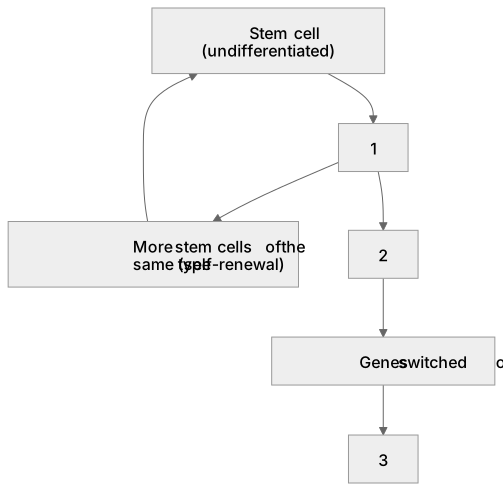
1Box 1
2Box 2
3Box 3
There is more to this lesson
The full lesson goes on to check your understanding and help you earn the marks. Create a free account to carry on, with your progress saved.
A week of Premium from your first lesson · Then the free plan continues · No card, no charge
Test your understanding of Stem cells: A stem cell is an undifferentiated cell of an organism which is capable of giving rise to many more cells of the same type, and from which certain other cells can arise from differentiation.
Active recall beats re-reading. Take an instant quiz now to test what you’ve learned and lock it into long-term memory.
A week of Premium from your first lesson · Then the free plan continues · No card, no charge