AQA · GCSE · Biology
Course version: 8461 · Version from Sept 2018
Required practical activity 7: plan and carry out an investigation into…
Full specification wording
Structure and function: Required practical activity 7: plan and carry out an investigation into the effect of a factor on human reaction time.
In this practical you investigate how a chosen factor, such as caffeine intake, background noise, exercise or time of day, affects human reaction time.
Checked against the AQA 8461 specification (opens in a new tab) on .
- Point 12 of 13
- 4 key terms
Study notes
From the checked teaching notes for this specification point.
The idea
In this practical you investigate how a chosen factor, such as caffeine intake, background noise, exercise or time of day, affects human reaction time. A common method uses a ruler drop test: a partner holds a ruler vertically with the zero mark level with your open thumb and finger, then releases it without warning. You catch the ruler and record the distance it falls. A shorter distance indicates a faster reaction time. You should plan a hypothesis, identify the independent variable and control relevant variables such as the same hand, same partner and same starting position. Repeat readings and calculate a mean to improve reliability, and consider ethical issues such as informed consent. Present results in a table and graph, then interpret whether the factor affected reaction time.
What earns the marks
- State a hypothesis linking the chosen factor to reaction time.
- Identify the independent variable and the dependent variable, such as drop distance or calculated reaction time.
- Control relevant variables, for example using the same hand, same partner and same starting position.
- Collect repeat readings and calculate a mean to reduce the effect of random variation.
- Present results appropriately and interpret whether the factor changed reaction time.
Common mistakes and how to put them right
Allowing the partner to give a warning before releasing the ruler.
Put it right by releasing without warning so the response is a true reaction.
Recording only one reading per condition.
Put it right by taking repeats and calculating a mean.
Changing several factors at once.
Put it right by changing only the independent variable and controlling the others.
Exam tips
- Describe the method precisely enough for another student to repeat it.
- Name the variables clearly and explain how each control is achieved.
- Use your results to state whether the factor increased, decreased or had no effect on reaction time.
Try the lesson
The start of the Structure and function: Required practical activity 7: plan and carry out an investigation into the effect of a factor on human reaction time. lesson, made from checked teaching notes for this specification point.
Have a go first
In a reaction time investigation using a ruler drop test, which variable is the independent variable if the effect of caffeine is being tested?
Listen
In this practical you investigate how a chosen factor, such as caffeine intake, background noise, exercise or time of day, affects human reaction time. A common method uses a ruler drop test: a partner holds a ruler vertically with the zero mark level with your open thumb and finger, then releases it without warning. You catch the ruler and record the distance it falls. A shorter distance indicates a faster reaction time. You should plan a hypothesis, identify the independent variable and control relevant variables such as the same hand, same partner and same starting position. Repeat readings and calculate a mean to improve reliability, and consider ethical issues such as informed consent. Present results in a table and graph, then interpret whether the factor affected reaction time. A strong answer earns marks for these points. State a hypothesis linking the chosen factor to reaction time. Identify the independent variable and the dependent variable, such as drop distance or calculated reaction time. Control relevant variables, for example using the same hand, same partner and same starting position. Collect repeat readings and calculate a mean to reduce the effect of random variation. A common slip: Allowing the partner to give a warning before releasing the ruler. Instead, releasing without warning so the response is a true reaction. Exam tip: Describe the method precisely enough for another student to repeat it.
See it
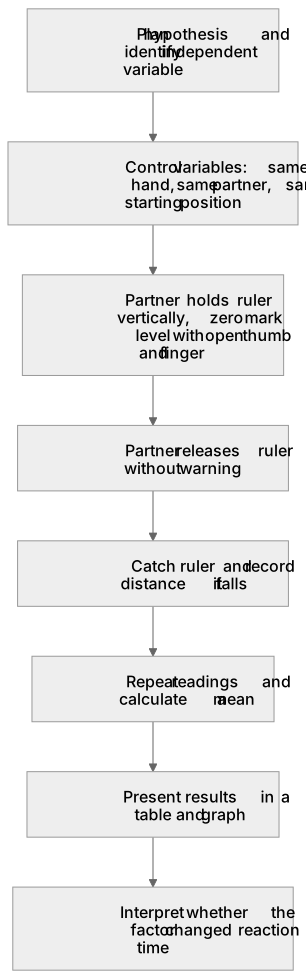
Put it in order
Put these steps in the order they happen.
- 1. Catch ruler and record distance it falls
- 2. Interpret whether the factor changed reaction time
- 3. Repeat readings and calculate a mean
- 4. Plan hypothesis and identify independent variable
- 5. Control variables: same hand, same partner, same starting position
- 6. Present results in a table and graph
- 7. Partner holds ruler vertically, zero mark level with open thumb and finger
- 8. Partner releases ruler without warning
Key words
Say what each word means before you turn the card.
Experimental design and control variables
Try answering aloud or in your head before turning the card.
Human reaction time
Try answering aloud or in your head before turning the card.
Reliability and repeat measurements
Try answering aloud or in your head before turning the card.
Data presentation and interpretation
Try answering aloud or in your head before turning the card.
See every definition
- Experimental design and control variables
- Planning a hypothesis, identifying the independent variable and controlling relevant variables such as the same hand, same partner and same starting position.
- Human reaction time
- How quickly a person responds, measured in the ruler drop test by the distance the ruler falls before it is caught, where a shorter distance indicates a faster reaction time.
- Reliability and repeat measurements
- Collecting repeat readings and calculating a mean to reduce the effect of random variation and improve reliability.
- Data presentation and interpretation
- Presenting results in a table and graph, then interpreting whether the factor affected reaction time.
Label the diagram
Some boxes have lost their names. Pick the right name for each number.
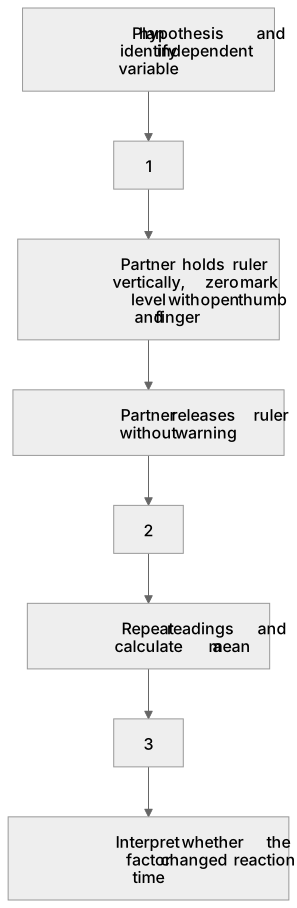
1Box 1
2Box 2
3Box 3
There is more to this lesson
The full lesson goes on to check your understanding and help you earn the marks. Create a free account to carry on, with your progress saved.
A week of Premium from your first lesson · Then the free plan continues · No card, no charge
Test your understanding of Structure and function: Required practical activity 7: plan and carry out an investigation into the effect of a factor on human reaction time.
Active recall beats re-reading. Take an instant quiz now to test what you’ve learned and lock it into long-term memory.
A week of Premium from your first lesson · Then the free plan continues · No card, no charge