AQA · GCSE · Biology
Course version: 8461 · Version from Sept 2018
(HT only) Students should be able to explain some of the difficulties of…
Full specification wording
The brain (biology only): (HT only) Students should be able to explain some of the difficulties of investigating brain function and treating brain damage and disease.
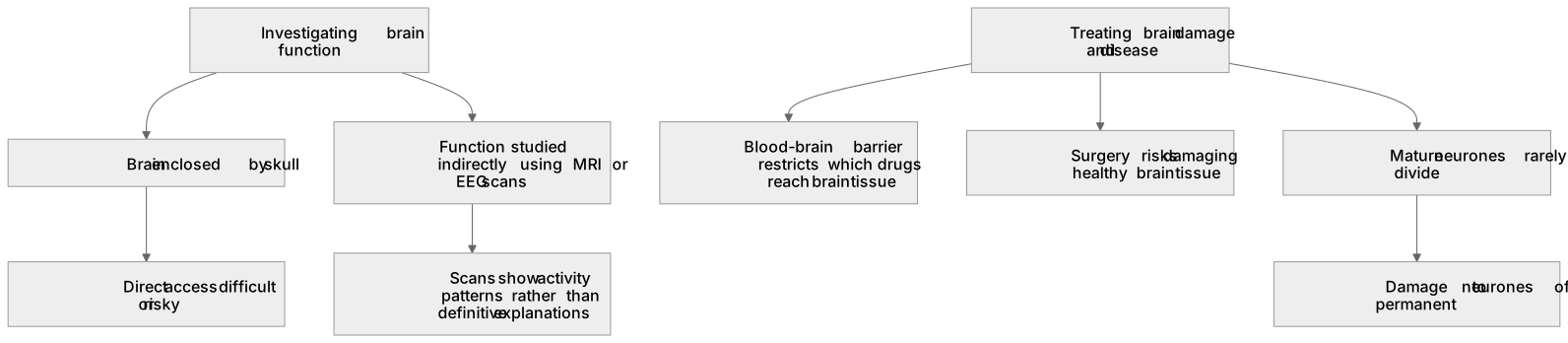
Investigating the brain is difficult because it is enclosed within the skull, making direct access risky, and because its neurones are delicate and do not readily regenerate.
Checked against the AQA 8461 specification (opens in a new tab) on .
- Point 3 of 5
- 3 key terms
Study notes
From the checked teaching notes for this specification point.
The idea
Investigating the brain is difficult because it is enclosed within the skull, making direct access risky, and because its neurones are delicate and do not readily regenerate. Studying living brain function often relies on indirect methods such as MRI or EEG scans, which show activity patterns rather than giving definitive explanations. Treating brain damage and disease is also challenging: the blood-brain barrier limits which drugs can reach the brain, surgery risks damaging healthy tissue, and damage to neurones is often permanent because mature neurones rarely divide.
What earns the marks
- Explains that the brain is enclosed by the skull, making direct investigation difficult or risky.
- Explains that brain function is studied indirectly using scans such as MRI or EEG rather than direct observation.
- Explains that the blood-brain barrier restricts which drugs or treatments can reach brain tissue.
- Explains that damage to neurones is often permanent because mature neurones have limited ability to regenerate.
- Explains that treating brain disease is difficult because surgery risks damaging healthy brain tissue.
- Uses causal language such as 'because' or 'therefore' to link each difficulty to its consequence.
Common mistakes and how to put them right
Stating that the brain is difficult to study without giving a reason.
Put it right: Explain why, for example because it is protected by the skull.
Claiming that brain damage always repairs itself.
Put it right: Mature neurones rarely regenerate, so damage is often permanent.
Confusing the blood-brain barrier with the skull.
Put it right: The barrier is a selective boundary controlling substances entering brain tissue.
Exam tips
- Aim for two or three distinct difficulties, each with a clear reason, rather than one long vague point.
- Use connectives such as 'because' and 'therefore' to make the causal link explicit.
- Refer to named techniques such as MRI scans when explaining why investigation is indirect.
Try the lesson
The start of the The brain (biology only): (HT only) Students should be able to explain some of the difficulties of investigating brain function and treating brain damage and disease. lesson, made from checked teaching notes for this specification point.
Have a go first
Why does surgical treatment for brain disease or brain damage carry a very high level of risk for the patient?
Listen
Investigating the brain is difficult because it is enclosed within the skull, making direct access risky, and because its neurones are delicate and do not readily regenerate. Studying living brain function often relies on indirect methods such as MRI or EEG scans, which show activity patterns rather than giving definitive explanations. Treating brain damage and disease is also challenging: the blood-brain barrier limits which drugs can reach the brain, surgery risks damaging healthy tissue, and damage to neurones is often permanent because mature neurones rarely divide. A strong answer earns marks for these points. Explains that the brain is enclosed by the skull, making direct investigation difficult or risky. Explains that brain function is studied indirectly using scans such as MRI or EEG rather than direct observation. Explains that the blood-brain barrier restricts which drugs or treatments can reach brain tissue. Explains that damage to neurones is often permanent because mature neurones have limited ability to regenerate. A common slip: Stating that the brain is difficult to study without giving a reason. Instead, explain why, for example because it is protected by the skull. Exam tip: Aim for two or three distinct difficulties, each with a clear reason, rather than one long vague point.
See it
Key words
Say what each word means before you turn the card.
Brain imaging techniques
Try answering aloud or in your head before turning the card.
Barriers to treatment
Try answering aloud or in your head before turning the card.
Neurone regeneration
Try answering aloud or in your head before turning the card.
See every definition
- Brain imaging techniques
- Indirect methods such as MRI or EEG scans that show activity patterns rather than giving definitive explanations of living brain function.
- Barriers to treatment
- Difficulties including the blood-brain barrier limiting which drugs reach the brain and surgery risking damage to healthy tissue.
- Neurone regeneration
- The limited ability of mature neurones to divide, meaning damage to neurones is often permanent.
Label the diagram
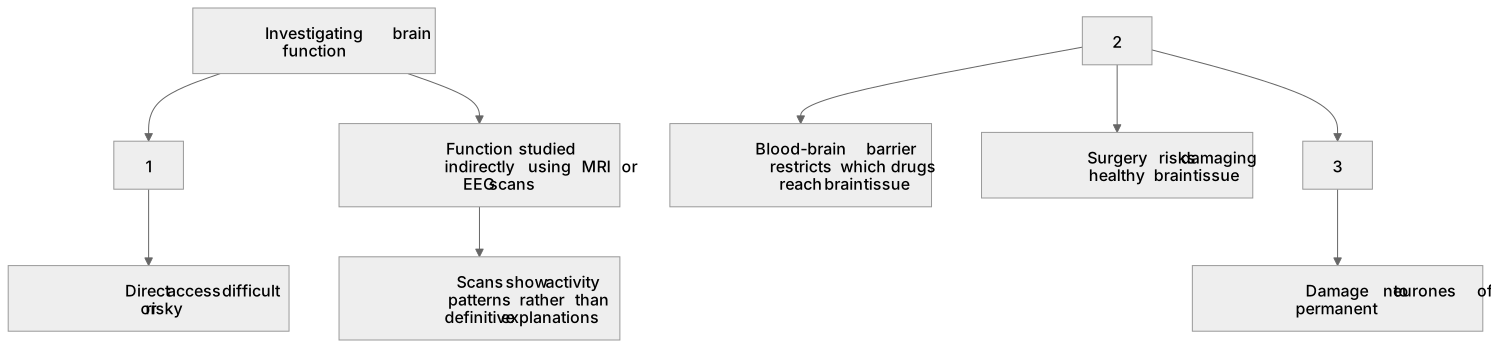
Some boxes have lost their names. Pick the right name for each number.
1Box 1
2Box 2
3Box 3
There is more to this lesson
The full lesson goes on to check your understanding and help you earn the marks. Create a free account to carry on, with your progress saved.
A week of Premium from your first lesson · Then the free plan continues · No card, no charge
Test your understanding of The brain (biology only): (HT only) Students should be able to explain some of the difficulties of investigating brain function and treating brain damage and disease.
Active recall beats re-reading. Take an instant quiz now to test what you’ve learned and lock it into long-term memory.
A week of Premium from your first lesson · Then the free plan continues · No card, no charge