AQA · GCSE · Biology
Course version: 8461 · Version from Sept 2018
Accommodation is the process of changing the shape of the lens to focus on…
Full specification wording
The eye (biology only): Accommodation is the process of changing the shape of the lens to focus on near or distant objects.
Accommodation is the reflex adjustment of lens shape so that light from objects at different distances focuses sharply on the retina.
Checked against the AQA 8461 specification (opens in a new tab) on .
- Point 4 of 10
- 4 key terms
Study notes
From the checked teaching notes for this specification point.
The idea
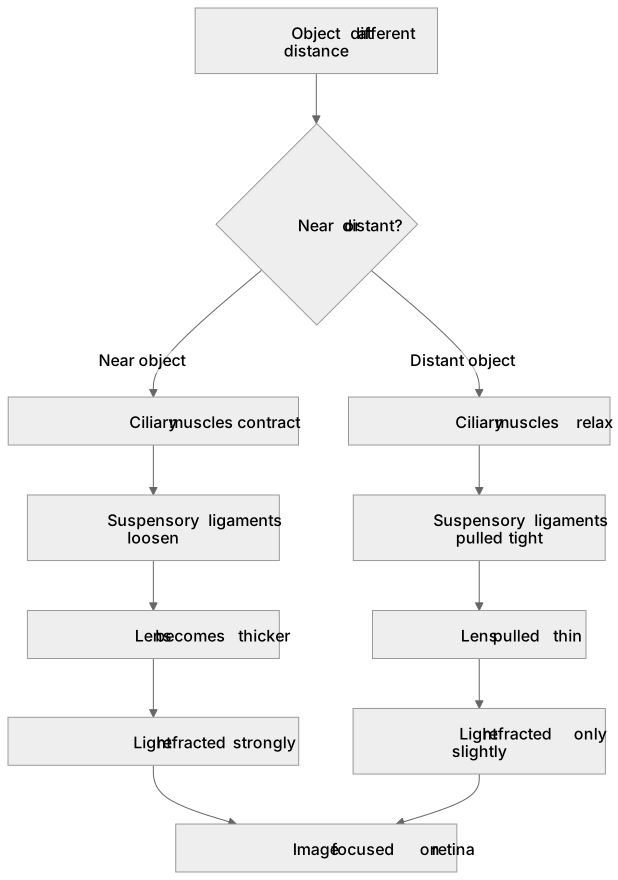
Accommodation is the reflex adjustment of lens shape so that light from objects at different distances focuses sharply on the retina. The lens is elastic and its shape is controlled by the ciliary muscles and suspensory ligaments. When viewing a near object, the ciliary muscles contract, the suspensory ligaments loosen, and the lens becomes thicker, refracting light strongly. When viewing a distant object, the ciliary muscles relax, the suspensory ligaments are pulled tight, and the lens is pulled thin, refracting light only slightly. This ensures the image falls on the retina, where receptors detect it. The process is automatic and protects clear vision across a range of distances.
What earns the marks
- Accommodation changes the shape of the lens to focus light from near or distant objects onto the retina.
- The ciliary muscles and suspensory ligaments work antagonistically to alter lens shape.
- For a near object, the ciliary muscles contract, suspensory ligaments loosen, and the lens becomes thicker and more strongly refracting.
- For a distant object, the ciliary muscles relax, suspensory ligaments are pulled tight, and the lens becomes thinner and less strongly refracting.
- The lens is elastic, so it changes shape rather than moving position.
- Focusing on the retina ensures light-sensitive cells receive a clear image.
Common mistakes and how to put them right
Saying the lens moves forwards or backwards to focus.
Put it right by describing thickening or thinning of the lens.
Reversing the roles of ciliary muscles and suspensory ligaments.
Put it right by linking contraction to a thicker lens.
Thinking accommodation is the same as pupil reflex.
Put it right by separating the two processes.
Exam tips
- Use a two-column table to compare near and distant focusing, listing ciliary muscle state, ligament state and lens shape.
- Write the sequence as a cause-and-effect chain: stimulus, muscle action, ligament change, lens shape, refraction, focus on retina.
- Avoid saying 'the lens gets fatter' in isolation; always state the effect on refraction and focus.
Try the lesson
The start of the The eye (biology only): Accommodation is the process of changing the shape of the lens to focus on near or distant objects. lesson, made from checked teaching notes for this specification point.
Have a go first
What is accommodation in the eye?
Listen
Accommodation is the reflex adjustment of lens shape so that light from objects at different distances focuses sharply on the retina. The lens is elastic and its shape is controlled by the ciliary muscles and suspensory ligaments. When viewing a near object, the ciliary muscles contract, the suspensory ligaments loosen, and the lens becomes thicker, refracting light strongly. When viewing a distant object, the ciliary muscles relax, the suspensory ligaments are pulled tight, and the lens is pulled thin, refracting light only slightly. This ensures the image falls on the retina, where receptors detect it. The process is automatic and protects clear vision across a range of distances. A strong answer earns marks for these points. Accommodation changes the shape of the lens to focus light from near or distant objects onto the retina. The ciliary muscles and suspensory ligaments work antagonistically to alter lens shape. For a near object, the ciliary muscles contract, suspensory ligaments loosen, and the lens becomes thicker and more strongly refracting. For a distant object, the ciliary muscles relax, suspensory ligaments are pulled tight, and the lens becomes thinner and less strongly refracting. A common slip: Saying the lens moves forwards or backwards to focus: the lens changes shape in place. Instead, describing thickening or thinning of the lens. Exam tip: Use a two-column table to compare near and distant focusing, listing ciliary muscle state, ligament state and lens shape.
See it
Key words
Say what each word means before you turn the card.
Accommodation
Try answering aloud or in your head before turning the card.
Ciliary muscles
Try answering aloud or in your head before turning the card.
Suspensory ligaments
Try answering aloud or in your head before turning the card.
Retina
Try answering aloud or in your head before turning the card.
See every definition
- Accommodation
- The process of changing the shape of the lens to focus on near or distant objects.
- Ciliary muscles
- Muscles that control the shape of the lens, contracting for a near object and relaxing for a distant object.
- Suspensory ligaments
- Ligaments that loosen when the ciliary muscles contract and are pulled tight when the ciliary muscles relax.
- Retina
- The place where the image falls and where receptors detect it.
There is more to this lesson
The full lesson goes on to check your understanding and help you earn the marks. Create a free account to carry on, with your progress saved.
A week of Premium from your first lesson · Then the free plan continues · No card, no charge
Test your understanding of The eye (biology only): Accommodation is the process of changing the shape of the lens to focus on near or distant objects.
Active recall beats re-reading. Take an instant quiz now to test what you’ve learned and lock it into long-term memory.
A week of Premium from your first lesson · Then the free plan continues · No card, no charge