AQA · GCSE · Biology
Course version: 8461 · Version from Sept 2018
To focus on a near object: • the ciliary muscles contract • the suspensory…
Full specification wording
The eye (biology only): To focus on a near object: • the ciliary muscles contract • the suspensory ligaments loosen • the lens is then thicker and refracts light rays strongly.
When you look at a near object, light rays from it diverge more strongly and need greater refraction to converge on the retina.
Checked against the AQA 8461 specification (opens in a new tab) on .
- Point 5 of 10
- 4 key terms
Study notes
From the checked teaching notes for this specification point.
The idea
When you look at a near object, light rays from it diverge more strongly and need greater refraction to converge on the retina. The ciliary muscles contract, which reduces the tension on the suspensory ligaments so they loosen. The elastic lens then becomes thicker and more curved, increasing its refractive power. This stronger refraction bends the light rays more sharply so they focus on the retina. The sequence is: ciliary muscles contract, suspensory ligaments loosen, lens thickens, light is refracted strongly, and a clear image forms on the retina. This is an automatic reflex and is part of accommodation.
What earns the marks
- The ciliary muscles contract when focusing on a near object.
- Contraction of the ciliary muscles reduces tension in the suspensory ligaments, so they loosen.
- The lens becomes thicker and more curved because the suspensory ligaments are loose.
- A thicker lens refracts light rays more strongly.
- Stronger refraction brings diverging rays from a near object to a focus on the retina.
- The process is a reflex and occurs without conscious control.
Common mistakes and how to put them right
Saying the suspensory ligaments contract.
Put it right by naming the ciliary muscles as the contractile tissue.
Stating the lens becomes thinner for near objects.
Put it right by linking near vision to increased curvature and stronger refraction.
Thinking the ciliary muscles relax for near vision.
Put it right by associating contraction with a thicker lens.
Exam tips
- Learn the near-focus sequence as a chain: contract, loosen, thicken, refract strongly.
- Use the phrase 'refracts light rays strongly' rather than 'bends light a lot' to match scientific language.
- When answering, state the object distance first, then the muscle and ligament changes, then the lens shape and refraction.
Try the lesson
The start of the The eye (biology only): To focus on a near object: • the ciliary muscles contract • the suspensory ligaments loosen • the lens is then thicker and refracts light rays strongly. lesson, made from checked teaching notes for this specification point.
Have a go first
When the eye focuses on a near object, what happens to the ciliary muscles?
Listen
When you look at a near object, light rays from it diverge more strongly and need greater refraction to converge on the retina. The ciliary muscles contract, which reduces the tension on the suspensory ligaments so they loosen. The elastic lens then becomes thicker and more curved, increasing its refractive power. This stronger refraction bends the light rays more sharply so they focus on the retina. The sequence is: ciliary muscles contract, suspensory ligaments loosen, lens thickens, light is refracted strongly, and a clear image forms on the retina. This is an automatic reflex and is part of accommodation. A strong answer earns marks for these points. The ciliary muscles contract when focusing on a near object. Contraction of the ciliary muscles reduces tension in the suspensory ligaments, so they loosen. The lens becomes thicker and more curved because the suspensory ligaments are loose. A thicker lens refracts light rays more strongly. A common slip: Saying the suspensory ligaments contract: ligaments do not contract; the ciliary muscles contract and the ligaments loosen. Instead, naming the ciliary muscles as the contractile tissue. Exam tip: Learn the near-focus sequence as a chain: contract, loosen, thicken, refract strongly.
See it
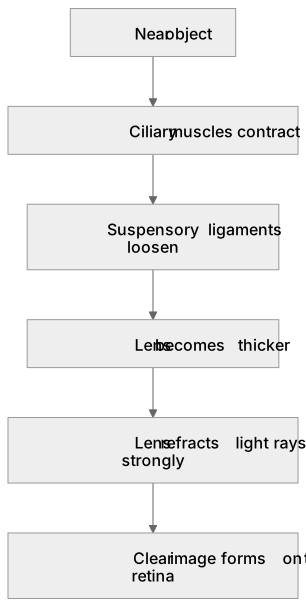
Put it in order
Put these steps in the order they happen.
- 1. Suspensory ligaments loosen
- 2. Ciliary muscles contract
- 3. Near object
- 4. Clear image forms on the retina
- 5. Lens refracts light rays strongly
- 6. Lens becomes thicker
Key words
Say what each word means before you turn the card.
Ciliary muscles
Try answering aloud or in your head before turning the card.
Suspensory ligaments
Try answering aloud or in your head before turning the card.
Lens
Try answering aloud or in your head before turning the card.
Refraction
Try answering aloud or in your head before turning the card.
See every definition
- Ciliary muscles
- These contract when focusing on a near object, and their contraction reduces tension in the suspensory ligaments.
- Suspensory ligaments
- These loosen when the ciliary muscles contract, and because they are loose the lens becomes thicker and more curved.
- Lens
- This becomes thicker and more curved when the suspensory ligaments are loose, and a thicker lens refracts light rays more strongly.
- Refraction
- Stronger refraction brings diverging rays from a near object to a focus on the retina.
Label the diagram
Some boxes have lost their names. Pick the right name for each number.
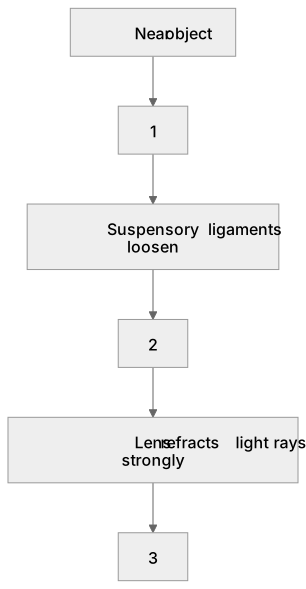
1Box 1
2Box 2
3Box 3
There is more to this lesson
The full lesson goes on to check your understanding and help you earn the marks. Create a free account to carry on, with your progress saved.
A week of Premium from your first lesson · Then the free plan continues · No card, no charge
Test your understanding of The eye (biology only): To focus on a near object: • the ciliary muscles contract • the suspensory ligaments loosen • the lens is then thicker and refracts light rays strongly.
Active recall beats re-reading. Take an instant quiz now to test what you’ve learned and lock it into long-term memory.
A week of Premium from your first lesson · Then the free plan continues · No card, no charge