AQA · GCSE · Biology
Course version: 8461 · Version from Sept 2018
New technologies now include hard and soft contact lenses, laser surgery…
Full specification wording
The eye (biology only): New technologies now include hard and soft contact lenses, laser surgery to change the shape of the cornea and a replacement lens in the eye.
The eye focuses light using the cornea and lens, but defects like myopia and hyperopia blur vision.
Checked against the AQA 8461 specification (opens in a new tab) on .
- Point 9 of 10
- 4 key terms
Study notes
From the checked teaching notes for this specification point.
The idea
The eye focuses light using the cornea and lens, but defects like myopia and hyperopia blur vision. New technologies correct these defects by altering how light is refracted. Hard and soft contact lenses sit on the surface of the cornea to provide the correct refraction; soft lenses are flexible, while hard lenses are rigid and durable. Laser surgery permanently reshapes the cornea so its refractive power matches the eyeball's length, removing the need for glasses. Alternatively, a replacement artificial lens can be implanted inside the eye to correct severe focusing errors.
What earns the marks
- State that contact lenses sit on the surface of the cornea and refract light to compensate for visual defects.
- Describe laser surgery as a procedure that permanently changes the shape of the cornea to alter its refractive power.
- Explain that a replacement lens involves implanting an artificial lens inside the eye to correct severe focusing errors.
- Compare the risks of these technologies, noting that surgery carries risks of internal eye infection or permanent damage, whereas contact lenses carry a risk of surface infections if not cleaned properly.
- Contrast hard and soft contact lenses, noting that soft lenses are generally more comfortable but hard lenses are more durable.
Common mistakes and how to put them right
Thinking contact lenses sit inside the eyeball or change the shape of the cornea.
Put it right: Contact lenses sit on the outer surface of the cornea and refract light, but they do not alter the cornea's physical structure.
Confusing the cornea with the lens when describing laser surgery.
Put it right: Laser surgery reshapes the cornea (the clear front surface of the eye), not the internal lens.
Assuming all corrective procedures carry the same risks.
Put it right: Distinguish between surface risks (e.g. corneal infections from dirty contact lenses) and internal surgical risks (e.g. retinal damage from replacement lens surgery).
Exam tips
- Link each technology to its specific mechanism: laser surgery reshapes the cornea, contact lenses sit on the cornea to refract light, and replacement lenses are implanted internally.
- When asked to evaluate these technologies, always provide a balanced argument by giving at least one specific benefit (e.g. convenience for sports) and one specific risk (e.g. surgical complications) for each method.
Try the lesson
The start of the The eye (biology only): New technologies now include hard and soft contact lenses, laser surgery to change the shape of the cornea and a replacement lens in the eye. lesson, made from checked teaching notes for this specification point.
Have a go first
Which new technology for treating eye problems involves changing the shape of the cornea?
Listen
The eye focuses light using the cornea and lens, but defects like myopia and hyperopia blur vision. New technologies correct these defects by altering how light is refracted. Hard and soft contact lenses sit on the surface of the cornea to provide the correct refraction; soft lenses are flexible, while hard lenses are rigid and durable. Laser surgery permanently reshapes the cornea so its refractive power matches the eyeball's length, removing the need for glasses. Alternatively, a replacement artificial lens can be implanted inside the eye to correct severe focusing errors. A strong answer earns marks for these points. State that contact lenses sit on the surface of the cornea and refract light to compensate for visual defects. Describe laser surgery as a procedure that permanently changes the shape of the cornea to alter its refractive power. Explain that a replacement lens involves implanting an artificial lens inside the eye to correct severe focusing errors. Compare the risks of these technologies, noting that surgery carries risks of internal eye infection or permanent damage, whereas contact lenses carry a risk of surface infections if not cleaned properly. A common slip: Thinking contact lenses sit inside the eyeball or change the shape of the cornea. Instead, contact lenses sit on the outer surface of the cornea and refract light, but they do not alter the cornea's physical structure. Exam tip: Link each technology to its specific mechanism: laser surgery reshapes the cornea, contact lenses sit on the cornea to refract light, and replacement lenses are implanted internally.
See it

Key words
Say what each word means before you turn the card.
Contact lenses
Try answering aloud or in your head before turning the card.
Laser surgery
Try answering aloud or in your head before turning the card.
Replacement lens
Try answering aloud or in your head before turning the card.
Risk evaluation
Try answering aloud or in your head before turning the card.
See every definition
- Contact lenses
- Hard and soft lenses that sit on the surface of the cornea to provide the correct refraction.
- Laser surgery
- A procedure that permanently reshapes the cornea so its refractive power matches the eyeball's length, removing the need for glasses.
- Replacement lens
- An artificial lens implanted inside the eye to correct severe focusing errors.
- Risk evaluation
- Comparing benefits like convenience against risks such as surgical complications or eye infections.
Label the diagram
Some boxes have lost their names. Pick the right name for each number.
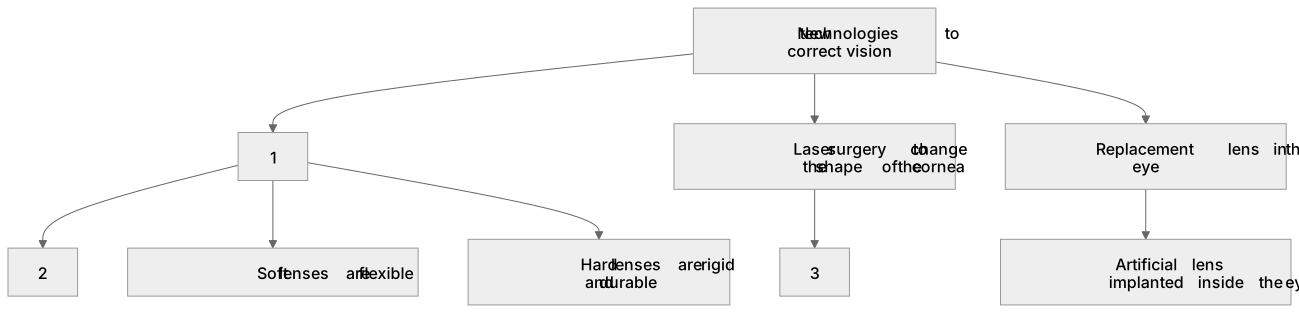
1Box 1
2Box 2
3Box 3
There is more to this lesson
The full lesson goes on to check your understanding and help you earn the marks. Create a free account to carry on, with your progress saved.
A week of Premium from your first lesson · Then the free plan continues · No card, no charge
Test your understanding of The eye (biology only): New technologies now include hard and soft contact lenses, laser surgery to change the shape of the cornea and a replacement lens in the eye.
Active recall beats re-reading. Take an instant quiz now to test what you’ve learned and lock it into long-term memory.
A week of Premium from your first lesson · Then the free plan continues · No card, no charge