AQA · GCSE · Biology
Course version: 8461 · Version from Sept 2018
It also emulsifies fat to form small droplets which increases the surface…
Full specification wording
The human digestive system: It also emulsifies fat to form small droplets which increases the surface area.
Bile emulsifies fat, meaning it physically breaks large fat globules into many tiny droplets.
Checked against the AQA 8461 specification (opens in a new tab) on .
- Point 16 of 25
- 4 key terms
Study notes
From the checked teaching notes for this specification point.
The idea
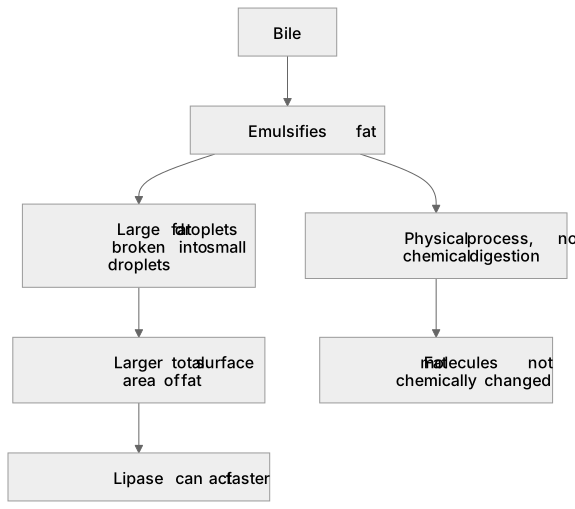
Bile emulsifies fat, meaning it physically breaks large fat globules into many tiny droplets. This is a physical process, not chemical digestion, because no covalent bonds in fat molecules are broken. The droplets remain fat, but they are spread through the watery contents of the small intestine, forming an emulsion. The key benefit is a much larger total surface area of fat exposed to the enzyme lipase. Lipase molecules can then attach to more fat surface at the same time, so fat is broken down faster. A useful model is shaking oil with water: large drops become many small droplets, increasing the area available for reaction. Emulsification therefore speeds up digestion without itself producing fatty acids and glycerol.
What earns the marks
- Bile emulsifies fat by breaking large fat droplets into smaller droplets.
- Emulsification is a physical process, not chemical digestion.
- Smaller droplets have a larger total surface area for the same volume of fat.
- The increased surface area allows lipase to act faster.
- Fat molecules are not chemically changed by emulsification alone.
Common mistakes and how to put them right
Saying bile chemically digests fat.
Put it right by stating that bile emulsifies fat physically while lipase digests it chemically.
Saying emulsification decreases surface area.
Put it right by stating that many small droplets have a larger total surface area than one large globule.
Saying bile breaks fat into fatty acids and glycerol.
Put it right by stating that lipase produces fatty acids and glycerol.
Exam tips
- Use the phrase small droplets and link them explicitly to increased surface area.
- State that emulsification is physical, not chemical, to distinguish it from enzyme action.
- When explaining rate, connect larger surface area to more frequent collisions between lipase and fat.
Try the lesson
The start of the The human digestive system: It also emulsifies fat to form small droplets which increases the surface area. lesson, made from checked teaching notes for this specification point.
Have a go first
What does bile do to fat in the small intestine?
Listen
Bile emulsifies fat, meaning it physically breaks large fat globules into many tiny droplets. This is a physical process, not chemical digestion, because no covalent bonds in fat molecules are broken. The droplets remain fat, but they are spread through the watery contents of the small intestine, forming an emulsion. The key benefit is a much larger total surface area of fat exposed to the enzyme lipase. Lipase molecules can then attach to more fat surface at the same time, so fat is broken down faster. A useful model is shaking oil with water: large drops become many small droplets, increasing the area available for reaction. Emulsification therefore speeds up digestion without itself producing fatty acids and glycerol. A strong answer earns marks for these points. Bile emulsifies fat by breaking large fat droplets into smaller droplets. Emulsification is a physical process, not chemical digestion. Smaller droplets have a larger total surface area for the same volume of fat. The increased surface area allows lipase to act faster. A common slip: Saying bile chemically digests fat. Instead, stating that bile emulsifies fat physically while lipase digests it chemically. Exam tip: Use the phrase small droplets and link them explicitly to increased surface area.
See it
Key words
Say what each word means before you turn the card.
Emulsification
Try answering aloud or in your head before turning the card.
Physical versus chemical digestion
Try answering aloud or in your head before turning the card.
Surface area and reaction rate
Try answering aloud or in your head before turning the card.
Emulsions in digestion
Try answering aloud or in your head before turning the card.
See every definition
- Emulsification
- The physical breakdown of fat into small droplets, which increases the surface area.
- Physical versus chemical digestion
- Emulsification is a physical process, not chemical digestion, because no covalent bonds in fat molecules are broken.
- Surface area and reaction rate
- The increased surface area allows lipase to act faster, so fat is broken down faster.
- Emulsions in digestion
- The droplets remain fat but are spread through the watery contents of the small intestine, forming an emulsion.
Label the diagram
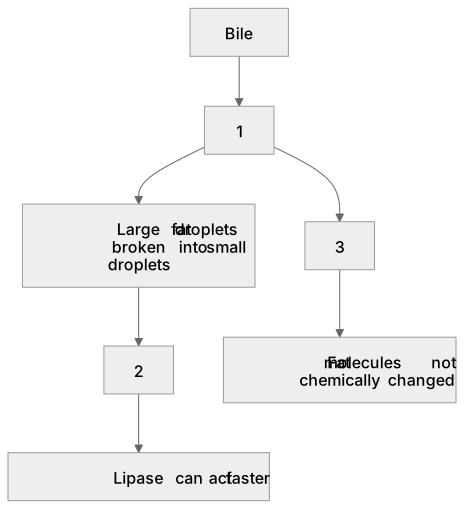
Some boxes have lost their names. Pick the right name for each number.
1Box 1
2Box 2
3Box 3
There is more to this lesson
The full lesson goes on to check your understanding and help you earn the marks. Create a free account to carry on, with your progress saved.
A week of Premium from your first lesson · Then the free plan continues · No card, no charge
Test your understanding of The human digestive system: It also emulsifies fat to form small droplets which increases the surface area.
Active recall beats re-reading. Take an instant quiz now to test what you’ve learned and lock it into long-term memory.
A week of Premium from your first lesson · Then the free plan continues · No card, no charge