AQA · GCSE · Biology
Course version: 8461 · Version from Sept 2018
Students should be able to understand simple word equations but no…
Full specification wording
The human digestive system: Students should be able to understand simple word equations but no chemical symbol equations are required.
A word equation names the reactants on the left and the products on the right, separated by an arrow that means changes into.
Checked against the AQA 8461 specification (opens in a new tab) on .
- Point 8 of 25
Study notes
From the checked teaching notes for this specification point.
The idea
A word equation names the reactants on the left and the products on the right, separated by an arrow that means changes into. For digestion, the general pattern is substrate → products, for example starch → sugars, protein → amino acids and lipid → fatty acids + glycerol. The arrow is not an equals sign; it shows the direction of the change. Word equations summarise the action of a named enzyme, so you may write amylase above the arrow to show which enzyme catalyses the reaction. You do not need to write chemical formulae or balance symbol equations for this specification point.
For example: Writing lipid → fatty acids + glycerol correctly shows that one lipid molecule is broken into two types of product, and the plus sign separates products rather than showing addition of reactants.
What earns the marks
- A word equation names reactants on the left and products on the right of an arrow.
- The arrow means changes into and shows the direction of the reaction.
- Digestion word equations follow the pattern substrate → products, such as starch → sugars.
- A named enzyme may be written above the arrow to show the catalyst.
- Chemical symbols and balanced symbol equations are not required for this specification point.
Common mistakes and how to put them right
Writing products on the left and reactants on the right.
Put it right by placing the substrate before the arrow and the products after it.
Using an equals sign instead of an arrow.
Put it right by using an arrow to show the direction of change.
Trying to balance a word equation as if it were a symbol equation.
Put it right by naming substances only, since balancing is not required here.
Exam tips
- Write the substrate first, then the arrow, then the products, and check that every product named in your answer is a small soluble molecule.
- Place the enzyme name above the arrow if the question asks which enzyme is responsible.
- Keep to names of substances; do not convert them into formulae unless a question specifically asks for symbols.
Try the lesson
The start of the The human digestive system: Students should be able to understand simple word equations but no chemical symbol equations are required. lesson, made from checked teaching notes for this specification point.
Have a go first
Which word equation shows the digestion of starch?
Listen
A word equation names the reactants on the left and the products on the right, separated by an arrow that means changes into. For digestion, the general pattern is substrate → products, for example starch → sugars, protein → amino acids and lipid → fatty acids + glycerol. The arrow is not an equals sign; it shows the direction of the change. Word equations summarise the action of a named enzyme, so you may write amylase above the arrow to show which enzyme catalyses the reaction. You do not need to write chemical formulae or balance symbol equations for this specification point. For example, writing lipid → fatty acids + glycerol correctly shows that one lipid molecule is broken into two types of product, and the plus sign separates products rather than showing addition of reactants. A strong answer earns marks for these points. A word equation names reactants on the left and products on the right of an arrow. The arrow means changes into and shows the direction of the reaction. Digestion word equations follow the pattern substrate → products, such as starch → sugars. A named enzyme may be written above the arrow to show the catalyst. A common slip: Writing products on the left and reactants on the right. Instead, placing the substrate before the arrow and the products after it. Exam tip: Write the substrate first, then the arrow, then the products, and check that every product named in your answer is a small soluble molecule.
See it
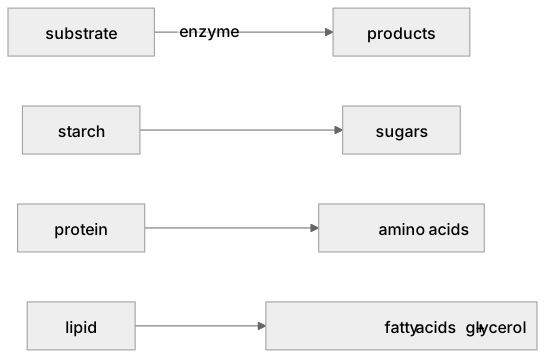
Label the diagram
Some boxes have lost their names. Pick the right name for each number.
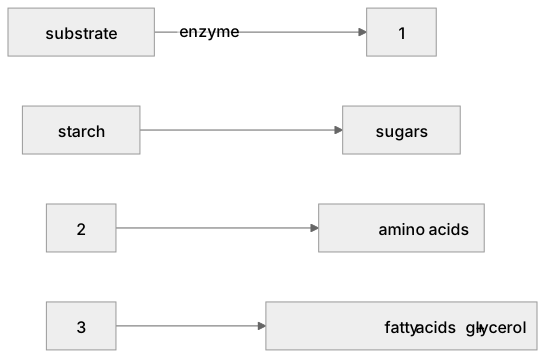
1Box 1
2Box 2
3Box 3
There is more to this lesson
The full lesson goes on to check your understanding and help you earn the marks. Create a free account to carry on, with your progress saved.
A week of Premium from your first lesson · Then the free plan continues · No card, no charge
Test your understanding of The human digestive system: Students should be able to understand simple word equations but no chemical symbol equations are required.
Active recall beats re-reading. Take an instant quiz now to test what you’ve learned and lock it into long-term memory.
A week of Premium from your first lesson · Then the free plan continues · No card, no charge