AQA · GCSE · Biology
Course version: 8461 · Version from Sept 2018
Students should be able to explain the use of hormones in modern…
Full specification wording
The use of hormones to treat infertility (HT only): Students should be able to explain the use of hormones in modern reproductive technologies to treat infertility.
Infertility can be treated using hormones.
Checked against the AQA 8461 specification (opens in a new tab) on .
- Point 1 of 7
- 2 key terms
Study notes
From the checked teaching notes for this specification point.
The idea
Infertility can be treated using hormones. If a woman's own FSH level is too low to stimulate eggs to mature, she may be given a 'fertility drug' containing FSH and LH. This stimulates eggs to mature in the ovary and triggers ovulation, increasing the chances of pregnancy. In In Vitro Fertilisation (IVF), a woman is given FSH and LH to stimulate the maturation of several eggs. These eggs are collected from the mother and fertilised by sperm from the father in a laboratory. The fertilised eggs develop into embryos. When they are tiny balls of cells, one or two embryos are inserted into the mother's uterus. Success depends on factors like age, but treatment is emotionally and physically demanding and can lead to multiple births.
What earns the marks
- Explains that a fertility drug containing FSH and LH can be given to women whose own FSH levels are too low, stimulating eggs to mature and be released.
- Describes the first stage of IVF as giving a mother FSH and LH to stimulate the maturation of several eggs.
- States that in IVF, eggs are collected and fertilised by sperm in a laboratory, developing into embryos.
- Explains that at the stage when they are tiny balls of cells, one or two embryos are inserted into the mother's uterus.
- Evaluates IVF by noting it can be physically and emotionally demanding, success rates are not 100%, and it can lead to multiple births.
Common mistakes and how to put them right
Stating that IVF guarantees pregnancy.
Put it right: Success rates vary and depend heavily on factors such as the mother's age.
Confusing the roles of FSH and LH.
Put it right: FSH stimulates eggs to mature, whereas LH stimulates the release of the egg (ovulation).
Forgetting where fertilisation occurs in IVF.
Put it right: Fertilisation happens in a laboratory outside the body, not in the uterus or fallopian tubes.
Exam tips
- When describing IVF, clearly sequence the steps: hormone treatment, egg collection, fertilisation, embryo development, and transfer.
- Remember to mention that embryos are transferred into the uterus (womb), not the ovaries.
Try the lesson
The start of the The use of hormones to treat infertility (HT only): Students should be able to explain the use of hormones in modern reproductive technologies to treat infertility. lesson, made from checked teaching notes for this specification point.
Have a go first
In fertility treatment, why is FSH given to a woman before eggs are collected?
Listen
Infertility can be treated using hormones. If a woman's own FSH level is too low to stimulate eggs to mature, she may be given a 'fertility drug' containing FSH and LH. This stimulates eggs to mature in the ovary and triggers ovulation, increasing the chances of pregnancy. In In Vitro Fertilisation (IVF), a woman is given FSH and LH to stimulate the maturation of several eggs. These eggs are collected from the mother and fertilised by sperm from the father in a laboratory. The fertilised eggs develop into embryos. When they are tiny balls of cells, one or two embryos are inserted into the mother's uterus. Success depends on factors like age, but treatment is emotionally and physically demanding and can lead to multiple births. A strong answer earns marks for these points. Explains that a fertility drug containing FSH and LH can be given to women whose own FSH levels are too low, stimulating eggs to mature and be released. Describes the first stage of IVF as giving a mother FSH and LH to stimulate the maturation of several eggs. States that in IVF, eggs are collected and fertilised by sperm in a laboratory, developing into embryos. Explains that at the stage when they are tiny balls of cells, one or two embryos are inserted into the mother's uterus. A common slip: Stating that IVF guarantees pregnancy. Instead, success rates vary and depend heavily on factors such as the mother's age. Exam tip: When describing IVF, clearly sequence the steps: hormone treatment, egg collection, fertilisation, embryo development, and transfer.
See it
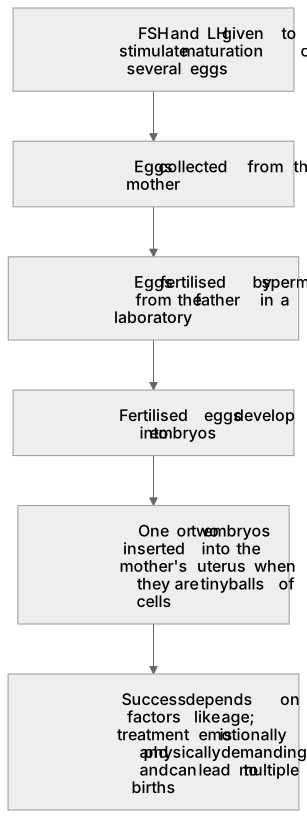
Put it in order
Put these steps in the order they happen.
- 1. Eggs fertilised by sperm from the father in a laboratory
- 2. Eggs collected from the mother
- 3. FSH and LH given to stimulate maturation of several eggs
- 4. Success depends on factors like age; treatment is emotionally and physically demanding and can lead to multiple births
- 5. One or two embryos inserted into the mother's uterus when they are tiny balls of cells
- 6. Fertilised eggs develop into embryos
Key words
Say what each word means before you turn the card.
In Vitro Fertilisation (IVF)
Try answering aloud or in your head before turning the card.
Fertility drug
Try answering aloud or in your head before turning the card.
See every definition
- In Vitro Fertilisation (IVF)
- A treatment in which a woman is given FSH and LH to stimulate the maturation of several eggs, which are collected and fertilised by sperm in a laboratory.
- Fertility drug
- A treatment containing FSH and LH given to a woman whose own FSH level is too low, stimulating eggs to mature in the ovary and triggering ovulation.
Label the diagram
Some boxes have lost their names. Pick the right name for each number.
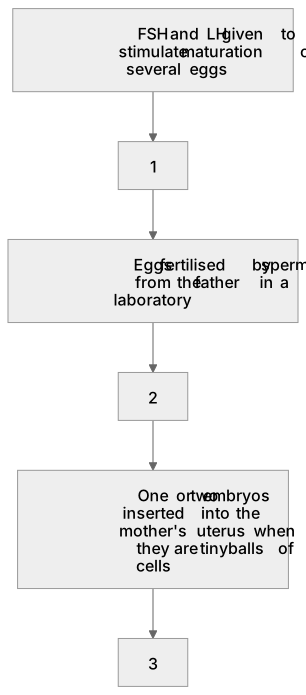
1Box 1
2Box 2
3Box 3
There is more to this lesson
The full lesson goes on to check your understanding and help you earn the marks. Create a free account to carry on, with your progress saved.
A week of Premium from your first lesson · Then the free plan continues · No card, no charge
Test your understanding of The use of hormones to treat infertility (HT only): Students should be able to explain the use of hormones in modern reproductive technologies to treat infertility.
Active recall beats re-reading. Take an instant quiz now to test what you’ve learned and lock it into long-term memory.
A week of Premium from your first lesson · Then the free plan continues · No card, no charge