AQA · GCSE · Biology
Course version: 8461 · Version from Sept 2018
This includes giving FSH and LH in a ‘fertility drug’ to a woman. She may…
Full specification wording
The use of hormones to treat infertility (HT only): This includes giving FSH and LH in a ‘fertility drug’ to a woman. She may then become pregnant in the normal way.
Infertility can arise when a woman does not release eggs regularly because her pituitary gland produces too little follicle-stimulating hormone (FSH) or luteinising hormone (LH).
Checked against the AQA 8461 specification (opens in a new tab) on .
- Point 2 of 7
- 3 key terms
Study notes
From the checked teaching notes for this specification point.
The idea
Infertility can arise when a woman does not release eggs regularly because her pituitary gland produces too little follicle-stimulating hormone (FSH) or luteinising hormone (LH). A fertility drug containing these hormones is given, usually as a course of injections, so that FSH stimulates several follicles in the ovaries to mature and LH triggers ovulation. Because the woman's own reproductive system is being stimulated, intercourse at the time of ovulation can lead to fertilisation inside the body and a natural pregnancy. This is different from IVF, where eggs are collected and fertilised outside the body. Doctors monitor the response with ultrasound scans and sometimes blood tests, and may adjust the dose to reduce the chance of multiple pregnancies.
What earns the marks
- FSH is given to stimulate the maturation of follicles in the ovaries, so that eggs develop.
- LH is given to trigger ovulation, releasing the mature egg from the follicle.
- The hormones are supplied together as a fertility drug, often by injection over a treatment cycle.
- Because ovulation occurs naturally after treatment, fertilisation and pregnancy can happen through intercourse in the normal way.
- Treatment is monitored, for example by ultrasound, so the dose can be adjusted and the risk of multiple births reduced.
Common mistakes and how to put them right
Thinking that FSH alone causes ovulation.
Put it right: FSH matures the follicle, while LH triggers ovulation.
Confusing this treatment with IVF.
Put it right: In fertility drug treatment, fertilisation happens inside the woman's body, whereas IVF involves collecting eggs and fertilising them outside the body.
Believing the drug guarantees pregnancy.
Put it right: It increases the chance of ovulation and pregnancy, but success is not guaranteed.
Exam tips
- Name both hormones and give each one's specific role rather than saying they 'help' fertility.
- Use the phrase 'pregnant in the normal way' to show that fertilisation occurs inside the body.
Try the lesson
The start of the The use of hormones to treat infertility (HT only): This includes giving FSH and LH in a ‘fertility drug’ to a woman. She may then become pregnant in the normal way. lesson, made from checked teaching notes for this specification point.
Have a go first
A woman is given a fertility drug containing FSH and LH. Which statement describes the intended effect of this treatment?
Listen
Infertility can arise when a woman does not release eggs regularly because her pituitary gland produces too little follicle-stimulating hormone (FSH) or luteinising hormone (LH). A fertility drug containing these hormones is given, usually as a course of injections, so that FSH stimulates several follicles in the ovaries to mature and LH triggers ovulation. Because the woman's own reproductive system is being stimulated, intercourse at the time of ovulation can lead to fertilisation inside the body and a natural pregnancy. This is different from IVF, where eggs are collected and fertilised outside the body. Doctors monitor the response with ultrasound scans and sometimes blood tests, and may adjust the dose to reduce the chance of multiple pregnancies. A strong answer earns marks for these points. FSH is given to stimulate the maturation of follicles in the ovaries, so that eggs develop. LH is given to trigger ovulation, releasing the mature egg from the follicle. The hormones are supplied together as a fertility drug, often by injection over a treatment cycle. Because ovulation occurs naturally after treatment, fertilisation and pregnancy can happen through intercourse in the normal way. A common slip: Thinking that FSH alone causes ovulation. Instead, FSH matures the follicle, while LH triggers ovulation. Exam tip: Name both hormones and give each one's specific role rather than saying they 'help' fertility.
See it
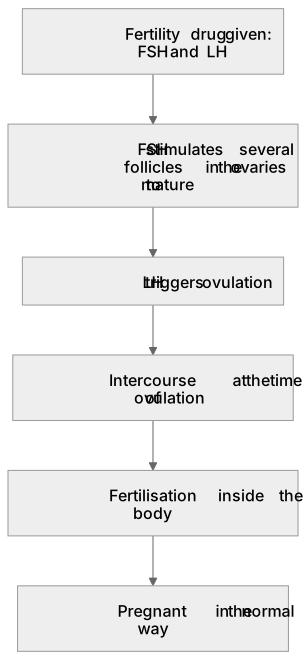
Put it in order
Put these steps in the order they happen.
- 1. LH triggers ovulation
- 2. FSH stimulates several follicles in the ovaries to mature
- 3. Fertility drug given: FSH and LH
- 4. Pregnant in the normal way
- 5. Fertilisation inside the body
- 6. Intercourse at the time of ovulation
Key words
Say what each word means before you turn the card.
FSH and LH as pituitary hormones
Try answering aloud or in your head before turning the card.
Treating infertility with hormone therapy
Try answering aloud or in your head before turning the card.
Natural fertilisation versus assisted reproduction
Try answering aloud or in your head before turning the card.
See every definition
- FSH and LH as pituitary hormones
- Hormones produced by the pituitary gland that stimulate the maturation of follicles in the ovaries and trigger ovulation.
- Treating infertility with hormone therapy
- Giving FSH and LH in a fertility drug, often as injections, so that eggs mature and ovulation occurs.
- Natural fertilisation versus assisted reproduction
- Fertilisation inside the body through intercourse in the normal way, rather than collecting eggs and fertilising them outside the body.
Label the diagram
Some boxes have lost their names. Pick the right name for each number.
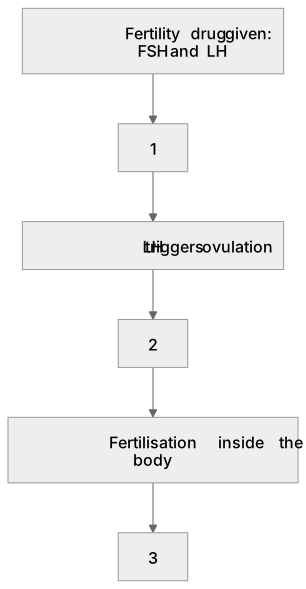
1Box 1
2Box 2
3Box 3
There is more to this lesson
The full lesson goes on to check your understanding and help you earn the marks. Create a free account to carry on, with your progress saved.
A week of Premium from your first lesson · Then the free plan continues · No card, no charge
Test your understanding of The use of hormones to treat infertility (HT only): This includes giving FSH and LH in a ‘fertility drug’ to a woman. She may then become pregnant in the normal way.
Active recall beats re-reading. Take an instant quiz now to test what you’ve learned and lock it into long-term memory.
A week of Premium from your first lesson · Then the free plan continues · No card, no charge