AQA · GCSE · Biology
Course version: 8461 · Version from Sept 2018
The fertilised eggs develop into embryos. • At the stage when they are…
Full specification wording
The use of hormones to treat infertility (HT only): The fertilised eggs develop into embryos. • At the stage when they are tiny balls of cells, one or two embryos are inserted into the mother’s uterus (womb).
After IVF, eggs collected from the mother are mixed with sperm so that fertilisation occurs outside the body.
Checked against the AQA 8461 specification (opens in a new tab) on .
- Point 6 of 7
- 4 key terms
Study notes
From the checked teaching notes for this specification point.
The idea
After IVF, eggs collected from the mother are mixed with sperm so that fertilisation occurs outside the body. Each fertilised egg, now a zygote, divides by mitosis to form an embryo. The embryo is cultured in a laboratory until it reaches the stage where it is a tiny ball of cells, typically after a few days. At this point one or two embryos are transferred into the mother’s uterus through the cervix using a thin catheter. The lining of the uterus must be ready to receive the embryo, which is why hormonal treatment is used earlier in the cycle. Transferring more than one embryo increases the chance of pregnancy but also raises the risk of multiple births.
What earns the marks
- Fertilisation occurs outside the body, producing a zygote that divides by mitosis to form an embryo.
- The embryo is cultured in the laboratory until it is a tiny ball of cells before transfer.
- One or two embryos are inserted into the mother’s uterus (womb), not into the oviduct.
- Transfer into the uterus allows the embryo to implant in the prepared lining and continue development.
- Inserting two embryos increases the chance of pregnancy but also increases the risk of multiple births.
Common mistakes and how to put them right
Thinking the embryo is inserted into the oviduct.
Put it right: The correct site is the uterus (womb).
Believing the embryo is already a fully formed fetus at transfer.
Put it right: It is a tiny ball of cells.
Confusing fertilisation outside the body with implantation outside the body.
Put it right: Implantation occurs in the uterus.
Exam tips
- Use the term embryo for the ball of cells and zygote for the single fertilised cell.
- State clearly that transfer is into the uterus, and link the number of embryos to multiple-birth risk.
- Sequence the steps: collect eggs, mix with sperm, fertilise, divide, culture, transfer one or two embryos.
Try the lesson
The start of the The use of hormones to treat infertility (HT only): The fertilised eggs develop into embryos. • At the stage when they are tiny balls of cells, one or two embryos are inserted into the mother’s uterus (womb). lesson, made from checked teaching notes for this specification point.
Have a go first
During in vitro fertilisation (IVF), at what stage of development are the fertilised eggs typically inserted into the mother's uterus?
Listen
After IVF, eggs collected from the mother are mixed with sperm so that fertilisation occurs outside the body. Each fertilised egg, now a zygote, divides by mitosis to form an embryo. The embryo is cultured in a laboratory until it reaches the stage where it is a tiny ball of cells, typically after a few days. At this point one or two embryos are transferred into the mother’s uterus through the cervix using a thin catheter. The lining of the uterus must be ready to receive the embryo, which is why hormonal treatment is used earlier in the cycle. Transferring more than one embryo increases the chance of pregnancy but also raises the risk of multiple births. A strong answer earns marks for these points. Fertilisation occurs outside the body, producing a zygote that divides by mitosis to form an embryo. The embryo is cultured in the laboratory until it is a tiny ball of cells before transfer. One or two embryos are inserted into the mother’s uterus (womb), not into the oviduct. Transfer into the uterus allows the embryo to implant in the prepared lining and continue development. Exam tip: Use the term embryo for the ball of cells and zygote for the single fertilised cell.
See it
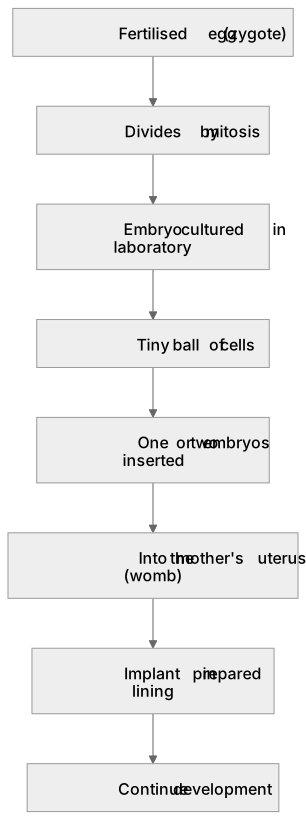
Put it in order
Put these steps in the order they happen.
- 1. One or two embryos inserted
- 2. Continue development
- 3. Into the mother's uterus (womb)
- 4. Fertilised egg (zygote)
- 5. Divides by mitosis
- 6. Implant in prepared lining
- 7. Embryo cultured in laboratory
- 8. Tiny ball of cells
Key words
Say what each word means before you turn the card.
Embryo
Try answering aloud or in your head before turning the card.
Zygote
Try answering aloud or in your head before turning the card.
Uterus (womb)
Try answering aloud or in your head before turning the card.
Multiple births
Try answering aloud or in your head before turning the card.
See every definition
- Embryo
- The fertilised egg divides by mitosis to form this, which is cultured in a laboratory until it is a tiny ball of cells.
- Zygote
- The single fertilised cell produced when fertilisation occurs outside the body, which divides by mitosis to form an embryo.
- Uterus (womb)
- The site into which one or two embryos are inserted at the tiny ball of cells stage.
- Multiple births
- A risk that is raised by transferring more than one embryo, which also increases the chance of pregnancy.
Label the diagram
Some boxes have lost their names. Pick the right name for each number.
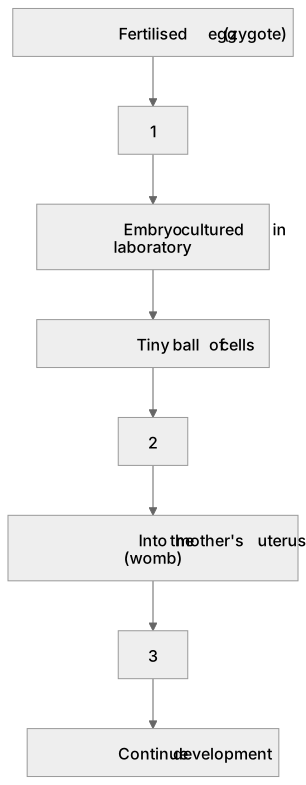
1Box 1
2Box 2
3Box 3
There is more to this lesson
The full lesson goes on to check your understanding and help you earn the marks. Create a free account to carry on, with your progress saved.
A week of Premium from your first lesson · Then the free plan continues · No card, no charge
Test your understanding of The use of hormones to treat infertility (HT only): The fertilised eggs develop into embryos. • At the stage when they are tiny balls of cells, one or two embryos are inserted into the mother’s uterus (womb).
Active recall beats re-reading. Take an instant quiz now to test what you’ve learned and lock it into long-term memory.
A week of Premium from your first lesson · Then the free plan continues · No card, no charge