AQA · GCSE · Biology
Course version: 8461 · Version from Sept 2018
The eggs are collected from the mother and fertilised by sperm from the…
Full specification wording
The use of hormones to treat infertility (HT only): The eggs are collected from the mother and fertilised by sperm from the father in the laboratory.
After hormone treatment has matured several eggs, the eggs are collected from the mother.
Checked against the AQA 8461 specification (opens in a new tab) on .
- Point 5 of 7
- 4 key terms
Study notes
From the checked teaching notes for this specification point.
The idea
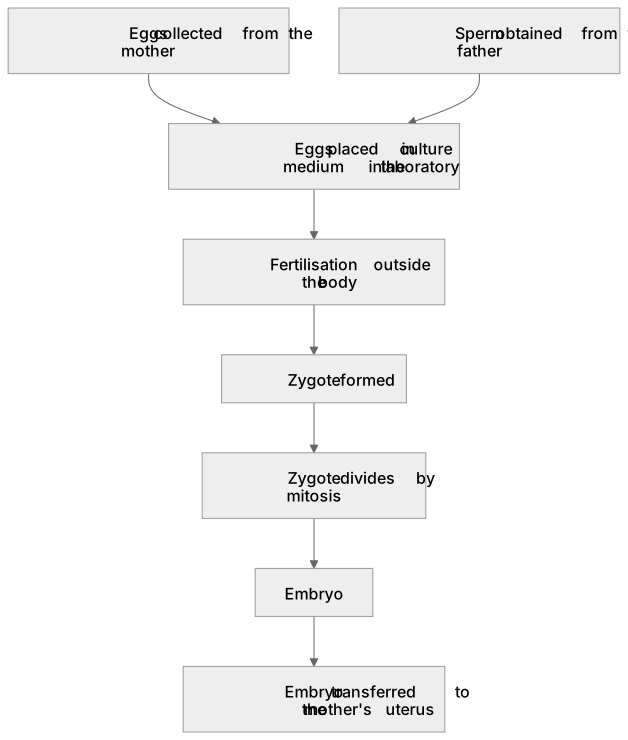
After hormone treatment has matured several eggs, the eggs are collected from the mother. This is usually done by a fine needle guided by ultrasound, through the vagina into the ovaries. The collected eggs are placed in a dish of culture medium in the laboratory. Sperm from the father is added so that fertilisation can occur outside the body. Each sperm cell fuses with an egg cell, combining their genetic material to form a zygote. The zygote divides by mitosis to form an embryo. Keeping the eggs and sperm in the laboratory allows fertilisation to be observed and controlled before any embryo is transferred to the mother's uterus. This is a higher-tier topic, so you should describe the sequence and explain why laboratory fertilisation is used.
What earns the marks
- Eggs are collected from the mother's ovaries, often using a needle guided by ultrasound.
- Sperm is obtained from the father and added to the eggs in the laboratory.
- Fertilisation occurs outside the body when a sperm nucleus fuses with an egg nucleus.
- The resulting zygote divides by mitosis to form an embryo.
- Laboratory fertilisation allows control and observation of fertilisation before embryo transfer.
- The process is part of IVF and is studied at higher tier only.
Common mistakes and how to put them right
Saying the embryo is fertilised in the laboratory.
Put it right by stating that the egg is fertilised by the sperm, forming a zygote that develops into an embryo.
Confusing fertilisation with implantation.
Put it right by stating that fertilisation occurs in the laboratory dish, while implantation occurs later in the uterus.
Thinking the sperm is collected from the mother.
Put it right by stating that sperm comes from the father.
Exam tips
- Use the correct sequence: collect eggs, add sperm, fertilisation, zygote, embryo.
- State clearly that fertilisation happens outside the body, in the laboratory.
- Mention that the embryo later divides by mitosis before being transferred.
Try the lesson
The start of the The use of hormones to treat infertility (HT only): The eggs are collected from the mother and fertilised by sperm from the father in the laboratory. lesson, made from checked teaching notes for this specification point.
Have a go first
Describe what happens to the eggs immediately after they are collected from the mother during IVF.
Listen
After hormone treatment has matured several eggs, the eggs are collected from the mother. This is usually done by a fine needle guided by ultrasound, through the vagina into the ovaries. The collected eggs are placed in a dish of culture medium in the laboratory. Sperm from the father is added so that fertilisation can occur outside the body. Each sperm cell fuses with an egg cell, combining their genetic material to form a zygote. The zygote divides by mitosis to form an embryo. Keeping the eggs and sperm in the laboratory allows fertilisation to be observed and controlled before any embryo is transferred to the mother's uterus. This is a higher-tier topic, so you should describe the sequence and explain why laboratory fertilisation is used. A strong answer earns marks for these points. Eggs are collected from the mother's ovaries, often using a needle guided by ultrasound. Sperm is obtained from the father and added to the eggs in the laboratory. Fertilisation occurs outside the body when a sperm nucleus fuses with an egg nucleus. The resulting zygote divides by mitosis to form an embryo. A common slip: Saying the embryo is fertilised in the laboratory. Instead, stating that the egg is fertilised by the sperm, forming a zygote that develops into an embryo. Exam tip: Use the correct sequence: collect eggs, add sperm, fertilisation, zygote, embryo.
See it
Key words
Say what each word means before you turn the card.
Fertilisation outside the body
Try answering aloud or in your head before turning the card.
Gamete collection and laboratory techniques
Try answering aloud or in your head before turning the card.
Zygote and embryo development
Try answering aloud or in your head before turning the card.
IVF treatment sequence
Try answering aloud or in your head before turning the card.
See every definition
- Fertilisation outside the body
- Sperm from the father is added to the collected eggs so that fertilisation can occur outside the body.
- Gamete collection and laboratory techniques
- Eggs are collected from the mother, usually by a fine needle guided by ultrasound, and placed in a dish of culture medium in the laboratory.
- Zygote and embryo development
- Each sperm cell fuses with an egg cell, combining their genetic material to form a zygote, which divides by mitosis to form an embryo.
- IVF treatment sequence
- Laboratory fertilisation allows fertilisation to be observed and controlled before any embryo is transferred to the mother's uterus.
Label the diagram
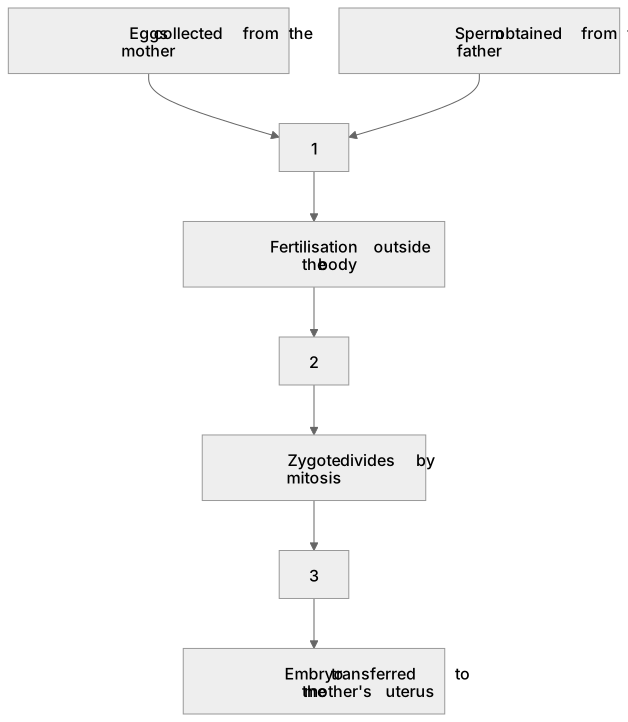
Some boxes have lost their names. Pick the right name for each number.
1Box 1
2Box 2
3Box 3
There is more to this lesson
The full lesson goes on to check your understanding and help you earn the marks. Create a free account to carry on, with your progress saved.
A week of Premium from your first lesson · Then the free plan continues · No card, no charge
Test your understanding of The use of hormones to treat infertility (HT only): The eggs are collected from the mother and fertilised by sperm from the father in the laboratory.
Active recall beats re-reading. Take an instant quiz now to test what you’ve learned and lock it into long-term memory.
A week of Premium from your first lesson · Then the free plan continues · No card, no charge