AQA · GCSE · Biology
Course version: 8461 · Version from Sept 2018
Individual organisms within a particular species show a wide range of…
Full specification wording
Theory of evolution (biology only): Individual organisms within a particular species show a wide range of variation for a characteristic.
Members of the same species share the ability to interbreed and produce fertile offspring, but they are not identical.
Checked against the AQA 8461 specification (opens in a new tab) on .
- Point 2 of 8
- 4 key terms
Study notes
From the checked teaching notes for this specification point.
The idea
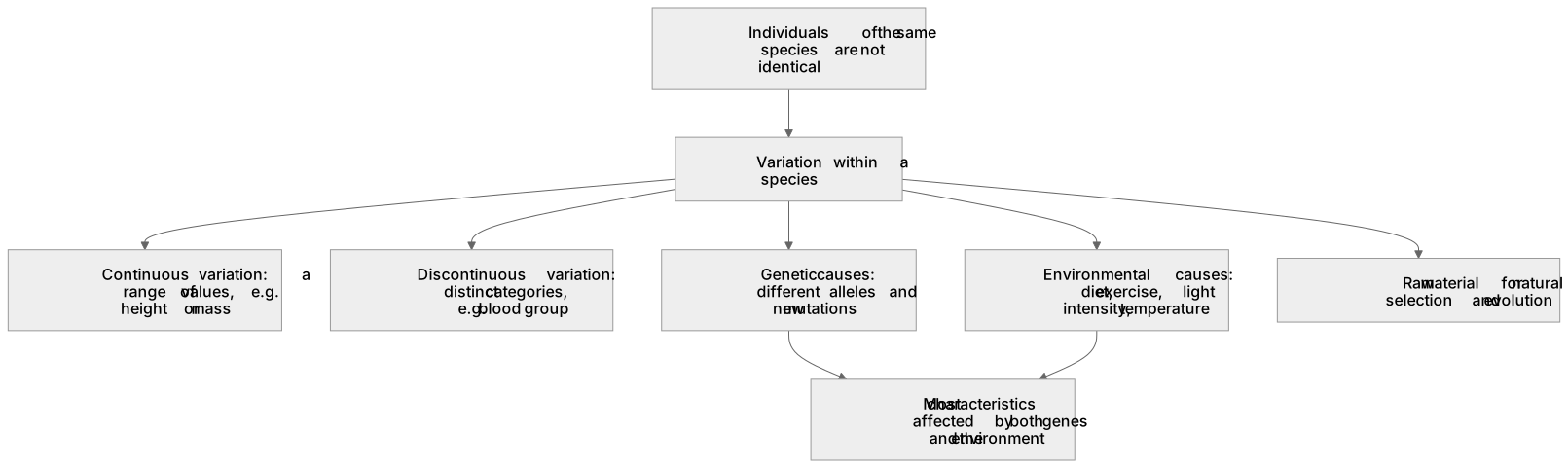
Members of the same species share the ability to interbreed and produce fertile offspring, but they are not identical. Within a species, individuals differ in many characteristics, such as height, mass, fur colour, leaf length or disease resistance. This variation arises from differences in genes, including mutations, and from environmental factors such as diet, exercise, light and temperature. Some variation is continuous, where measurements fall along a range and can take any value, for example human height. Other variation is discontinuous, where individuals fall into distinct categories, for example blood group or flower colour. This wide range of variation is important because it provides the raw material on which natural selection can act.
What earns the marks
- Individuals of the same species are not identical; they differ in many characteristics.
- Variation within a species can be continuous, such as height or mass, or discontinuous, such as blood group.
- Genetic causes of variation include different alleles and new mutations.
- Environmental causes of variation include diet, exercise, light intensity and temperature.
- Most characteristics are affected by both genes and the environment.
- Variation within a species is the raw material for natural selection and evolution.
Common mistakes and how to put them right
Confusing variation within a species with differences between species.
Put it right by stating that members of one species can interbreed, while different species generally cannot.
Treating all variation as genetic.
Put it right by explaining that the environment also causes differences, and many characteristics are influenced by both.
Describing discontinuous variation as a smooth range of values.
Put it right by stating that discontinuous variation produces distinct categories, while continuous variation produces a range.
Exam tips
- When describing a graph, name the type of variation and quote a value or category from the data to support your answer.
- Use the terms continuous and discontinuous accurately, and give one example of each.
- For questions on evolution, link variation to survival: individuals with advantageous variations are more likely to survive and reproduce.
Try the lesson
The start of the Theory of evolution (biology only): Individual organisms within a particular species show a wide range of variation for a characteristic. lesson, made from checked teaching notes for this specification point.
Have a go first
Which statement best describes the variation found among individual organisms of the same species?
Listen
Members of the same species share the ability to interbreed and produce fertile offspring, but they are not identical. Within a species, individuals differ in many characteristics, such as height, mass, fur colour, leaf length or disease resistance. This variation arises from differences in genes, including mutations, and from environmental factors such as diet, exercise, light and temperature. Some variation is continuous, where measurements fall along a range and can take any value, for example human height. Other variation is discontinuous, where individuals fall into distinct categories, for example blood group or flower colour. This wide range of variation is important because it provides the raw material on which natural selection can act. A strong answer earns marks for these points. Individuals of the same species are not identical; they differ in many characteristics. Variation within a species can be continuous, such as height or mass, or discontinuous, such as blood group. Genetic causes of variation include different alleles and new mutations. Environmental causes of variation include diet, exercise, light intensity and temperature. A common slip: Confusing variation within a species with differences between species. Instead, stating that members of one species can interbreed, while different species generally cannot. Exam tip: When describing a graph, name the type of variation and quote a value or category from the data to support your answer.
See it
Key words
Say what each word means before you turn the card.
Variation within species
Try answering aloud or in your head before turning the card.
Continuous variation
Try answering aloud or in your head before turning the card.
Discontinuous variation
Try answering aloud or in your head before turning the card.
Natural selection
Try answering aloud or in your head before turning the card.
See every definition
- Variation within species
- Individual organisms within a particular species show a wide range of variation for a characteristic, arising from differences in genes and from environmental factors.
- Continuous variation
- Variation where measurements fall along a range and can take any value, for example human height.
- Discontinuous variation
- Variation where individuals fall into distinct categories, for example blood group or flower colour.
- Natural selection
- The process for which variation within a species is the raw material, acting on advantageous variations so that individuals with them are more likely to survive and reproduce.
Label the diagram
Some boxes have lost their names. Pick the right name for each number.
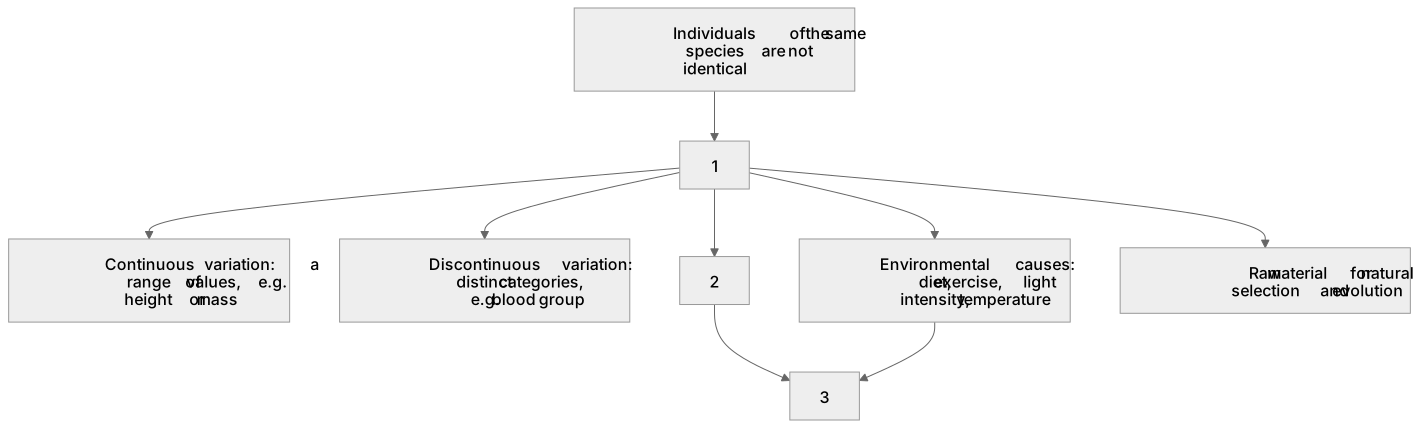
1Box 1
2Box 2
3Box 3
There is more to this lesson
The full lesson goes on to check your understanding and help you earn the marks. Create a free account to carry on, with your progress saved.
A week of Premium from your first lesson · Then the free plan continues · No card, no charge
Test your understanding of Theory of evolution (biology only): Individual organisms within a particular species show a wide range of variation for a characteristic.
Active recall beats re-reading. Take an instant quiz now to test what you’ve learned and lock it into long-term memory.
A week of Premium from your first lesson · Then the free plan continues · No card, no charge