AQA · GCSE · Biology
Course version: 8461 · Version from Sept 2018
Individuals with characteristics most suited to the environment are more…
Full specification wording
Theory of evolution (biology only): Individuals with characteristics most suited to the environment are more likely to survive to breed successfully.
This is the core of natural selection.
Checked against the AQA 8461 specification (opens in a new tab) on .
- Point 3 of 8
- 4 key terms
Study notes
From the checked teaching notes for this specification point.
The idea
This is the core of natural selection. Within a population, individuals vary because of differences in their genes, and some variants give a better fit to the local conditions. Those better-suited individuals are more likely to survive, and because they survive longer they are more likely to reproduce and pass their alleles on. A concrete case: in a population of beetles on green leaves, green individuals are harder for birds to spot than brown ones, so more green beetles live to breed. The environment does the selecting, not the organism, and no individual changes to suit the environment during its life. Selection acts on the variation already present, so the population shifts over generations rather than within one lifetime.
What earns the marks
- States that variation exists between individuals in a population, and that this variation is inherited.
- Explains that the environment presents a selection pressure, such as predation, disease or competition for resources.
- Links the characteristic to survival: individuals whose characteristics suit the environment are more likely to survive.
- Links survival to reproduction: survivors are more likely to breed successfully and so contribute offspring to the next generation.
- Uses a specific example, such as green beetles being camouflaged on green leaves, to show the selection pressure acting on a named characteristic.
- Avoids teleological wording: the organism does not choose to change, and the environment does not create the useful characteristic on demand.
Common mistakes and how to put them right
Saying an individual 'adapts' during its lifetime to suit the environment.
Put it right: Variation already exists and selection acts on it across generations.
Treating survival alone as the endpoint.
Put it right: Survival matters because it raises the chance of successful breeding, which is what changes allele frequencies.
Writing that the environment causes the useful mutation when it is needed.
Put it right: Mutations arise at random and selection then favours any that happen to be useful.
Exam tips
- Use the chain variation → selection pressure → survival → reproduction → inheritance, and make each arrow explicit in your answer.
- Name the characteristic and the pressure in your example, for example 'green colouration' and 'predation by birds', rather than writing 'better adapted' on its own.
- If a question says 'explain', give the mechanism; if it says 'describe', state the pattern without needing every causal link.
Try the lesson
The start of the Theory of evolution (biology only): Individuals with characteristics most suited to the environment are more likely to survive to breed successfully. lesson, made from checked teaching notes for this specification point.
Have a go first
In a population of beetles, some are green and some are brown. Birds eat the beetles they can see most easily against the brown soil. Which beetles are most likely to survive and breed successfully?
Listen
This is the core of natural selection. Within a population, individuals vary because of differences in their genes, and some variants give a better fit to the local conditions. Those better-suited individuals are more likely to survive, and because they survive longer they are more likely to reproduce and pass their alleles on. A concrete case: in a population of beetles on green leaves, green individuals are harder for birds to spot than brown ones, so more green beetles live to breed. The environment does the selecting, not the organism, and no individual changes to suit the environment during its life. Selection acts on the variation already present, so the population shifts over generations rather than within one lifetime. A strong answer earns marks for these points. States that variation exists between individuals in a population, and that this variation is inherited.
See it
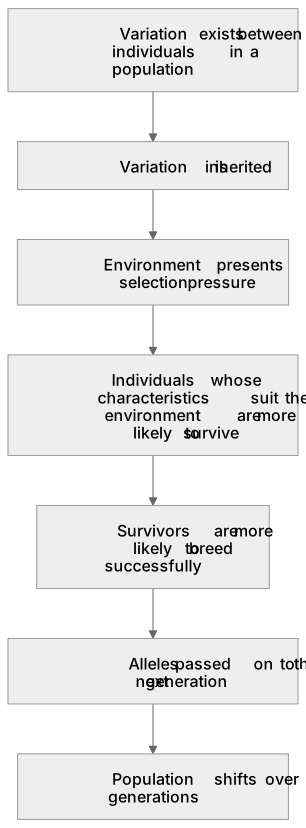
Put it in order
Put these steps in the order they happen.
- 1. Population shifts over generations
- 2. Alleles passed on to the next generation
- 3. Environment presents a selection pressure
- 4. Survivors are more likely to breed successfully
- 5. Variation exists between individuals in a population
- 6. Variation is inherited
- 7. Individuals whose characteristics suit the environment are more likely to survive
Key words
Say what each word means before you turn the card.
Natural selection
Try answering aloud or in your head before turning the card.
Variation within populations
Try answering aloud or in your head before turning the card.
Selection pressures in the environment
Try answering aloud or in your head before turning the card.
Differential survival and reproduction
Try answering aloud or in your head before turning the card.
See every definition
- Natural selection
- Individuals with characteristics most suited to the environment are more likely to survive to breed successfully, so the population shifts over generations.
- Variation within populations
- Individuals in a population vary because of differences in their genes, and some variants give a better fit to the local conditions.
- Selection pressures in the environment
- The environment presents a selection pressure, such as predation, disease or competition for resources, and the environment does the selecting, not the organism.
- Differential survival and reproduction
- Better-suited individuals are more likely to survive, and because they survive longer they are more likely to reproduce and pass their alleles on.
Label the diagram
Some boxes have lost their names. Pick the right name for each number.
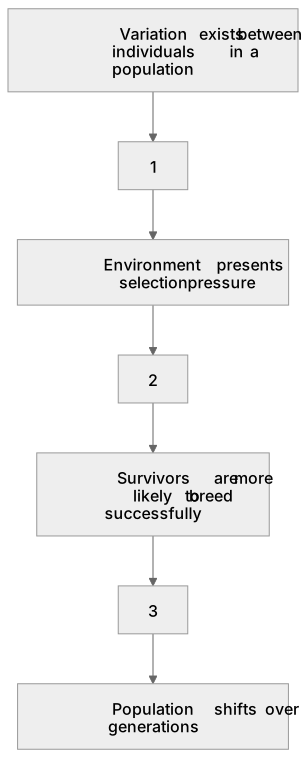
1Box 1
2Box 2
3Box 3
There is more to this lesson
The full lesson goes on to check your understanding and help you earn the marks. Create a free account to carry on, with your progress saved.
A week of Premium from your first lesson · Then the free plan continues · No card, no charge
Test your understanding of Theory of evolution (biology only): Individuals with characteristics most suited to the environment are more likely to survive to breed successfully.
Active recall beats re-reading. Take an instant quiz now to test what you’ve learned and lock it into long-term memory.
A week of Premium from your first lesson · Then the free plan continues · No card, no charge