AQA · GCSE · Biology
Course version: 8461 · Version from Sept 2018
The characteristics that have enabled these individuals to survive are…
Full specification wording
Theory of evolution (biology only): The characteristics that have enabled these individuals to survive are then passed on to the next generation.
This statement completes natural selection by explaining inheritance.
Checked against the AQA 8461 specification (opens in a new tab) on .
- Point 4 of 8
- 4 key terms
Study notes
From the checked teaching notes for this specification point.
The idea
This statement completes natural selection by explaining inheritance. The survivors breed, and their gametes carry the alleles behind the useful characteristics, so those alleles become more common in the next generation. Over many generations the proportion of well-suited individuals rises and the population changes. The key point is that characteristics are not passed on because they were useful; they are passed on because the alleles controlling them were present in the parents who reproduced. A concrete case: green beetles survive and lay eggs, and their offspring inherit the alleles for green colouration, so the next generation contains more green beetles. Acquired changes during life, such as a suntan or a scar, are not inherited in this way.
What earns the marks
- States that the survivors reproduce and so contribute gametes to the next generation.
- Explains that the alleles for the useful characteristics are present in the gametes and are therefore inherited by offspring.
- Links inheritance to a change in the population: the proportion of individuals with the useful characteristic increases over generations.
- Distinguishes inherited alleles from characteristics acquired during an organism's lifetime, which are not passed on in this way.
- Uses a specific example, such as green beetles passing on alleles for green colouration to their offspring.
- Recognises that this process repeated over many generations can lead to evolution of the population.
Common mistakes and how to put them right
Claiming that an organism passes on a characteristic it acquired during its life, such as a stronger muscle from use.
Put it right: Only alleles in the gametes are inherited.
Saying the characteristic is passed on because it is useful.
Put it right: Inheritance depends on which alleles the parents carry, and usefulness only affects who survives to breed.
Describing change in one individual rather than in the population.
Put it right: Evolution is a change in the inherited characteristics of a population over generations.
Exam tips
- Write 'alleles' rather than 'genes' when explaining what is passed on, and say they are carried in the gametes.
- Finish the selection story with the next generation: state that the useful alleles become more common in the population.
- Use the phrase 'over many generations' to show you understand the timescale rather than a single breeding event.
Try the lesson
The start of the Theory of evolution (biology only): The characteristics that have enabled these individuals to survive are then passed on to the next generation. lesson, made from checked teaching notes for this specification point.
Have a go first
A population of rabbits lives where winters are cold. Rabbits with thicker fur are more likely to survive the cold and breed. Which statement best describes what happens to fur thickness in the next generation?
Listen
This statement completes natural selection by explaining inheritance. The survivors breed, and their gametes carry the alleles behind the useful characteristics, so those alleles become more common in the next generation. Over many generations the proportion of well-suited individuals rises and the population changes. The key point is that characteristics are not passed on because they were useful; they are passed on because the alleles controlling them were present in the parents who reproduced. A concrete case: green beetles survive and lay eggs, and their offspring inherit the alleles for green colouration, so the next generation contains more green beetles. Acquired changes during life, such as a suntan or a scar, are not inherited in this way. A strong answer earns marks for these points. States that the survivors reproduce and so contribute gametes to the next generation. Explains that the alleles for the useful characteristics are present in the gametes and are therefore inherited by offspring. Links inheritance to a change in the population: the proportion of individuals with the useful characteristic increases over generations. Distinguishes inherited alleles from characteristics acquired during an organism's lifetime, which are not passed on in this way. A common slip: Claiming that an organism passes on a characteristic it acquired during its life, such as a stronger muscle from use. Instead, only alleles in the gametes are inherited. Exam tip: Write 'alleles' rather than 'genes' when explaining what is passed on, and say they are carried in the gametes.
See it
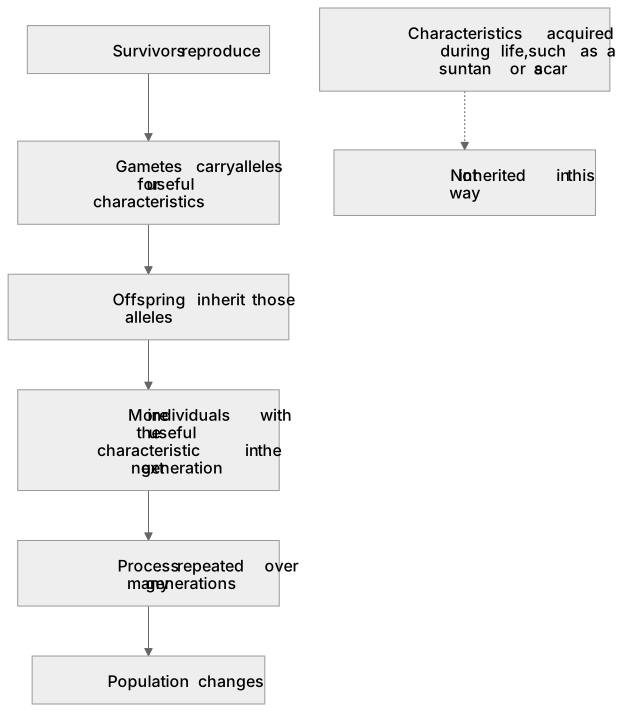
Key words
Say what each word means before you turn the card.
Inheritance of alleles
Try answering aloud or in your head before turning the card.
Reproduction and gametes
Try answering aloud or in your head before turning the card.
Change in populations over generations
Try answering aloud or in your head before turning the card.
Evolution by natural selection
Try answering aloud or in your head before turning the card.
See every definition
- Inheritance of alleles
- The alleles for useful characteristics are present in the gametes and are therefore inherited by offspring.
- Reproduction and gametes
- The survivors reproduce and so contribute gametes to the next generation.
- Change in populations over generations
- The proportion of individuals with the useful characteristic increases over generations.
- Evolution by natural selection
- This process repeated over many generations can lead to evolution of the population.
Label the diagram
Some boxes have lost their names. Pick the right name for each number.
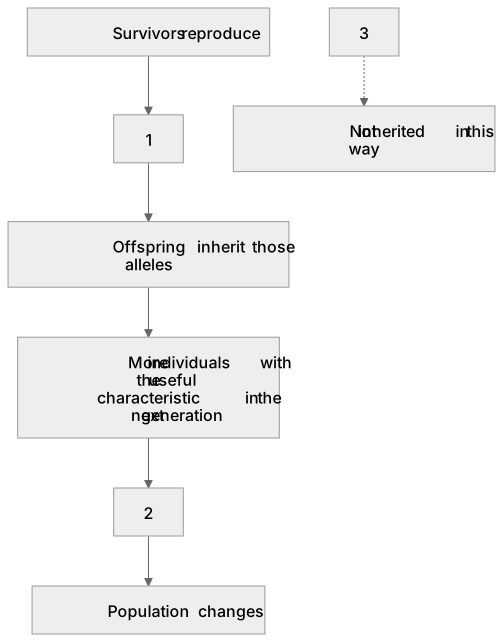
1Box 1
2Box 2
3Box 3
There is more to this lesson
The full lesson goes on to check your understanding and help you earn the marks. Create a free account to carry on, with your progress saved.
A week of Premium from your first lesson · Then the free plan continues · No card, no charge
Test your understanding of Theory of evolution (biology only): The characteristics that have enabled these individuals to survive are then passed on to the next generation.
Active recall beats re-reading. Take an instant quiz now to test what you’ve learned and lock it into long-term memory.
A week of Premium from your first lesson · Then the free plan continues · No card, no charge