AQA · GCSE · Biology
Course version: 8461 · Version from Sept 2018
Decomposers break down dead plant and animal matter by secreting enzymes…
Full specification wording
Trophic levels: Decomposers break down dead plant and animal matter by secreting enzymes into the environment.
Decomposers are organisms such as bacteria and fungi that obtain energy and nutrients from dead plant and animal matter and from waste products.
Checked against the AQA 8461 specification (opens in a new tab) on .
- Point 8 of 9
- 4 key terms
Study notes
From the checked teaching notes for this specification point.
The idea
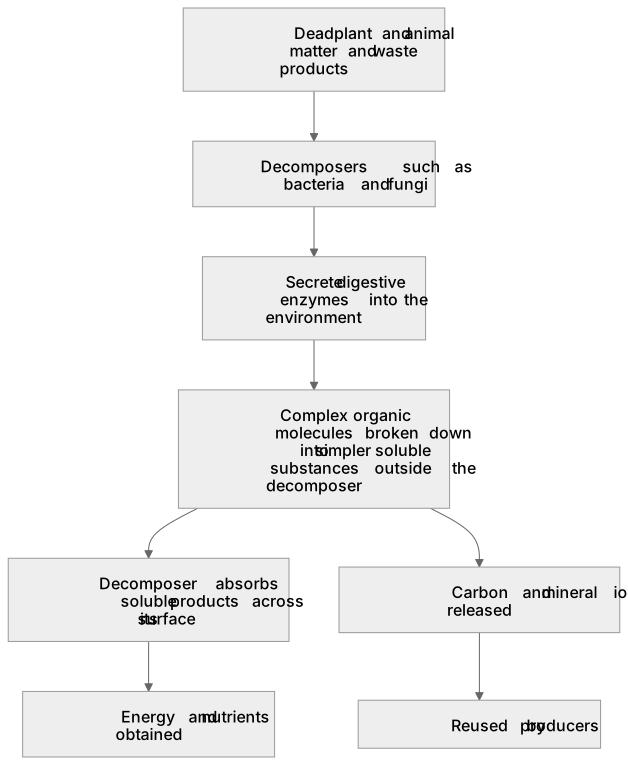
Decomposers are organisms such as bacteria and fungi that obtain energy and nutrients from dead plant and animal matter and from waste products. They do not ingest food in the way animals do. Instead, they secrete digestive enzymes into the surrounding environment, and these enzymes break down complex organic molecules into simpler soluble substances. The decomposer then absorbs these small molecules across its surface. For example, fungi secrete enzymes onto dead leaves, breaking down cellulose and other polymers into sugars and other small molecules that the fungus absorbs. This process returns carbon and mineral ions to the environment, so decomposers are essential for recycling nutrients and for keeping matter available to producers.
What earns the marks
- Decomposers are organisms such as bacteria and fungi that feed on dead plant and animal matter and on waste products.
- The secreted enzymes break down complex organic molecules into simpler soluble substances outside the decomposer.
- The decomposer absorbs the soluble products across its surface to obtain energy and nutrients.
- Decomposition releases carbon and mineral ions, which can be reused by producers, so decomposers are important in nutrient recycling.
Common mistakes and how to put them right
Saying decomposers eat dead matter.
Put it right: The error is describing ingestion, and the correction is that decomposers secrete enzymes externally and absorb the soluble products.
Confusing decomposers with detritivores.
Put it right: The error is treating them as the same group, and the correction is that detritivores such as earthworms ingest dead matter, while decomposers digest it externally.
Stating that enzymes are secreted inside the decomposer.
Put it right: The error is placing the digestion internally, and the correction is that the enzymes are released into the environment around the dead matter.
Exam tips
- Use the phrase secrete enzymes into the environment to show the external digestion step clearly.
- Link decomposition to nutrient recycling by mentioning carbon or mineral ions returning to the soil or water.
- Name a specific decomposer group, such as bacteria or fungi, rather than writing only animals.
Try the lesson
The start of the Trophic levels: Decomposers break down dead plant and animal matter by secreting enzymes into the environment. lesson, made from checked teaching notes for this specification point.
Have a go first
How do decomposers break down dead plant and animal matter?
Listen
Decomposers are organisms such as bacteria and fungi that obtain energy and nutrients from dead plant and animal matter and from waste products. They do not ingest food in the way animals do. Instead, they secrete digestive enzymes into the surrounding environment, and these enzymes break down complex organic molecules into simpler soluble substances. The decomposer then absorbs these small molecules across its surface. For example, fungi secrete enzymes onto dead leaves, breaking down cellulose and other polymers into sugars and other small molecules that the fungus absorbs. This process returns carbon and mineral ions to the environment, so decomposers are essential for recycling nutrients and for keeping matter available to producers. A strong answer earns marks for these points. Decomposers are organisms such as bacteria and fungi that feed on dead plant and animal matter and on waste products. The secreted enzymes break down complex organic molecules into simpler soluble substances outside the decomposer. The decomposer absorbs the soluble products across its surface to obtain energy and nutrients. Decomposition releases carbon and mineral ions, which can be reused by producers, so decomposers are important in nutrient recycling. Exam tip: Use the phrase secrete enzymes into the environment to show the external digestion step clearly.
See it
Key words
Say what each word means before you turn the card.
Decomposers
Try answering aloud or in your head before turning the card.
External digestion by microorganisms
Try answering aloud or in your head before turning the card.
Carbon and mineral ion cycling
Try answering aloud or in your head before turning the card.
Roles of bacteria and fungi in ecosystems
Try answering aloud or in your head before turning the card.
See every definition
- Decomposers
- Organisms such as bacteria and fungi that obtain energy and nutrients from dead plant and animal matter and from waste products.
- External digestion by microorganisms
- Secreting digestive enzymes into the surrounding environment so that complex organic molecules are broken down into simpler soluble substances outside the decomposer.
- Carbon and mineral ion cycling
- The return of carbon and mineral ions to the environment by decomposition, keeping matter available to producers.
- Roles of bacteria and fungi in ecosystems
- Obtaining energy and nutrients from dead matter and waste products, and being essential for recycling nutrients.
Label the diagram
Some boxes have lost their names. Pick the right name for each number.
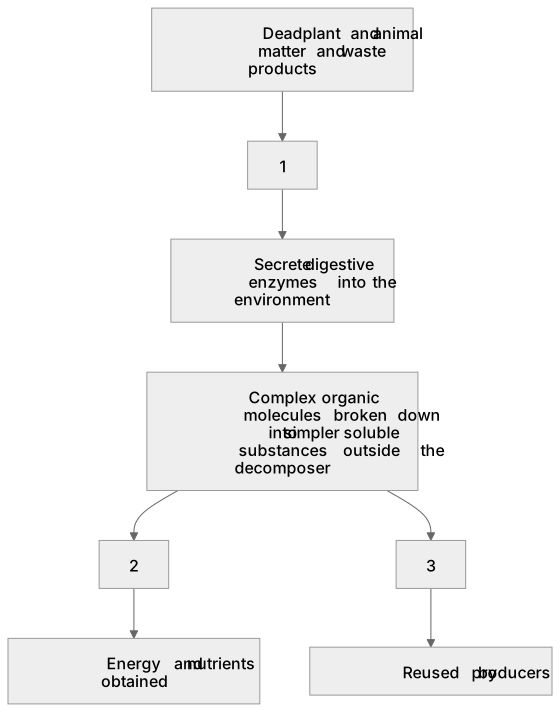
1Box 1
2Box 2
3Box 3
There is more to this lesson
The full lesson goes on to check your understanding and help you earn the marks. Create a free account to carry on, with your progress saved.
A week of Premium from your first lesson · Then the free plan continues · No card, no charge
Test your understanding of Trophic levels: Decomposers break down dead plant and animal matter by secreting enzymes into the environment.
Active recall beats re-reading. Take an instant quiz now to test what you’ve learned and lock it into long-term memory.
A week of Premium from your first lesson · Then the free plan continues · No card, no charge