AQA · GCSE · Biology
Course version: 8461 · Version from Sept 2018
Small soluble food molecules then diffuse into the microorganism.
Full specification wording
Trophic levels: Small soluble food molecules then diffuse into the microorganism.
This statement describes the final stage of digestion in microorganisms such as bacteria and fungi.
Checked against the AQA 8461 specification (opens in a new tab) on .
- Point 9 of 9
- 4 key terms
Study notes
From the checked teaching notes for this specification point.
The idea
This statement describes the final stage of digestion in microorganisms such as bacteria and fungi. These organisms release digestive enzymes outside their cells onto large insoluble food molecules, breaking them into small soluble products such as glucose, amino acids and glycerol. These products then move into the microorganism by diffusion, a passive process in which particles move from a region of higher concentration to a region of lower concentration down a concentration gradient. The small size and solubility of the products allow them to pass through the cell membrane. This extracellular digestion and absorption supplies the microorganism with the soluble nutrients it needs for respiration, growth and reproduction.
What earns the marks
- Digestion in microorganisms is extracellular: enzymes are secreted onto the food outside the cell.
- Enzymes break large insoluble molecules into small soluble molecules such as glucose, amino acids and glycerol.
- The small soluble products move into the microorganism by diffusion.
- Diffusion is passive and occurs down a concentration gradient from higher to lower concentration.
- The products are small and soluble, which allows them to cross the cell membrane.
- The absorbed nutrients are used for respiration, growth and reproduction.
Common mistakes and how to put them right
Thinking the microorganism takes in whole food particles by engulfing them.
Put it right: That enzymes digest the food externally and small soluble products diffuse in.
Confusing diffusion with active transport.
Put it right: Diffusion is passive and does not require energy from respiration.
Believing the food molecules are broken down inside the microorganism.
Put it right: The breakdown happens outside the cell before absorption.
Exam tips
- Use the phrase 'small soluble molecules' rather than just 'food' to show precise understanding.
- State the direction of diffusion as from a higher concentration outside to a lower concentration inside the microorganism.
- Link the small size and solubility of the products to their ability to pass through the cell membrane.
Try the lesson
The start of the Trophic levels: Small soluble food molecules then diffuse into the microorganism. lesson, made from checked teaching notes for this specification point.
Have a go first
A bacterium feeds by releasing enzymes onto a piece of dead plant material. The enzymes break the material down into small soluble food molecules. By which process do these small soluble food molecules then enter the bacterium?
Listen
This statement describes the final stage of digestion in microorganisms such as bacteria and fungi. These organisms release digestive enzymes outside their cells onto large insoluble food molecules, breaking them into small soluble products such as glucose, amino acids and glycerol. These products then move into the microorganism by diffusion, a passive process in which particles move from a region of higher concentration to a region of lower concentration down a concentration gradient. The small size and solubility of the products allow them to pass through the cell membrane. This extracellular digestion and absorption supplies the microorganism with the soluble nutrients it needs for respiration, growth and reproduction. A strong answer earns marks for these points. Digestion in microorganisms is extracellular: enzymes are secreted onto the food outside the cell. Enzymes break large insoluble molecules into small soluble molecules such as glucose, amino acids and glycerol. The small soluble products move into the microorganism by diffusion. Diffusion is passive and occurs down a concentration gradient from higher to lower concentration. A common slip: Thinking the microorganism takes in whole food particles by engulfing them. Instead, that enzymes digest the food externally and small soluble products diffuse in. Exam tip: Use the phrase 'small soluble molecules' rather than just 'food' to show precise understanding.
See it
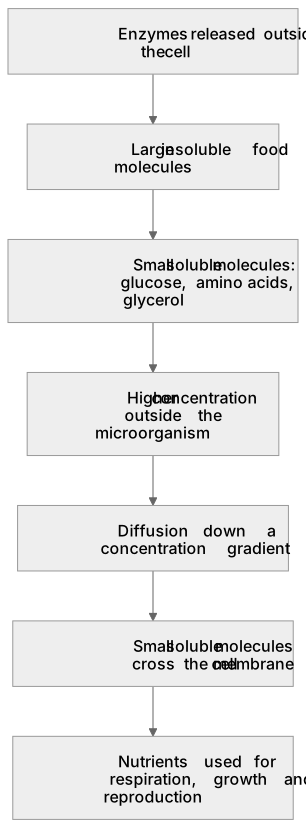
Put it in order
Put these steps in the order they happen.
- 1. Nutrients used for respiration, growth and reproduction
- 2. Small soluble molecules cross the cell membrane
- 3. Small soluble molecules: glucose, amino acids, glycerol
- 4. Diffusion down a concentration gradient
- 5. Enzymes released outside the cell
- 6. Large insoluble food molecules
- 7. Higher concentration outside the microorganism
Key words
Say what each word means before you turn the card.
Extracellular digestion
Try answering aloud or in your head before turning the card.
Enzyme action
Try answering aloud or in your head before turning the card.
Diffusion and concentration gradients
Try answering aloud or in your head before turning the card.
Absorption of soluble nutrients
Try answering aloud or in your head before turning the card.
See every definition
- Extracellular digestion
- Enzymes are secreted onto the food outside the cell, breaking large insoluble molecules into small soluble molecules.
- Enzyme action
- Enzymes break large insoluble molecules into small soluble molecules such as glucose, amino acids and glycerol.
- Diffusion and concentration gradients
- A passive process in which particles move from a region of higher concentration to a region of lower concentration down a concentration gradient.
- Absorption of soluble nutrients
- Small soluble products cross the cell membrane and supply the microorganism with the soluble nutrients it needs for respiration, growth and reproduction.
Label the diagram
Some boxes have lost their names. Pick the right name for each number.
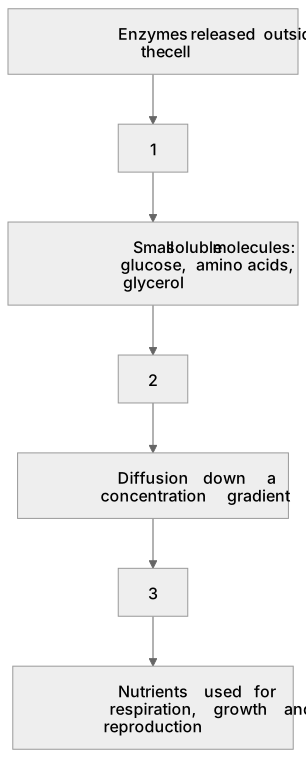
1Box 1
2Box 2
3Box 3
There is more to this lesson
The full lesson goes on to check your understanding and help you earn the marks. Create a free account to carry on, with your progress saved.
A week of Premium from your first lesson · Then the free plan continues · No card, no charge
Test your understanding of Trophic levels: Small soluble food molecules then diffuse into the microorganism.
Active recall beats re-reading. Take an instant quiz now to test what you’ve learned and lock it into long-term memory.
A week of Premium from your first lesson · Then the free plan continues · No card, no charge