AQA · GCSE · Biology
Course version: 8461 · Version from Sept 2018
Level 1: Plants and algae make their own food and are called producers.
Full specification wording
Trophic levels: Level 1: Plants and algae make their own food and are called producers.
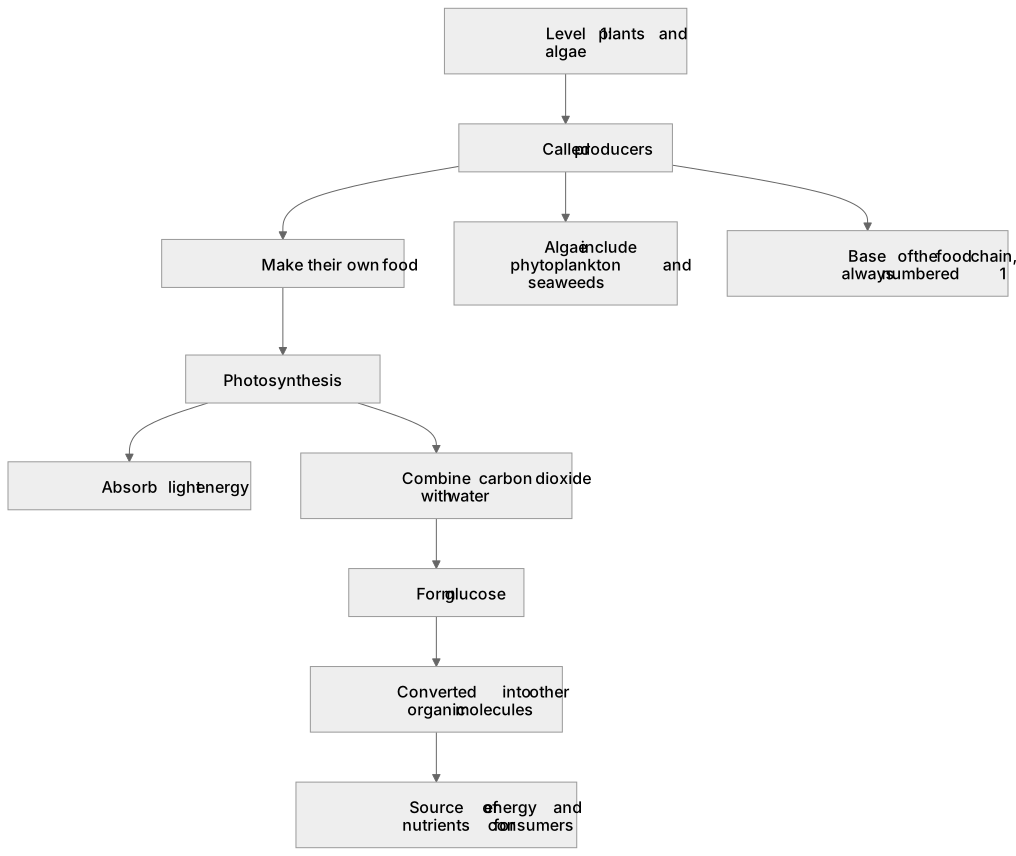
Level 1 of every food chain contains plants and algae, which are called producers because they make their own food.
Checked against the AQA 8461 specification (opens in a new tab) on .
- Point 4 of 9
- 4 key terms
Study notes
From the checked teaching notes for this specification point.
The idea
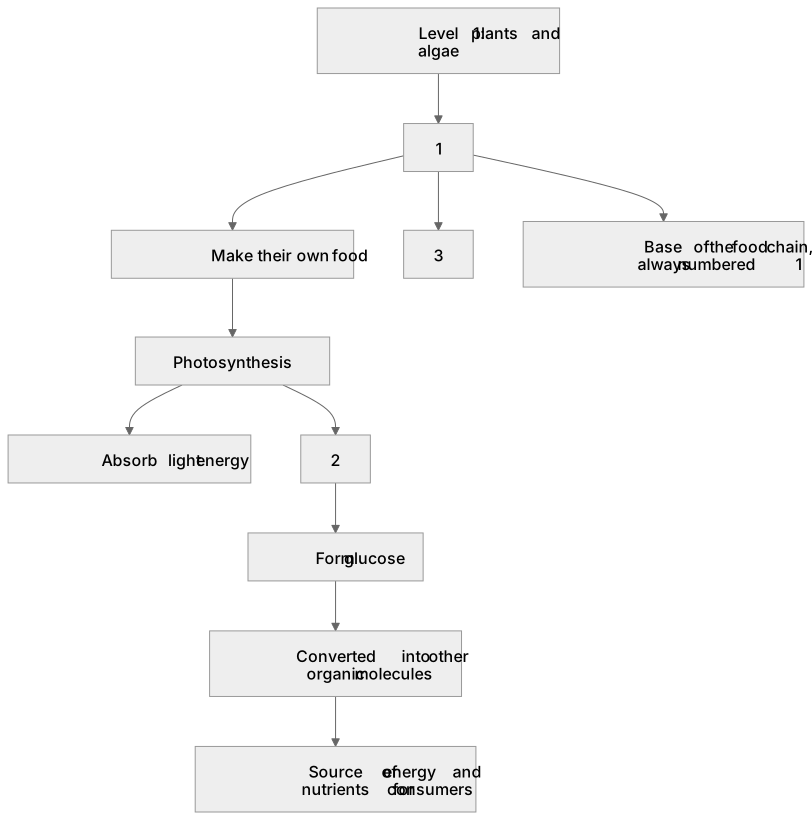
Level 1 of every food chain contains plants and algae, which are called producers because they make their own food. They carry out photosynthesis, absorbing light energy and combining carbon dioxide with water to form glucose, which is converted into other organic molecules. This organic matter becomes the energy and nutrient source for consumers at higher levels. Algae include microscopic phytoplankton in water as well as larger seaweeds, so level 1 is not restricted to land plants. Because producers do not eat other organisms, they occupy the base of the chain and are always numbered 1. Their role explains why food chains normally begin with a producer and why the total energy available decreases at each higher level.
What earns the marks
- Level 1 contains plants and algae, which are described as producers.
- Producers make their own food by photosynthesis rather than consuming other organisms.
- Photosynthesis uses light energy to combine carbon dioxide and water, producing glucose and oxygen.
- Algae, including phytoplankton, are producers as well as land plants, so level 1 occurs in aquatic and terrestrial ecosystems.
- Producers form the base of the food chain and are the original source of organic matter and energy for consumers.
Common mistakes and how to put them right
Defining producers as organisms that eat dead matter.
Put it right by stating that producers synthesise their own food by photosynthesis, while decomposers break down dead material.
Restricting level 1 to green land plants.
Put it right by including algae such as phytoplankton and seaweeds.
Saying producers take in food from the soil.
Put it right by explaining that they absorb mineral ions and water from the soil but make glucose using light energy.
Exam tips
- Quote the word producer and the process photosynthesis when explaining why plants and algae are at level 1.
- Include a named example of an alga, such as phytoplankton, to show that level 1 is not only land plants.
- Link level 1 to the start of the food chain so that energy transfer to consumers is clear.
Try the lesson
The start of the Trophic levels: Level 1: Plants and algae make their own food and are called producers. lesson, made from checked teaching notes for this specification point.
Have a go first
Which term describes plants and algae at trophic level 1 because they make their own food?
Listen
Level 1 of every food chain contains plants and algae, which are called producers because they make their own food. They carry out photosynthesis, absorbing light energy and combining carbon dioxide with water to form glucose, which is converted into other organic molecules. This organic matter becomes the energy and nutrient source for consumers at higher levels. Algae include microscopic phytoplankton in water as well as larger seaweeds, so level 1 is not restricted to land plants. Because producers do not eat other organisms, they occupy the base of the chain and are always numbered 1. Their role explains why food chains normally begin with a producer and why the total energy available decreases at each higher level. A strong answer earns marks for these points. Level 1 contains plants and algae, which are described as producers. Producers make their own food by photosynthesis rather than consuming other organisms. Photosynthesis uses light energy to combine carbon dioxide and water, producing glucose and oxygen. Algae, including phytoplankton, are producers as well as land plants, so level 1 occurs in aquatic and terrestrial ecosystems. A common slip: Defining producers as organisms that eat dead matter. Instead, stating that producers synthesise their own food by photosynthesis, while decomposers break down dead material. Exam tip: Quote the word producer and the process photosynthesis when explaining why plants and algae are at level 1.
See it
Key words
Say what each word means before you turn the card.
Producers
Try answering aloud or in your head before turning the card.
Photosynthesis
Try answering aloud or in your head before turning the card.
Algae
Try answering aloud or in your head before turning the card.
Base of the food chain
Try answering aloud or in your head before turning the card.
See every definition
- Producers
- Plants and algae, which make their own food and occupy level 1 of every food chain.
- Photosynthesis
- The process in which light energy is absorbed and carbon dioxide is combined with water to form glucose.
- Algae
- Producers that include microscopic phytoplankton in water as well as larger seaweeds, so level 1 is not restricted to land plants.
- Base of the food chain
- The position occupied by producers, which do not eat other organisms and are always numbered 1.
Label the diagram
Some boxes have lost their names. Pick the right name for each number.
1Box 1
2Box 2
3Box 3
There is more to this lesson
The full lesson goes on to check your understanding and help you earn the marks. Create a free account to carry on, with your progress saved.
A week of Premium from your first lesson · Then the free plan continues · No card, no charge
Test your understanding of Trophic levels: Level 1: Plants and algae make their own food and are called producers.
Active recall beats re-reading. Take an instant quiz now to test what you’ve learned and lock it into long-term memory.
A week of Premium from your first lesson · Then the free plan continues · No card, no charge