AQA · GCSE · Biology
Course version: 8461 · Version from Sept 2018
Level 2: Herbivores eat plants/algae and are called primary consumers.
Full specification wording
Trophic levels: Level 2: Herbivores eat plants/algae and are called primary consumers.
Trophic levels describe feeding positions in a food chain, and level 2 is the first consumer level.
Checked against the AQA 8461 specification (opens in a new tab) on .
- Point 5 of 9
- 4 key terms
Study notes
From the checked teaching notes for this specification point.
The idea
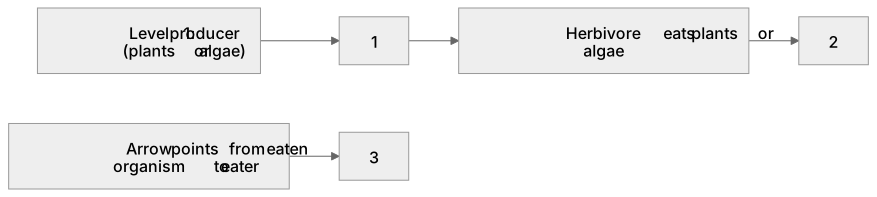
Trophic levels describe feeding positions in a food chain, and level 2 is the first consumer level. Producers such as grass, oak trees or phytoplankton occupy level 1 and make their own organic molecules by photosynthesis. Herbivores eat these plants or algae, so they obtain energy and matter from producers and are called primary consumers. For example, in the food chain phytoplankton → zooplankton → herring, the zooplankton is the primary consumer at level 2. A herbivore may be small, such as a caterpillar, or large, such as a cow, but its defining feature is a plant or algal diet. Ecologists identify level 2 by tracing the arrows, which show the direction of energy transfer, from a producer to the organism that eats it.
What earns the marks
- Level 1 contains producers, which are organisms such as plants and algae that make their own organic compounds by photosynthesis.
- Level 2 contains organisms that feed on producers, so they are the first consumers in the chain.
- Herbivores are animals that eat plants or algae, and in a food chain they occupy level 2 and are named primary consumers.
- The arrow in a food chain points from the organism being eaten to the organism that eats it, showing the direction of energy transfer.
- A named example such as grass → rabbit → fox correctly places the rabbit as the primary consumer at level 2.
Common mistakes and how to put them right
Calling the producer a primary consumer.
Put it right: The error is labelling level 1 as a consumer, and the correction is that producers make their own food while primary consumers eat producers.
Reversing the arrow direction.
Put it right: The error is drawing the arrow from consumer to producer, and the correction is that arrows show energy transfer from the eaten organism to the eater.
Assuming all primary consumers are large grazing mammals.
Put it right: The error is ignoring algae-eating aquatic animals, and the correction is that any herbivore feeding on plants or algae is a primary consumer.
Exam tips
- Trace the food chain from left to right and label each level before answering, so level 2 is identified from the producer rather than guessed.
- Use the exact terms herbivore and primary consumer together when explaining level 2, because both ideas are needed for a complete answer.
- If asked to complete a food chain, check that the arrow points away from the producer and towards the primary consumer.
Try the lesson
The start of the Trophic levels: Level 2: Herbivores eat plants/algae and are called primary consumers. lesson, made from checked teaching notes for this specification point.
Have a go first
In a food chain, which term describes the herbivores that eat plants or algae at level 2?
Listen
Trophic levels describe feeding positions in a food chain, and level 2 is the first consumer level. Producers such as grass, oak trees or phytoplankton occupy level 1 and make their own organic molecules by photosynthesis. Herbivores eat these plants or algae, so they obtain energy and matter from producers and are called primary consumers. For example, in the food chain phytoplankton → zooplankton → herring, the zooplankton is the primary consumer at level 2. A herbivore may be small, such as a caterpillar, or large, such as a cow, but its defining feature is a plant or algal diet. Ecologists identify level 2 by tracing the arrows, which show the direction of energy transfer, from a producer to the organism that eats it. A strong answer earns marks for these points. Level 1 contains producers, which are organisms such as plants and algae that make their own organic compounds by photosynthesis. Level 2 contains organisms that feed on producers, so they are the first consumers in the chain. Herbivores are animals that eat plants or algae, and in a food chain they occupy level 2 and are named primary consumers. The arrow in a food chain points from the organism being eaten to the organism that eats it, showing the direction of energy transfer. Exam tip: Trace the food chain from left to right and label each level before answering, so level 2 is identified from the producer rather than guessed.
See it

Key words
Say what each word means before you turn the card.
Producers
Try answering aloud or in your head before turning the card.
Primary consumers
Try answering aloud or in your head before turning the card.
Herbivores
Try answering aloud or in your head before turning the card.
Energy transfer
Try answering aloud or in your head before turning the card.
See every definition
- Producers
- Organisms such as plants and algae that make their own organic compounds by photosynthesis and occupy level 1.
- Primary consumers
- Herbivores that feed on producers, so they are the first consumers in the chain and occupy level 2.
- Herbivores
- Animals that eat plants or algae, and in a food chain they occupy level 2 and are named primary consumers.
- Energy transfer
- Shown by the arrow in a food chain, which points from the organism being eaten to the organism that eats it.
Label the diagram
Some boxes have lost their names. Pick the right name for each number.
1Box 1
2Box 2
3Box 3
There is more to this lesson
The full lesson goes on to check your understanding and help you earn the marks. Create a free account to carry on, with your progress saved.
A week of Premium from your first lesson · Then the free plan continues · No card, no charge
Test your understanding of Trophic levels: Level 2: Herbivores eat plants/algae and are called primary consumers.
Active recall beats re-reading. Take an instant quiz now to test what you’ve learned and lock it into long-term memory.
A week of Premium from your first lesson · Then the free plan continues · No card, no charge