AQA · GCSE · Biology
Course version: 8461 · Version from Sept 2018
Students should be able to describe the differences between the trophic…
Full specification wording
Trophic levels: Students should be able to describe the differences between the trophic levels of organisms within an ecosystem.
Trophic levels describe an organism's feeding position in a food chain, defined by how many energy-transfer steps separate it from the producer.
Checked against the AQA 8461 specification (opens in a new tab) on .
- Point 1 of 9
- 4 key terms
Study notes
From the checked teaching notes for this specification point.
The idea
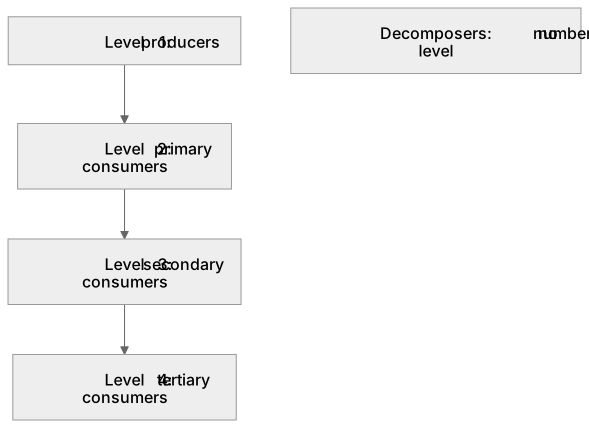
Trophic levels describe an organism's feeding position in a food chain, defined by how many energy-transfer steps separate it from the producer. Level 1 holds producers such as grass, algae and phytoplankton, which make their own food by photosynthesis. Level 2 holds primary consumers, herbivores such as rabbits or zooplankton, which eat producers. Level 3 holds secondary consumers, carnivores such as foxes or small fish, which eat herbivores. Level 4 holds tertiary consumers, predators such as owls or sharks. The key differences are therefore the type of food eaten, the source of energy and the number of transfers from the original producer. Decomposers are not assigned a numbered trophic level because they feed at every level.
What earns the marks
- Level 1 contains producers, which synthesise their own organic nutrients by photosynthesis rather than consuming other organisms.
- Level 2 contains primary consumers, which are herbivores feeding directly on producers.
- Level 3 contains secondary consumers, which are carnivores or omnivores feeding on primary consumers.
- Level 4 contains tertiary consumers, which feed on secondary consumers and sit further along the chain.
- The trophic level number counts the feeding steps from the producer, so each level differs by what the organism eats and how far it is from the original energy source.
- Decomposers break down dead material at all levels and are not given a numbered trophic level in a food chain.
Common mistakes and how to put them right
Treating trophic level as a measure of body size or physical height in the habitat.
Put it right by linking the number to feeding position and distance from the producer.
Calling every consumer a carnivore.
Put it right by stating that level 2 organisms are herbivores eating producers, while higher consumers eat other animals.
Giving decomposers a numbered trophic level such as level 5.
Put it right by explaining that decomposers act at every level and are shown separately from the numbered chain.
Exam tips
- Name the producer and each consumer in a stated food chain, then quote the level number for each organism to show the difference clearly.
- Use the terms producer, primary consumer, secondary consumer and tertiary consumer rather than vague words such as plant-eater or top animal.
- When asked to describe differences, compare pairs of levels directly, for example state what a level 2 organism eats compared with a level 3 organism.
Try the lesson
The start of the Trophic levels: Students should be able to describe the differences between the trophic levels of organisms within an ecosystem. lesson, made from checked teaching notes for this specification point.
Have a go first
In a food chain, which trophic level contains the producers?
Listen
Trophic levels describe an organism's feeding position in a food chain, defined by how many energy-transfer steps separate it from the producer. Level 1 holds producers such as grass, algae and phytoplankton, which make their own food by photosynthesis. Level 2 holds primary consumers, herbivores such as rabbits or zooplankton, which eat producers. Level 3 holds secondary consumers, carnivores such as foxes or small fish, which eat herbivores. Level 4 holds tertiary consumers, predators such as owls or sharks. The key differences are therefore the type of food eaten, the source of energy and the number of transfers from the original producer. Decomposers are not assigned a numbered trophic level because they feed at every level. A strong answer earns marks for these points. Level 1 contains producers, which synthesise their own organic nutrients by photosynthesis rather than consuming other organisms. Level 2 contains primary consumers, which are herbivores feeding directly on producers. Level 3 contains secondary consumers, which are carnivores or omnivores feeding on primary consumers. Level 4 contains tertiary consumers, which feed on secondary consumers and sit further along the chain. A common slip: Treating trophic level as a measure of body size or physical height in the habitat. Instead, linking the number to feeding position and distance from the producer. Exam tip: Name the producer and each consumer in a stated food chain, then quote the level number for each organism to show the difference clearly.
See it
Key words
Say what each word means before you turn the card.
Trophic level
Try answering aloud or in your head before turning the card.
Producers
Try answering aloud or in your head before turning the card.
Primary consumers
Try answering aloud or in your head before turning the card.
Decomposers
Try answering aloud or in your head before turning the card.
See every definition
- Trophic level
- Describes an organism's feeding position in a food chain, defined by how many energy-transfer steps separate it from the producer.
- Producers
- Level 1 organisms, such as grass, algae and phytoplankton, which make their own food by photosynthesis rather than consuming other organisms.
- Primary consumers
- Level 2 herbivores, such as rabbits or zooplankton, which eat producers.
- Decomposers
- Organisms that break down dead material at all levels and are not given a numbered trophic level in a food chain.
Label the diagram
Some boxes have lost their names. Pick the right name for each number.
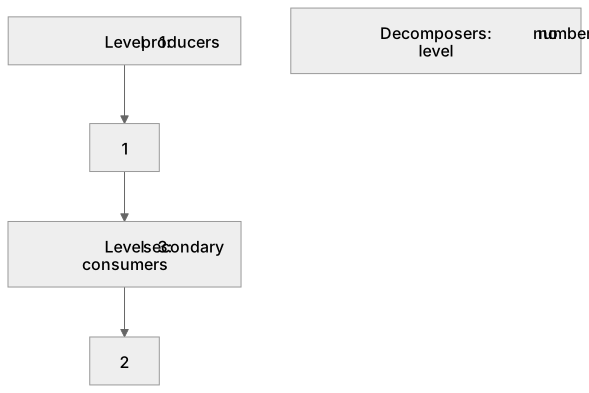
1Box 1
2Box 2
There is more to this lesson
The full lesson goes on to check your understanding and help you earn the marks. Create a free account to carry on, with your progress saved.
A week of Premium from your first lesson · Then the free plan continues · No card, no charge
Test your understanding of Trophic levels: Students should be able to describe the differences between the trophic levels of organisms within an ecosystem.
Active recall beats re-reading. Take an instant quiz now to test what you’ve learned and lock it into long-term memory.
A week of Premium from your first lesson · Then the free plan continues · No card, no charge