AQA · GCSE · Biology
Course version: 8461 · Version from Sept 2018
Trophic levels can be represented by numbers, starting at level 1 with…
Full specification wording
Trophic levels: Trophic levels can be represented by numbers, starting at level 1 with plants and algae.
Trophic levels are numbered so that feeding positions can be compared across different food chains.
Checked against the AQA 8461 specification (opens in a new tab) on .
- Point 2 of 9
- 4 key terms
Study notes
From the checked teaching notes for this specification point.
The idea
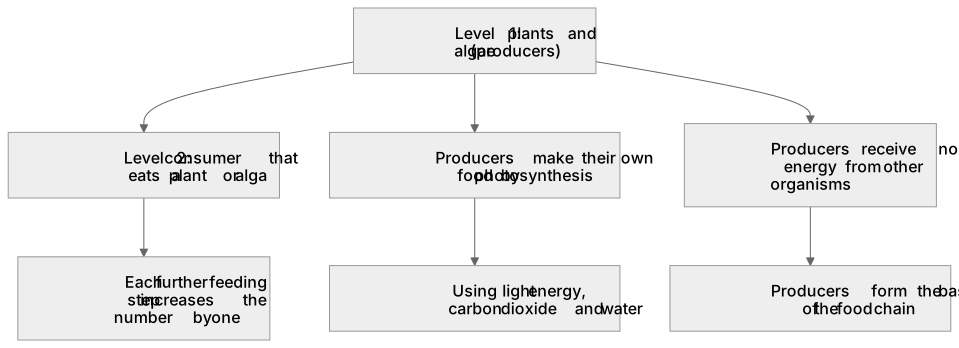
Trophic levels are numbered so that feeding positions can be compared across different food chains. Numbering always begins at level 1, which contains plants and algae. These organisms are producers: they absorb light energy and use photosynthesis to make glucose, converting carbon dioxide and water into organic compounds. Because they generate the organic matter that other organisms eat, they occupy the first step of every food chain and receive no energy from other organisms. A consumer that eats a plant or alga is at level 2, and each further feeding step increases the number by one. Using numbers makes it possible to compare a grassland chain such as grass to rabbit to fox with an aquatic chain such as algae to water flea to fish.
What earns the marks
- Trophic levels are numbered in sequence, and the numbering always starts at level 1.
- Level 1 is occupied by plants and algae, which are producers.
- Producers make their own food by photosynthesis, using light energy, carbon dioxide and water.
- Because producers do not consume other organisms, they form the base of the food chain and supply energy to all higher levels.
- Numbering allows feeding positions in different food chains to be compared directly, for example grass at level 1 in a field and algae at level 1 in a pond.
Common mistakes and how to put them right
Starting the numbering at level 0 or at the first consumer.
Put it right by stating that level 1 is always the producer, such as a plant or alga.
Assuming only land plants can be level 1.
Put it right by including algae and other photosynthetic organisms such as phytoplankton.
Describing producers as organisms that eat dead material.
Put it right by stating that producers synthesise their own food by photosynthesis.
Exam tips
- When labelling a food chain, write the level number beneath each organism and check that the first organism is a plant or alga.
- Use the phrase starting at level 1 with plants and algae when explaining the numbering convention.
- If a question gives an unfamiliar producer such as phytoplankton, still assign it level 1 because it photosynthesises.
Try the lesson
The start of the Trophic levels: Trophic levels can be represented by numbers, starting at level 1 with plants and algae. lesson, made from checked teaching notes for this specification point.
Have a go first
Which number is given to the trophic level containing plants and algae?
Listen
Trophic levels are numbered so that feeding positions can be compared across different food chains. Numbering always begins at level 1, which contains plants and algae. These organisms are producers: they absorb light energy and use photosynthesis to make glucose, converting carbon dioxide and water into organic compounds. Because they generate the organic matter that other organisms eat, they occupy the first step of every food chain and receive no energy from other organisms. A consumer that eats a plant or alga is at level 2, and each further feeding step increases the number by one. Using numbers makes it possible to compare a grassland chain such as grass to rabbit to fox with an aquatic chain such as algae to water flea to fish. A strong answer earns marks for these points. Trophic levels are numbered in sequence, and the numbering always starts at level 1. Level 1 is occupied by plants and algae, which are producers. Producers make their own food by photosynthesis, using light energy, carbon dioxide and water. Because producers do not consume other organisms, they form the base of the food chain and supply energy to all higher levels. A common slip: Starting the numbering at level 0 or at the first consumer. Instead, stating that level 1 is always the producer, such as a plant or alga. Exam tip: When labelling a food chain, write the level number beneath each organism and check that the first organism is a plant or alga.
See it
Key words
Say what each word means before you turn the card.
Trophic levels
Try answering aloud or in your head before turning the card.
Producers
Try answering aloud or in your head before turning the card.
Photosynthesis
Try answering aloud or in your head before turning the card.
Consumers
Try answering aloud or in your head before turning the card.
See every definition
- Trophic levels
- Represented by numbers, starting at level 1 with plants and algae, so that feeding positions can be compared across different food chains.
- Producers
- Plants and algae at level 1 that absorb light energy and use photosynthesis to make glucose, converting carbon dioxide and water into organic compounds.
- Photosynthesis
- The process by which producers use light energy, carbon dioxide and water to make glucose and generate the organic matter that other organisms eat.
- Consumers
- Organisms at level 2 and above, where a consumer that eats a plant or alga is at level 2 and each further feeding step increases the number by one.
Label the diagram
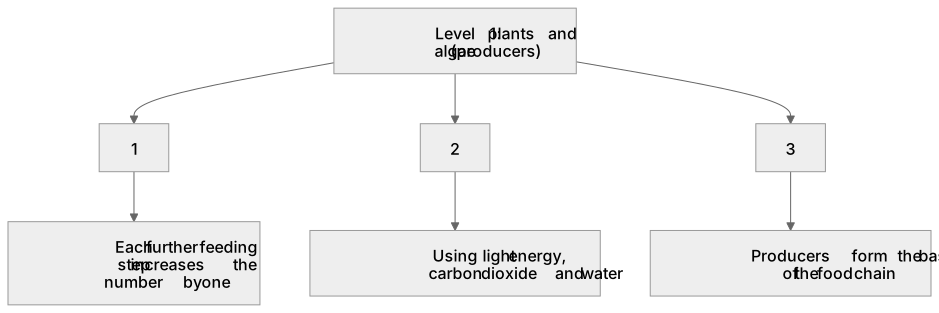
Some boxes have lost their names. Pick the right name for each number.
1Box 1
2Box 2
3Box 3
There is more to this lesson
The full lesson goes on to check your understanding and help you earn the marks. Create a free account to carry on, with your progress saved.
A week of Premium from your first lesson · Then the free plan continues · No card, no charge
Test your understanding of Trophic levels: Trophic levels can be represented by numbers, starting at level 1 with plants and algae.
Active recall beats re-reading. Take an instant quiz now to test what you’ve learned and lock it into long-term memory.
A week of Premium from your first lesson · Then the free plan continues · No card, no charge