AQA · GCSE · Biology
Course version: 8461 · Version from Sept 2018
Plant growth hormones are used in agriculture and horticulture.
Full specification wording
Use of plant hormones (HT only): Plant growth hormones are used in agriculture and horticulture.
Agriculture and horticulture both rely on plant growth hormones to manage crops and ornamental plants.
Checked against the AQA 8461 specification (opens in a new tab) on .
- Point 2 of 4
- 4 key terms
Study notes
From the checked teaching notes for this specification point.
The idea
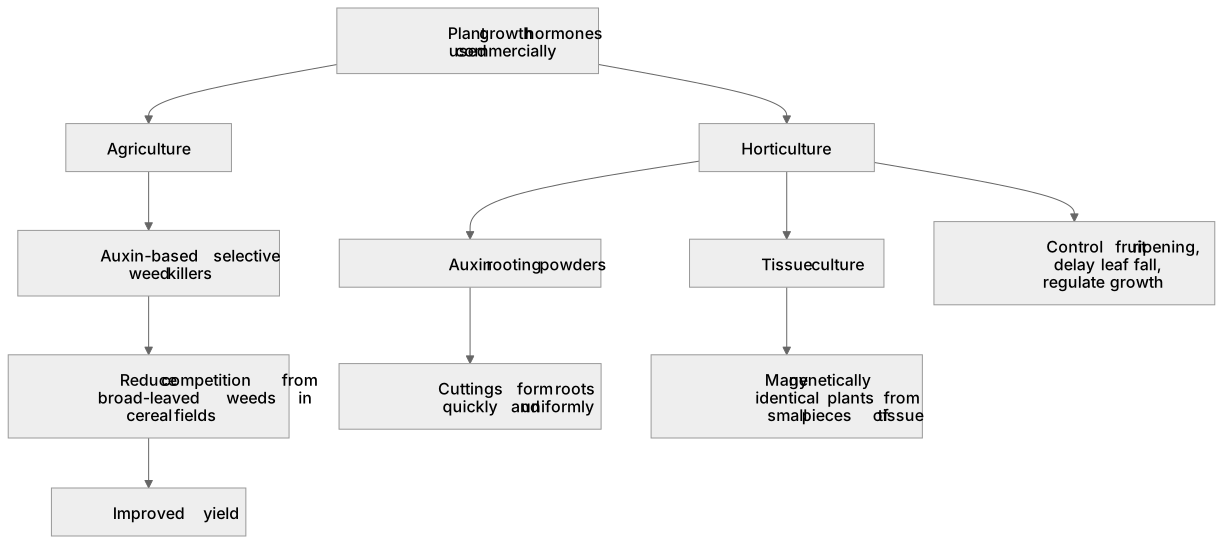
Agriculture and horticulture both rely on plant growth hormones to manage crops and ornamental plants. In agriculture, auxin-based selective weed killers reduce competition from broad-leaved weeds in cereal fields, improving yield. In horticulture, rooting powders containing auxins help cuttings such as pelargonium or rosemary develop roots quickly and uniformly, producing many identical plants. Tissue culture uses auxins and other hormones to multiply rare or valuable plants from small pieces of tissue under sterile conditions. Growers may also use hormones to control fruit ripening, delay leaf fall or regulate growth so plants are a convenient size for transport and sale. These uses show how understanding hormone action allows people to manipulate plant growth deliberately.
What earns the marks
- States that plant growth hormones are used commercially in agriculture and horticulture to control plant growth.
- Gives an agricultural example, such as auxin selective weed killers reducing competition from broad-leaved weeds in cereal crops.
- Gives a horticultural example, such as auxin rooting powder encouraging cuttings to form roots.
- Explains that tissue culture uses plant hormones to produce many genetically identical plants from small explants.
- Links each use to the underlying hormone effect, such as cell elongation, root initiation or controlled development.
Common mistakes and how to put them right
Describing agriculture and horticulture as identical.
Put it right: Agriculture mainly involves crop production while horticulture involves garden and ornamental plant production, though both use plant hormones.
Naming a use without naming the hormone or its effect.
Put it right: State the hormone involved and the growth response it produces.
Assuming all plant hormone uses increase growth.
Put it right: Some uses, such as weed killers, disrupt or inhibit normal growth.
Exam tips
- Give one clear agricultural use and one clear horticultural use, each with the hormone and its effect, to cover the statement fully.
- Use precise terms such as selective weed killer, rooting powder and tissue culture rather than vague phrases like chemicals for plants.
- If asked to compare uses, comment on whether the hormone promotes or disrupts growth and which plants are affected.
Try the lesson
The start of the Use of plant hormones (HT only): Plant growth hormones are used in agriculture and horticulture. lesson, made from checked teaching notes for this specification point.
Have a go first
Which statement describes a use of plant growth hormones in horticulture?
Listen
Agriculture and horticulture both rely on plant growth hormones to manage crops and ornamental plants. In agriculture, auxin-based selective weed killers reduce competition from broad-leaved weeds in cereal fields, improving yield. In horticulture, rooting powders containing auxins help cuttings such as pelargonium or rosemary develop roots quickly and uniformly, producing many identical plants. Tissue culture uses auxins and other hormones to multiply rare or valuable plants from small pieces of tissue under sterile conditions. Growers may also use hormones to control fruit ripening, delay leaf fall or regulate growth so plants are a convenient size for transport and sale. These uses show how understanding hormone action allows people to manipulate plant growth deliberately. A strong answer earns marks for these points. States that plant growth hormones are used commercially in agriculture and horticulture to control plant growth. Gives an agricultural example, such as auxin selective weed killers reducing competition from broad-leaved weeds in cereal crops. Gives a horticultural example, such as auxin rooting powder encouraging cuttings to form roots. Explains that tissue culture uses plant hormones to produce many genetically identical plants from small explants. A common slip: Describing agriculture and horticulture as identical. Instead, agriculture mainly involves crop production while horticulture involves garden and ornamental plant production, though both use plant hormones. Exam tip: Give one clear agricultural use and one clear horticultural use, each with the hormone and its effect, to cover the statement fully.
See it
Key words
Say what each word means before you turn the card.
Agriculture
Try answering aloud or in your head before turning the card.
Horticulture
Try answering aloud or in your head before turning the card.
Selective weed killer
Try answering aloud or in your head before turning the card.
Rooting powder
Try answering aloud or in your head before turning the card.
See every definition
- Agriculture
- Mainly involves crop production, and plant growth hormones are used in it to control plant growth.
- Horticulture
- Involves garden and ornamental plant production, and plant growth hormones are used in it to control plant growth.
- Selective weed killer
- An auxin-based agricultural use that reduces competition from broad-leaved weeds in cereal fields, improving yield.
- Rooting powder
- A horticultural product containing auxins that helps cuttings develop roots quickly and uniformly, producing many identical plants.
Label the diagram
Some boxes have lost their names. Pick the right name for each number.
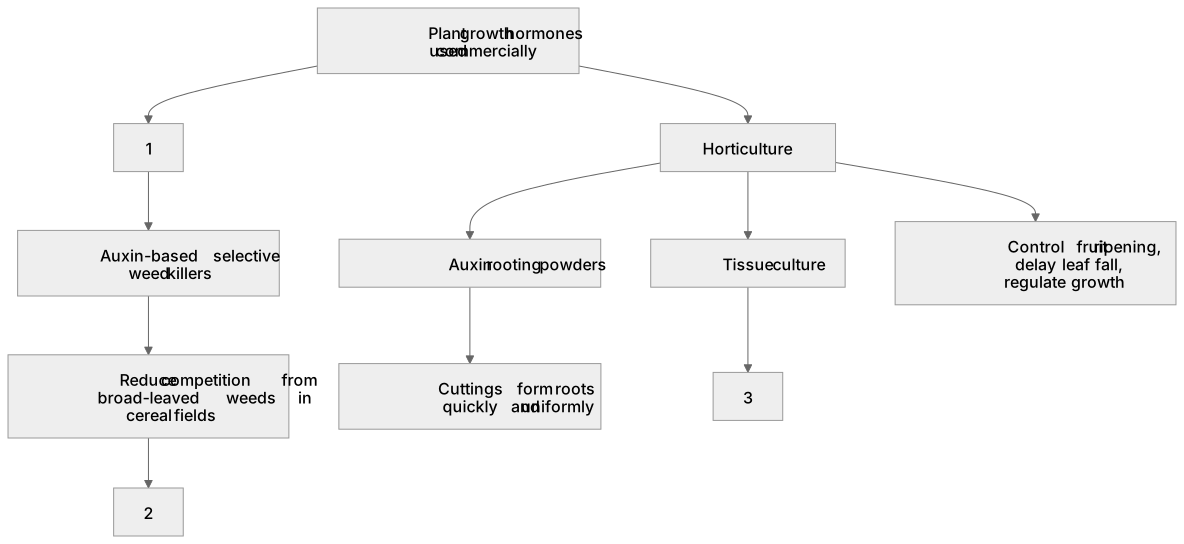
1Box 1
2Box 2
3Box 3
There is more to this lesson
The full lesson goes on to check your understanding and help you earn the marks. Create a free account to carry on, with your progress saved.
A week of Premium from your first lesson · Then the free plan continues · No card, no charge
Test your understanding of Use of plant hormones (HT only): Plant growth hormones are used in agriculture and horticulture.
Active recall beats re-reading. Take an instant quiz now to test what you’ve learned and lock it into long-term memory.
A week of Premium from your first lesson · Then the free plan continues · No card, no charge