AQA · GCSE · Biology
Course version: 8461 · Version from Sept 2018
Auxins are used: • as weed killers • as rooting powders • for promoting…
Full specification wording
Use of plant hormones (HT only): Auxins are used: • as weed killers • as rooting powders • for promoting growth in tissue culture.
Auxins have three important commercial uses.
Checked against the AQA 8461 specification (opens in a new tab) on .
- Point 3 of 4
- 4 key terms
Study notes
From the checked teaching notes for this specification point.
The idea
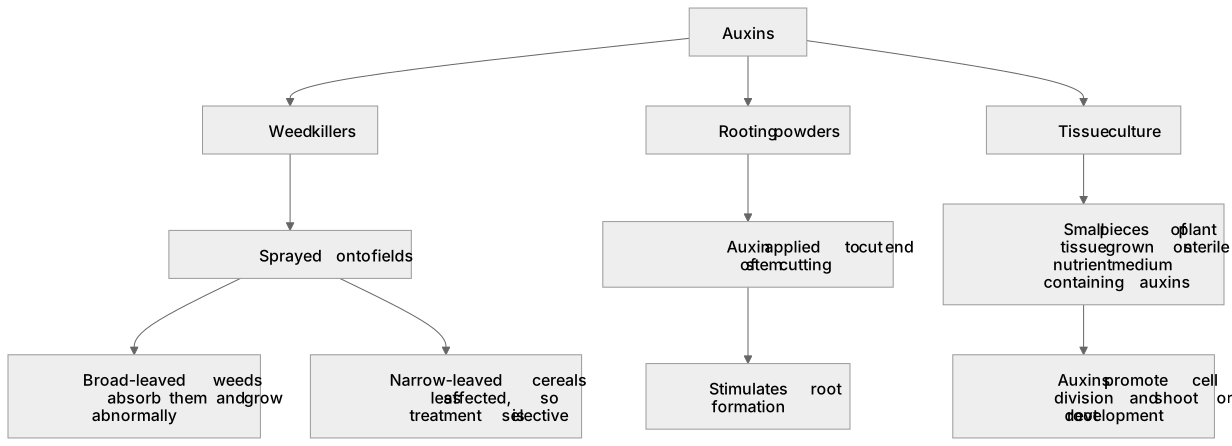
Auxins have three important commercial uses. As weed killers, synthetic auxins are sprayed onto fields; broad-leaved weeds absorb them and grow abnormally, while narrow-leaved cereals are less affected, so the treatment is selective. As rooting powders, auxin is applied to the cut end of a stem cutting; it stimulates root formation so the cutting establishes quickly and many identical plants can be produced. In tissue culture, small pieces of plant tissue are grown on a sterile nutrient medium containing auxins and other hormones; the auxins promote cell division and shoot or root development, producing many plantlets from one parent. Each use depends on auxin promoting or disrupting normal growth and development.
What earns the marks
- States that auxins can be used as selective weed killers that disrupt the growth of broad-leaved weeds.
- Explains that auxin rooting powders stimulate root formation in stem cuttings.
- Describes tissue culture as growing small explants on a sterile medium containing auxins to promote growth and development.
- Links each use to auxin action, such as cell elongation, root initiation or controlled cell division and differentiation.
- Recognises that these uses allow growers to control plant growth for agricultural or horticultural purposes.
Common mistakes and how to put them right
Saying auxin weed killers kill only weeds and never affect crops.
Put it right: They are selective because they affect broad-leaved plants much more than narrow-leaved cereals, but selectivity is not absolute.
Confusing rooting powder with fertiliser.
Put it right: Rooting powder contains auxin, a hormone that stimulates root growth, not nutrients.
Describing tissue culture as simply growing plants in soil.
Put it right: Tissue culture uses small explants on a sterile nutrient medium with hormones under controlled conditions.
Exam tips
- For each of the three uses, write one sentence naming the auxin use and one sentence explaining the growth effect it causes.
- Use the term selective when writing about auxin weed killers, and contrast broad-leaved weeds with narrow-leaved crops.
- In tissue culture answers, mention sterile conditions and the role of auxins in promoting growth from a small explant.
Try the lesson
The start of the Use of plant hormones (HT only): Auxins are used: • as weed killers • as rooting powders • for promoting growth in tissue culture. lesson, made from checked teaching notes for this specification point.
Have a go first
Which of these is a use of auxins in horticulture?
Listen
Auxins have three important commercial uses. As weed killers, synthetic auxins are sprayed onto fields; broad-leaved weeds absorb them and grow abnormally, while narrow-leaved cereals are less affected, so the treatment is selective. As rooting powders, auxin is applied to the cut end of a stem cutting; it stimulates root formation so the cutting establishes quickly and many identical plants can be produced. In tissue culture, small pieces of plant tissue are grown on a sterile nutrient medium containing auxins and other hormones; the auxins promote cell division and shoot or root development, producing many plantlets from one parent. Each use depends on auxin promoting or disrupting normal growth and development. A strong answer earns marks for these points. States that auxins can be used as selective weed killers that disrupt the growth of broad-leaved weeds. Explains that auxin rooting powders stimulate root formation in stem cuttings. Describes tissue culture as growing small explants on a sterile medium containing auxins to promote growth and development. Links each use to auxin action, such as cell elongation, root initiation or controlled cell division and differentiation. A common slip: Saying auxin weed killers kill only weeds and never affect crops. Instead, they are selective because they affect broad-leaved plants much more than narrow-leaved cereals, but selectivity is not absolute. Exam tip: For each of the three uses, write one sentence naming the auxin use and one sentence explaining the growth effect it causes.
See it
Key words
Say what each word means before you turn the card.
Selective weed killers
Try answering aloud or in your head before turning the card.
Rooting powders
Try answering aloud or in your head before turning the card.
Tissue culture
Try answering aloud or in your head before turning the card.
Auxin uses
Try answering aloud or in your head before turning the card.
See every definition
- Selective weed killers
- Synthetic auxins are sprayed onto fields, and broad-leaved weeds absorb them and grow abnormally, while narrow-leaved cereals are less affected.
- Rooting powders
- Auxin is applied to the cut end of a stem cutting and stimulates root formation, so the cutting establishes quickly and many identical plants can be produced.
- Tissue culture
- Small pieces of plant tissue are grown on a sterile nutrient medium containing auxins and other hormones, which promote cell division and shoot or root development.
- Auxin uses
- These depend on auxin promoting or disrupting normal growth and development, as a weed killer, as a rooting powder and in tissue culture.
Label the diagram
Some boxes have lost their names. Pick the right name for each number.
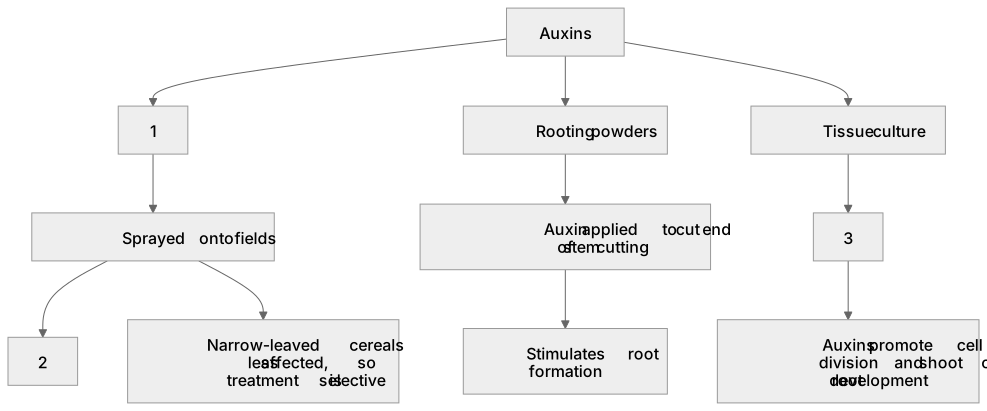
1Box 1
2Box 2
3Box 3
There is more to this lesson
The full lesson goes on to check your understanding and help you earn the marks. Create a free account to carry on, with your progress saved.
A week of Premium from your first lesson · Then the free plan continues · No card, no charge
Test your understanding of Use of plant hormones (HT only): Auxins are used: • as weed killers • as rooting powders • for promoting growth in tissue culture.
Active recall beats re-reading. Take an instant quiz now to test what you’ve learned and lock it into long-term memory.
A week of Premium from your first lesson · Then the free plan continues · No card, no charge