AQA · GCSE · Biology
Course version: 8461 · Version from Sept 2018
Students should be able to describe some of the ways in which monoclonal…
Full specification wording
Uses of monoclonal antibodies: Students should be able to describe some of the ways in which monoclonal antibodies can be used.
Monoclonal antibodies bind to one specific antigen, so they can be used wherever that antigen needs to be detected or targeted.
Checked against the AQA 8461 specification (opens in a new tab) on .
- Point 1 of 5
- 4 key terms
Study notes
From the checked teaching notes for this specification point.
The idea
Monoclonal antibodies bind to one specific antigen, so they can be used wherever that antigen needs to be detected or targeted. In pregnancy tests, an antibody binds to a hormone (hCG) in urine and produces a visible line. In laboratories, antibodies detect specific molecules in samples, for example in diagnosing infections or identifying blood groups. In medicine, antibodies can carry drugs or radioactive substances to cancer cells, or be used to treat some diseases by binding to specific targets. They may also be used in research to locate substances in cells using fluorescent markers. The uses of monoclonal antibodies are assessed at Higher Tier only.
What earns the marks
- Monoclonal antibodies bind to a specific antigen because their binding sites are complementary to it.
- In pregnancy tests, an antibody binds to a hormone in urine and causes a visible signal.
- In diagnosis, antibodies can detect specific molecules such as pathogens or markers of disease.
- In treatment, antibodies can carry drugs or radioactive substances to specific cells such as cancer cells.
- Monoclonal antibodies are also used in research to locate specific molecules in cells or tissues.
Common mistakes and how to put them right
Saying antibodies kill pathogens directly.
Put it right: They bind to specific antigens, and this binding can be used to detect or target substances.
Thinking one antibody can be used for any antigen.
Put it right: Each monoclonal antibody is specific to one antigen.
Confusing the role of the antibody with the role of the drug it carries.
Put it right: The antibody targets, while the drug or radioactive substance does the treating.
Exam tips
- Give named examples, such as pregnancy testing or cancer treatment, rather than general statements.
- Always link the use back to the antibody binding to a specific antigen.
- Remember that the uses of monoclonal antibodies are a Higher Tier only topic, so expect questions requiring detailed application of knowledge.
Try the lesson
The start of the Uses of monoclonal antibodies: Students should be able to describe some of the ways in which monoclonal antibodies can be used. lesson, made from checked teaching notes for this specification point.
Have a go first
Which of these is a use of monoclonal antibodies?
Listen
Monoclonal antibodies bind to one specific antigen, so they can be used wherever that antigen needs to be detected or targeted. In pregnancy tests, an antibody binds to a hormone (hCG) in urine and produces a visible line. In laboratories, antibodies detect specific molecules in samples, for example in diagnosing infections or identifying blood groups. In medicine, antibodies can carry drugs or radioactive substances to cancer cells, or be used to treat some diseases by binding to specific targets. They may also be used in research to locate substances in cells using fluorescent markers. The uses of monoclonal antibodies are assessed at Higher Tier only. A strong answer earns marks for these points. Monoclonal antibodies bind to a specific antigen because their binding sites are complementary to it. In pregnancy tests, an antibody binds to a hormone in urine and causes a visible signal. In diagnosis, antibodies can detect specific molecules such as pathogens or markers of disease. In treatment, antibodies can carry drugs or radioactive substances to specific cells such as cancer cells. A common slip: Saying antibodies kill pathogens directly. Instead, they bind to specific antigens, and this binding can be used to detect or target substances. Exam tip: Give named examples, such as pregnancy testing or cancer treatment, rather than general statements.
See it

Key words
Say what each word means before you turn the card.
Antigen specificity
Try answering aloud or in your head before turning the card.
Medical diagnosis
Try answering aloud or in your head before turning the card.
Targeted treatment
Try answering aloud or in your head before turning the card.
Laboratory research
Try answering aloud or in your head before turning the card.
See every definition
- Antigen specificity
- Monoclonal antibodies bind to one specific antigen because their binding sites are complementary to it.
- Medical diagnosis
- Antibodies can detect specific molecules such as pathogens or markers of disease.
- Targeted treatment
- Antibodies can carry drugs or radioactive substances to specific cells such as cancer cells.
- Laboratory research
- Monoclonal antibodies are used to locate specific molecules in cells or tissues.
Label the diagram
Some boxes have lost their names. Pick the right name for each number.
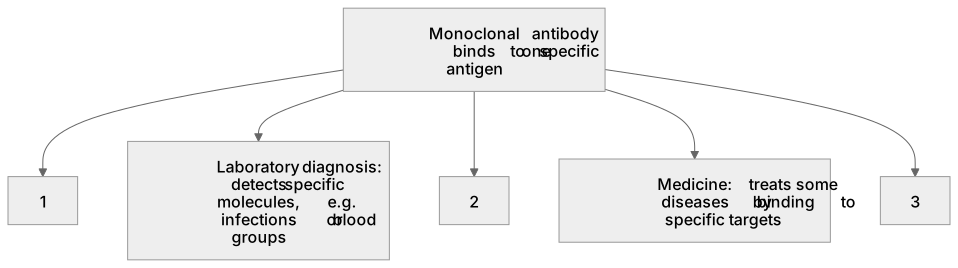
1Box 1
2Box 2
3Box 3
There is more to this lesson
The full lesson goes on to check your understanding and help you earn the marks. Create a free account to carry on, with your progress saved.
A week of Premium from your first lesson · Then the free plan continues · No card, no charge
Test your understanding of Uses of monoclonal antibodies: Students should be able to describe some of the ways in which monoclonal antibodies can be used.
Active recall beats re-reading. Take an instant quiz now to test what you’ve learned and lock it into long-term memory.
A week of Premium from your first lesson · Then the free plan continues · No card, no charge