OCR · A-Level · Biology
Course version: H420 · Version from Sept 2025
(i) the interrelationship between the organelles involved in the…
Full specification wording
Cell structure: (i) the interrelationship between the organelles involved in the production and secretion of proteins
Protein secretion is a coordinated pathway.
Checked against the OCR H420 specification (opens in a new tab) on .
- Point 8 of 10
- 4 key terms
Study notes
From the checked teaching notes for this specification point.
The idea
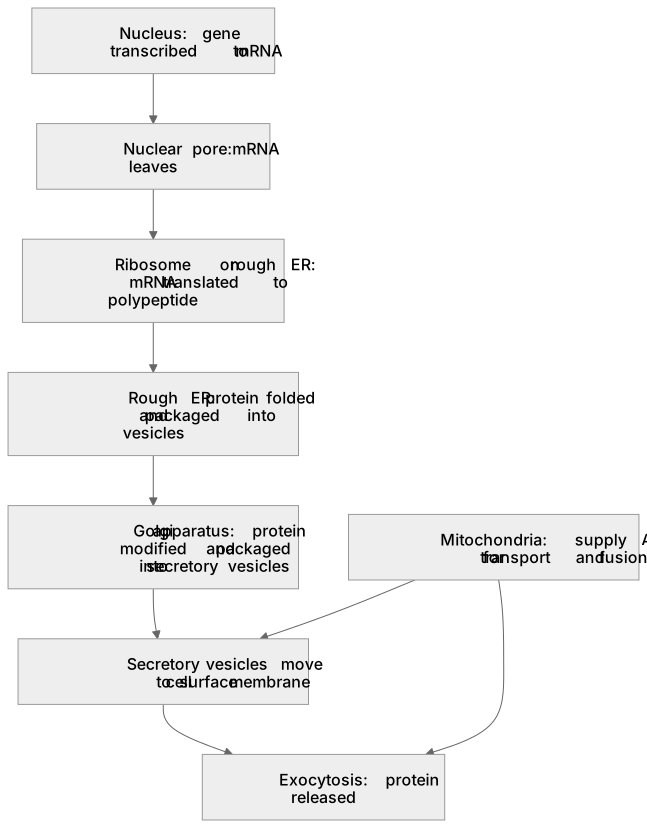
Protein secretion is a coordinated pathway. A gene in the nucleus is transcribed to mRNA, which leaves through a nuclear pore and binds to a ribosome. On the rough endoplasmic reticulum, the ribosome translates mRNA into a polypeptide, which enters the ER lumen and is folded. The ER packages the protein into vesicles that fuse with the Golgi apparatus, where it is modified, for example by adding carbohydrate. The Golgi packages the protein into secretory vesicles that move to the cell surface membrane and fuse with it, releasing the protein by exocytosis. Mitochondria supply the ATP for these transport and fusion events. Learn the order and the role of each organelle.
What earns the marks
- States that the nucleus contains the gene and mRNA carries the code to the ribosome.
- Places translation of the polypeptide on ribosomes attached to the rough endoplasmic reticulum.
- Describes the rough ER folding and packaging the protein into transport vesicles.
- Explains that the Golgi apparatus modifies the protein and packages it into secretory vesicles.
- Describes exocytosis at the cell surface membrane releasing the protein.
- Identifies mitochondria as supplying ATP for vesicle movement and membrane fusion.
Common mistakes and how to put them right
Reversing the order of ER and Golgi.
Put it right: Is that the ER comes before the Golgi in the secretory pathway.
Claiming the Golgi synthesises the polypeptide.
Put it right: Is that ribosomes translate the protein and the Golgi modifies it.
Omitting the ATP source.
Put it right: Is to state that mitochondria provide ATP for transport and exocytosis.
Exam tips
- Write the pathway as an ordered sequence from nucleus to exocytosis.
- Name the vesicle type at each transfer step to show understanding.
- Link each organelle to one specific job rather than listing them.
Try the lesson
The start of the Cell structure: (i) the interrelationship between the organelles involved in the production and secretion of proteins lesson, made from checked teaching notes for this specification point.
Have a go first
Which organelle modifies proteins, for example by adding carbohydrate, and packages them into vesicles for secretion?
Listen
Protein secretion is a coordinated pathway. A gene in the nucleus is transcribed to mRNA, which leaves through a nuclear pore and binds to a ribosome. On the rough endoplasmic reticulum, the ribosome translates mRNA into a polypeptide, which enters the ER lumen and is folded. The ER packages the protein into vesicles that fuse with the Golgi apparatus, where it is modified, for example by adding carbohydrate. The Golgi packages the protein into secretory vesicles that move to the cell surface membrane and fuse with it, releasing the protein by exocytosis. Mitochondria supply the ATP for these transport and fusion events. Learn the order and the role of each organelle. A strong answer earns marks for these points. States that the nucleus contains the gene and mRNA carries the code to the ribosome. Places translation of the polypeptide on ribosomes attached to the rough endoplasmic reticulum. Describes the rough ER folding and packaging the protein into transport vesicles. Explains that the Golgi apparatus modifies the protein and packages it into secretory vesicles. A common slip: Reversing the order of ER and Golgi. Instead, is that the ER comes before the Golgi in the secretory pathway. Exam tip: Write the pathway as an ordered sequence from nucleus to exocytosis.
See it
Key words
Say what each word means before you turn the card.
Protein synthesis and transport
Try answering aloud or in your head before turning the card.
Organelle cooperation
Try answering aloud or in your head before turning the card.
Modification in the Golgi
Try answering aloud or in your head before turning the card.
Exocytosis and ATP supply
Try answering aloud or in your head before turning the card.
See every definition
- Protein synthesis and transport
- The ordered pathway in which a gene in the nucleus is transcribed to mRNA, which binds to a ribosome and is translated into a polypeptide.
- Organelle cooperation
- The coordinated pathway in which the nucleus, ribosome, rough endoplasmic reticulum, Golgi apparatus, secretory vesicles, cell surface membrane and mitochondria each play a role.
- Modification in the Golgi
- The Golgi apparatus modifies the protein, for example by adding carbohydrate, and packages it into secretory vesicles.
- Exocytosis and ATP supply
- Secretory vesicles fuse with the cell surface membrane, releasing the protein by exocytosis, with mitochondria supplying the ATP for these transport and fusion events.
Label the diagram
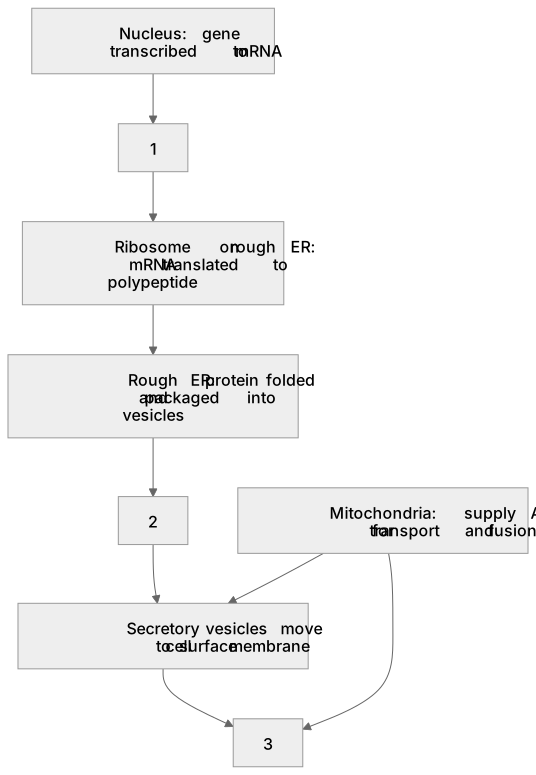
Some boxes have lost their names. Pick the right name for each number.
1Box 1
2Box 2
3Box 3
There is more to this lesson
The full lesson goes on to check your understanding and help you earn the marks. Create a free account to carry on, with your progress saved.
A week of Premium from your first lesson · Then the free plan continues · No card, no charge
Test your understanding of Cell structure: (i) the interrelationship between the organelles involved in the production and secretion of proteins
Active recall beats re-reading. Take an instant quiz now to test what you’ve learned and lock it into long-term memory.
A week of Premium from your first lesson · Then the free plan continues · No card, no charge