OCR · A-Level · Biology
Course version: H420 · Version from Sept 2025
(g) the primary and secondary immune responses
Full specification wording
Communicable diseases, disease prevention and the immune system: (g) the primary and secondary immune responses
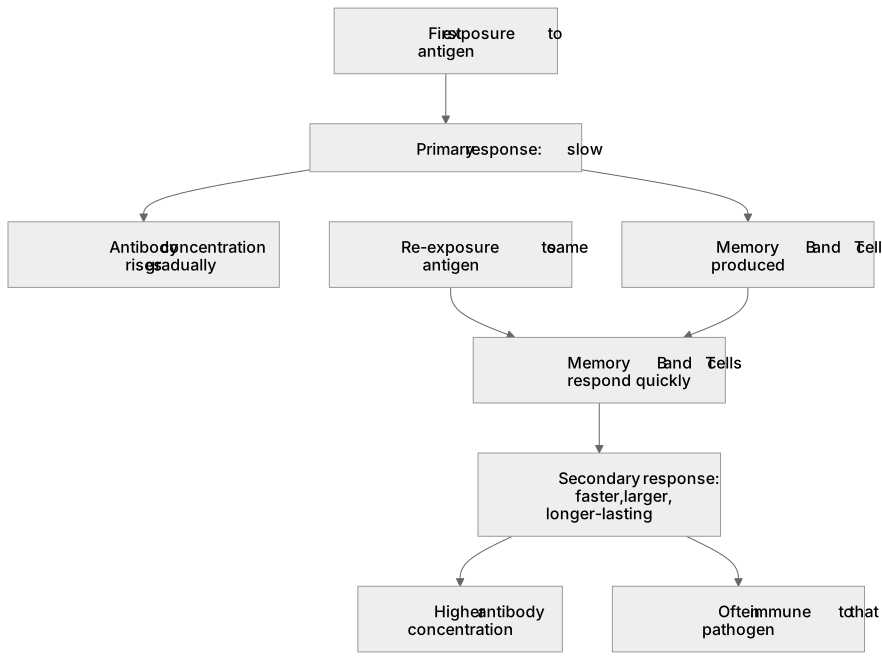
The primary immune response follows first exposure to an antigen.
Checked against the OCR H420 specification (opens in a new tab) on .
- Point 7 of 14
- 4 key terms
Study notes
From the checked teaching notes for this specification point.
The idea
The primary immune response follows first exposure to an antigen. It is slow because the few lymphocytes with a matching receptor must be selected, then divide and differentiate. Antibody concentration rises gradually and may take days, and memory cells are produced. On later exposure to the same antigen, memory B and T cells respond quickly, so the secondary response is faster, larger and longer-lasting, with a higher antibody concentration. Memory cells also mean the person is often immune to that pathogen. A question may ask you to compare the two responses, interpret a graph of antibody concentration against time, or identify which features belong to the secondary response.
What earns the marks
- The primary response is slow, produces a lower antibody concentration and generates memory cells.
- The secondary response is faster and produces a higher and longer-lasting antibody concentration.
- Memory B and T cells are responsible for the speed and size of the secondary response.
- The secondary response occurs on re-exposure to the same antigen and can prevent symptoms, giving immunity.
Common mistakes and how to put them right
Saying the secondary response involves a new antigen.
Put it right: Is that it is triggered by the same antigen on re-exposure.
Claiming the primary response is faster.
Put it right: Is that the primary response is slower and the secondary response is faster and larger.
Ignoring memory cells: correction is that memory cells explain the speed and magnitude of the secondary response.
Exam tips
- When reading a graph, compare the time to peak and the peak height of antibody concentration for each exposure.
- Link each feature of the secondary response back to memory cells rather than to a new set of lymphocytes.
- Check that any option about immunity refers to re-exposure to the same antigen.
Try the lesson
The start of the Communicable diseases, disease prevention and the immune system: (g) the primary and secondary immune responses lesson, made from checked teaching notes for this specification point.
Have a go first
In a primary immune response, how does the concentration of antibody in the blood typically change after first exposure to an antigen?
Listen
The primary immune response follows first exposure to an antigen. It is slow because the few lymphocytes with a matching receptor must be selected, then divide and differentiate. Antibody concentration rises gradually and may take days, and memory cells are produced. On later exposure to the same antigen, memory B and T cells respond quickly, so the secondary response is faster, larger and longer-lasting, with a higher antibody concentration. Memory cells also mean the person is often immune to that pathogen. A question may ask you to compare the two responses, interpret a graph of antibody concentration against time, or identify which features belong to the secondary response. A strong answer earns marks for these points. The primary response is slow, produces a lower antibody concentration and generates memory cells. The secondary response is faster and produces a higher and longer-lasting antibody concentration. Memory B and T cells are responsible for the speed and size of the secondary response. The secondary response occurs on re-exposure to the same antigen and can prevent symptoms, giving immunity. A common slip: Saying the secondary response involves a new antigen. Instead, is that it is triggered by the same antigen on re-exposure. Exam tip: When reading a graph, compare the time to peak and the peak height of antibody concentration for each exposure.
See it
Key words
Say what each word means before you turn the card.
Primary immune response
Try answering aloud or in your head before turning the card.
Secondary response
Try answering aloud or in your head before turning the card.
Memory cells
Try answering aloud or in your head before turning the card.
Antibody concentration
Try answering aloud or in your head before turning the card.
See every definition
- Primary immune response
- The response that follows first exposure to an antigen; it is slow because the few lymphocytes with a matching receptor must be selected, then divide and differentiate.
- Secondary response
- On later exposure to the same antigen, memory B and T cells respond quickly, so this response is faster, larger and longer-lasting, with a higher antibody concentration.
- Memory cells
- Cells produced in the primary response; memory B and T cells are responsible for the speed and size of the secondary response and mean the person is often immune to that pathogen.
- Antibody concentration
- In the primary response it rises gradually and may take days, whereas the secondary response produces a higher and longer-lasting antibody concentration.
Label the diagram
Some boxes have lost their names. Pick the right name for each number.
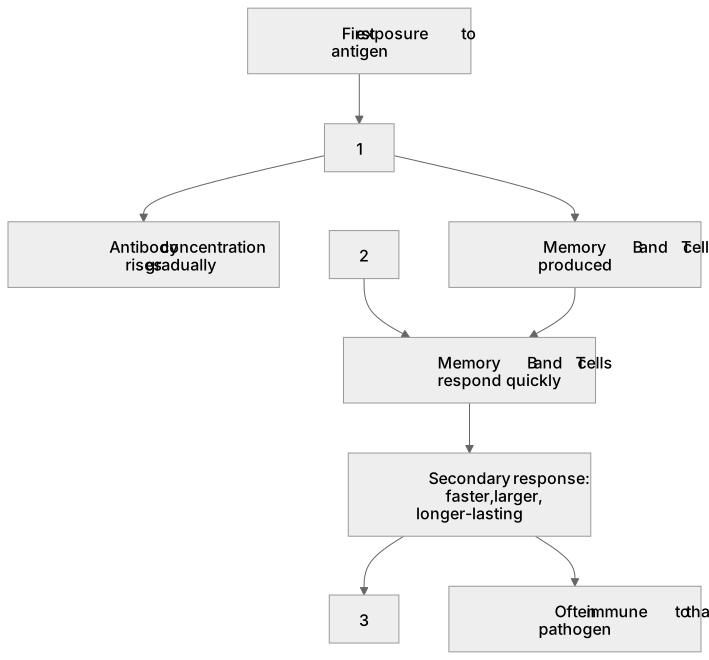
1Box 1
2Box 2
3Box 3
There is more to this lesson
The full lesson goes on to check your understanding and help you earn the marks. Create a free account to carry on, with your progress saved.
A week of Premium from your first lesson · Then the free plan continues · No card, no charge
Test your understanding of Communicable diseases, disease prevention and the immune system: (g) the primary and secondary immune responses
Active recall beats re-reading. Take an instant quiz now to test what you’ve learned and lock it into long-term memory.
A week of Premium from your first lesson · Then the free plan continues · No card, no charge