OCR · A-Level · Biology
Course version: H420 · Version from Sept 2025
(d) the process of primary succession in the development of an ecosystem
Full specification wording
Ecosystems: (d) the process of primary succession in the development of an ecosystem
Primary succession is the colonisation of bare, previously uncolonised ground where no soil or seed bank exists, for example after a volcanic eruption or glacial retreat.
Checked against the OCR H420 specification (opens in a new tab) on .
- Point 4 of 6
- 4 key terms
Study notes
From the checked teaching notes for this specification point.
The idea
Primary succession is the colonisation of bare, previously uncolonised ground where no soil or seed bank exists, for example after a volcanic eruption or glacial retreat. Pioneer species such as lichens and mosses arrive by wind or water dispersal, tolerate harsh conditions and begin weathering rock. Their death and decay, together with trapped particles, slowly build a thin soil layer and add organic matter and nutrients. As soil deepens and water retention improves, larger plants such as grasses and shrubs can establish, outcompeting pioneers. Each stage is a seral stage; the community changes until a stable climax community forms, determined by climate. Biodiversity and soil depth generally increase, while pioneer species decline. The process is directional and slow, and it differs from secondary succession, which starts on existing soil.
What earns the marks
- Primary succession begins on bare, previously uncolonised ground with no pre-existing soil or seed bank.
- Pioneer species such as lichens and mosses colonise, tolerate harsh conditions and begin to weather rock.
- Death and decay of pioneers, plus trapped particles, build a thin soil layer and add organic matter and nutrients.
- As soil deepens and retains more water, larger plants such as grasses and shrubs establish and outcompete pioneers.
- Each community is a seral stage, and succession continues until a stable climax community determined by climate forms.
- Biodiversity and soil depth generally increase through succession, while pioneer species decline.
- Primary succession differs from secondary succession, which begins on already-formed soil.
Common mistakes and how to put them right
Thinking primary succession starts on bare rock that already has soil.
Put it right by stressing that no soil or seed bank exists at the start.
Confusing primary with secondary succession.
Put it right by noting secondary succession begins on existing soil after a disturbance.
Assuming the climax community is always the same everywhere.
Put it right by explaining it is determined by the prevailing climate.
Believing pioneers are outcompeted immediately.
Put it right by describing the gradual build-up of soil before larger plants establish.
Exam tips
- Link each stage to a change in an abiotic factor, such as soil depth or water retention, to show the mechanism.
- Use the term seral stage and climax community precisely when describing the sequence.
- Contrast primary with secondary succession explicitly when a question asks you to distinguish them.
Try the lesson
The start of the Ecosystems: (d) the process of primary succession in the development of an ecosystem lesson, made from checked teaching notes for this specification point.
Have a go first
What name is given to the first organisms to colonise an area of bare rock at the start of primary succession?
Listen
Primary succession is the colonisation of bare, previously uncolonised ground where no soil or seed bank exists, for example after a volcanic eruption or glacial retreat. Pioneer species such as lichens and mosses arrive by wind or water dispersal, tolerate harsh conditions and begin weathering rock. Their death and decay, together with trapped particles, slowly build a thin soil layer and add organic matter and nutrients. As soil deepens and water retention improves, larger plants such as grasses and shrubs can establish, outcompeting pioneers. Each stage is a seral stage; the community changes until a stable climax community forms, determined by climate. Biodiversity and soil depth generally increase, while pioneer species decline. The process is directional and slow, and it differs from secondary succession, which starts on existing soil. A strong answer earns marks for these points. Primary succession begins on bare, previously uncolonised ground with no pre-existing soil or seed bank. Pioneer species such as lichens and mosses colonise, tolerate harsh conditions and begin to weather rock. Death and decay of pioneers, plus trapped particles, build a thin soil layer and add organic matter and nutrients. As soil deepens and retains more water, larger plants such as grasses and shrubs establish and outcompete pioneers. A common slip: Thinking primary succession starts on bare rock that already has soil. Instead, stressing that no soil or seed bank exists at the start. Exam tip: Link each stage to a change in an abiotic factor, such as soil depth or water retention, to show the mechanism.
See it
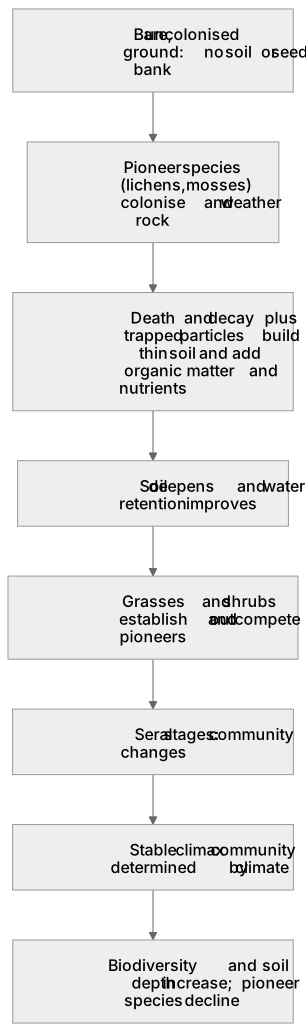
Put it in order
Put these steps in the order they happen.
- 1. Grasses and shrubs establish and outcompete pioneers
- 2. Biodiversity and soil depth increase; pioneer species decline
- 3. Seral stages: community changes
- 4. Bare, uncolonised ground: no soil or seed bank
- 5. Pioneer species (lichens, mosses) colonise and weather rock
- 6. Stable climax community determined by climate
- 7. Death and decay plus trapped particles build thin soil and add organic matter and nutrients
- 8. Soil deepens and water retention improves
Key words
Say what each word means before you turn the card.
Colonisation of bare ground
Try answering aloud or in your head before turning the card.
Pioneer species and weathering
Try answering aloud or in your head before turning the card.
Soil formation and organic matter
Try answering aloud or in your head before turning the card.
Seral stages and climax community
Try answering aloud or in your head before turning the card.
See every definition
- Colonisation of bare ground
- The arrival of organisms on bare, previously uncolonised ground where no soil or seed bank exists, for example after a volcanic eruption or glacial retreat.
- Pioneer species and weathering
- Lichens and mosses that arrive by wind or water dispersal, tolerate harsh conditions and begin weathering rock.
- Soil formation and organic matter
- The death and decay of pioneers, together with trapped particles, slowly build a thin soil layer and add organic matter and nutrients.
- Seral stages and climax community
- Each stage is a seral stage, and the community changes until a stable climax community forms, determined by climate.
Label the diagram
Some boxes have lost their names. Pick the right name for each number.
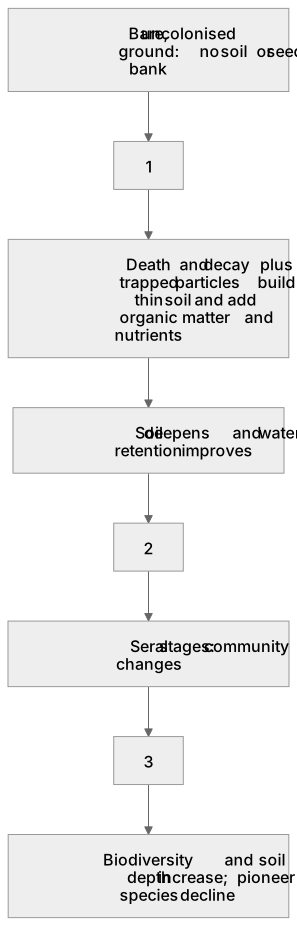
1Box 1
2Box 2
3Box 3
There is more to this lesson
The full lesson goes on to check your understanding and help you earn the marks. Create a free account to carry on, with your progress saved.
A week of Premium from your first lesson · Then the free plan continues · No card, no charge
Test your understanding of Ecosystems: (d) the process of primary succession in the development of an ecosystem
Active recall beats re-reading. Take an instant quiz now to test what you’ve learned and lock it into long-term memory.
A week of Premium from your first lesson · Then the free plan continues · No card, no charge