OCR · A-Level · Biology
Course version: H420 · Version from Sept 2025
Enzymes: (c) the mechanism of enzyme action
Enzymes are globular protein catalysts that lower the activation energy of a reaction.
Checked against the OCR H420 specification (opens in a new tab) on .
- Point 3 of 6
- 4 key terms
Study notes
From the checked teaching notes for this specification point.
The idea
Enzymes are globular protein catalysts that lower the activation energy of a reaction. The currently accepted mechanism is the induced-fit model: the active site is not a rigid shape but moulds around the substrate as it binds, so the substrate and active site become complementary. Formation of the enzyme–substrate complex strains bonds in the substrate and positions reacting groups correctly, which speeds up the reaction. The active site is specific because its shape and chemistry (including charged and hydrophobic residues) only fit particular substrates. After the reaction the products leave the active site, which is free to bind more substrate. A common MCQ trap is confusing the older lock-and-key idea with induced fit: lock-and-key treats the active site as a fixed shape, whereas induced fit describes a conformational change on binding.
What earns the marks
- Enzymes are globular proteins that act as biological catalysts and lower activation energy.
- The active site is a specific region of the enzyme with a shape and chemistry complementary to a particular substrate.
- In the induced-fit model the active site changes shape (moulds) as the substrate binds, forming the enzyme–substrate complex.
- Forming the complex strains substrate bonds and/or brings reacting groups together, lowering activation energy and increasing rate.
- Products are released and the active site is unchanged and available to catalyse further reactions.
- Specificity arises because only substrates that can induce a complementary fit bind to the active site.
Common mistakes and how to put them right
Treating the active site as a rigid, unchanging shape (lock-and-key) rather than a shape that moulds to the substrate in the induced-fit model.
Put it right by describing the conformational change on binding.
Saying the enzyme is used up or permanently changed by the reaction.
Put it right by stating the enzyme is released unchanged and reused.
Claiming enzymes increase the activation energy or the energy of products.
Put it right by stating they lower activation energy without changing the overall energy change of the reaction.
Describing the active site as complementary to the product rather than to the substrate.
Put it right by linking specificity to the substrate.
Exam tips
- Read each option carefully and eliminate any that describe lock-and-key as the current model.
- Check whether an option confuses 'lowering activation energy' with 'providing energy' — only the former is correct.
- When two options seem similar, look for the one that mentions the enzyme–substrate complex and the shape change on binding.
Try the lesson
The start of the Enzymes: (c) the mechanism of enzyme action lesson, made from checked teaching notes for this specification point.
Have a go first
In the lock-and-key model of enzyme action, what does the active site represent?
Listen
Enzymes are globular protein catalysts that lower the activation energy of a reaction. The currently accepted mechanism is the induced-fit model: the active site is not a rigid shape but moulds around the substrate as it binds, so the substrate and active site become complementary. Formation of the enzyme–substrate complex strains bonds in the substrate and positions reacting groups correctly, which speeds up the reaction. The active site is specific because its shape and chemistry (including charged and hydrophobic residues) only fit particular substrates. After the reaction the products leave the active site, which is free to bind more substrate. A common MCQ trap is confusing the older lock-and-key idea with induced fit: lock-and-key treats the active site as a fixed shape, whereas induced fit describes a conformational change on binding. A strong answer earns marks for these points. Enzymes are globular proteins that act as biological catalysts and lower activation energy. The active site is a specific region of the enzyme with a shape and chemistry complementary to a particular substrate. In the induced-fit model the active site changes shape (moulds) as the substrate binds, forming the enzyme–substrate complex. Forming the complex strains substrate bonds and/or brings reacting groups together, lowering activation energy and increasing rate. A common slip: Treating the active site as a rigid, unchanging shape (lock-and-key) rather than a shape that moulds to the substrate in the induced-fit model. Instead, describing the conformational change on binding. Exam tip: Read each option carefully and eliminate any that describe lock-and-key as the current model.
See it
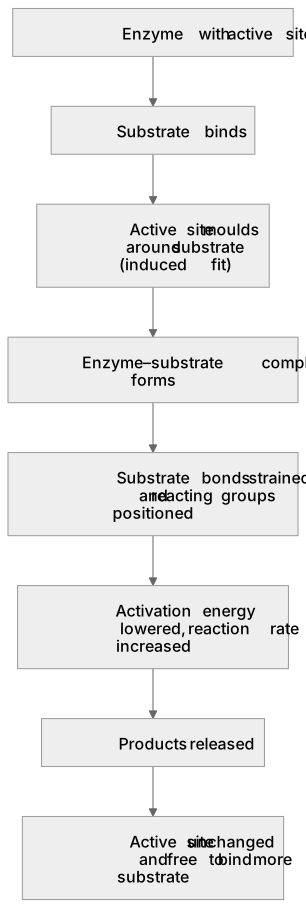
Put it in order
Put these steps in the order they happen.
- 1. Substrate bonds strained and reacting groups positioned
- 2. Active site unchanged and free to bind more substrate
- 3. Activation energy lowered, reaction rate increased
- 4. Enzyme with active site
- 5. Substrate binds
- 6. Products released
- 7. Active site moulds around substrate (induced fit)
- 8. Enzyme–substrate complex forms
Key words
Say what each word means before you turn the card.
Induced-fit model of enzyme action
Try answering aloud or in your head before turning the card.
Enzyme–substrate complex formation
Try answering aloud or in your head before turning the card.
Lowering activation energy
Try answering aloud or in your head before turning the card.
Enzyme specificity and active-site complementarity
Try answering aloud or in your head before turning the card.
See every definition
- Induced-fit model of enzyme action
- The active site is not a rigid shape but moulds around the substrate as it binds, so the substrate and active site become complementary.
- Enzyme–substrate complex formation
- Forming the complex strains bonds in the substrate and positions reacting groups correctly, which speeds up the reaction.
- Lowering activation energy
- Globular protein catalysts lower the activation energy of a reaction, speeding it up.
- Enzyme specificity and active-site complementarity
- The active site is specific because its shape and chemistry, including charged and hydrophobic residues, only fit particular substrates.
Label the diagram
Some boxes have lost their names. Pick the right name for each number.
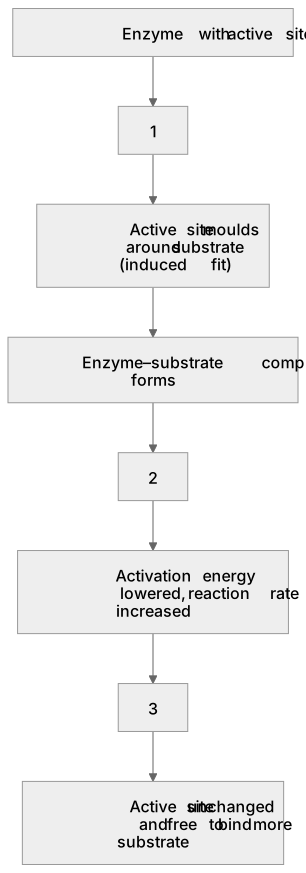
1Box 1
2Box 2
3Box 3
There is more to this lesson
The full lesson goes on to check your understanding and help you earn the marks. Create a free account to carry on, with your progress saved.
A week of Premium from your first lesson · Then the free plan continues · No card, no charge
Test your understanding of Enzymes: (c) the mechanism of enzyme action
Active recall beats re-reading. Take an instant quiz now to test what you’ve learned and lock it into long-term memory.
A week of Premium from your first lesson · Then the free plan continues · No card, no charge