OCR · A-Level · Biology
Course version: H420 · Version from Sept 2025
(c) the structures and functions of the components of the mammalian…
Full specification wording
Exchange surfaces: (c) the structures and functions of the components of the mammalian gaseous exchange system
The mammalian gaseous exchange system moves air to and from alveoli, where oxygen diffuses into blood and carbon dioxide diffuses out.
Checked against the OCR H420 specification (opens in a new tab) on .
- Point 3 of 7
- 4 key terms
Study notes
From the checked teaching notes for this specification point.
The idea
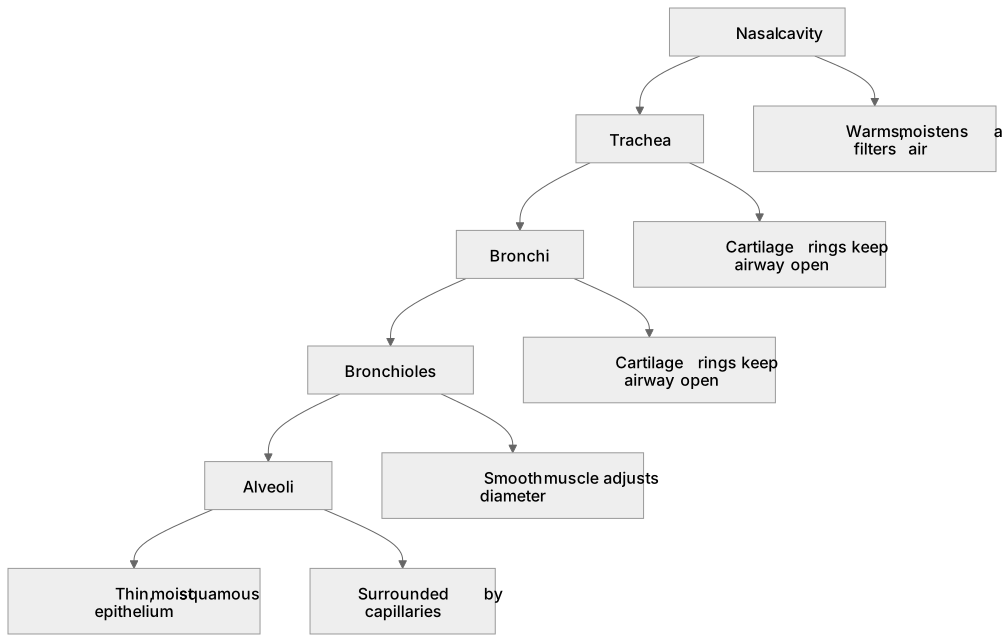
The mammalian gaseous exchange system moves air to and from alveoli, where oxygen diffuses into blood and carbon dioxide diffuses out. Trace the route: nasal cavity, trachea, bronchi, bronchioles, alveoli. The nasal cavity warms, moistens and filters air. The trachea and bronchi are held open by cartilage rings and lined with ciliated epithelium and goblet cells; mucus traps particles and cilia sweep it away. Smooth muscle in bronchioles adjusts their diameter. Elastic fibres let airways and alveoli stretch during inhalation and recoil during exhalation. Each alveolus has a thin squamous epithelium and a moist surface, giving a short diffusion distance and a large total surface area. Surrounding capillaries have thin walls and a steep concentration gradient maintained by blood flow and ventilation. Learn each structure with its function and link structure to efficient exchange.
What earns the marks
- The nasal cavity warms, moistens and filters incoming air.
- Cartilage rings in the trachea and bronchi keep the airways open.
- Ciliated epithelium and goblet cells trap particles in mucus and move it away from the lungs.
- Smooth muscle in bronchioles changes airway diameter to control airflow.
- Elastic fibres allow airways and alveoli to stretch and recoil during ventilation.
- Alveolar walls are thin and moist, giving a short diffusion distance and a large surface area.
- Capillaries have thin walls and a steep concentration gradient maintained by ventilation and blood flow.
Common mistakes and how to put them right
Omitting elastic fibres: they are a required component, so state their role in stretch and recoil of airways and alveoli.
Confusing cartilage with smooth muscle.
Put it right: Cartilage holds airways open, whereas smooth muscle alters bronchiolar diameter.
Describing alveoli as having thick walls.
Put it right: The squamous epithelium is thin to shorten the diffusion distance.
Forgetting the nasal cavity.
Put it right: It warms, moistens and filters air before it reaches the trachea.
Exam tips
- Draw a labelled diagram from nasal cavity to alveolus and annotate each structure with its function.
- When asked about efficient exchange, link thin walls, large surface area and a steep concentration gradient to named structures.
Try the lesson
The start of the Exchange surfaces: (c) the structures and functions of the components of the mammalian gaseous exchange system lesson, made from checked teaching notes for this specification point.
Have a go first
Which feature of alveoli directly shortens the diffusion distance for oxygen into the blood?
Listen
The mammalian gaseous exchange system moves air to and from alveoli, where oxygen diffuses into blood and carbon dioxide diffuses out. Trace the route: nasal cavity, trachea, bronchi, bronchioles, alveoli. The nasal cavity warms, moistens and filters air. The trachea and bronchi are held open by cartilage rings and lined with ciliated epithelium and goblet cells; mucus traps particles and cilia sweep it away. Smooth muscle in bronchioles adjusts their diameter. Elastic fibres let airways and alveoli stretch during inhalation and recoil during exhalation. Each alveolus has a thin squamous epithelium and a moist surface, giving a short diffusion distance and a large total surface area. Surrounding capillaries have thin walls and a steep concentration gradient maintained by blood flow and ventilation. Learn each structure with its function and link structure to efficient exchange. A strong answer earns marks for these points. The nasal cavity warms, moistens and filters incoming air. Cartilage rings in the trachea and bronchi keep the airways open. Ciliated epithelium and goblet cells trap particles in mucus and move it away from the lungs. Smooth muscle in bronchioles changes airway diameter to control airflow. Exam tip: Draw a labelled diagram from nasal cavity to alveolus and annotate each structure with its function.
See it
Key words
Say what each word means before you turn the card.
Airway structure and support
Try answering aloud or in your head before turning the card.
Mucus, cilia and airway defence
Try answering aloud or in your head before turning the card.
Elastic recoil and ventilation
Try answering aloud or in your head before turning the card.
Alveolar and capillary adaptations for diffusion
Try answering aloud or in your head before turning the card.
See every definition
- Airway structure and support
- Cartilage rings in the trachea and bronchi keep the airways open, while smooth muscle in bronchioles changes airway diameter to control airflow.
- Mucus, cilia and airway defence
- Ciliated epithelium and goblet cells trap particles in mucus and move it away from the lungs, and the nasal cavity warms, moistens and filters incoming air.
- Elastic recoil and ventilation
- Elastic fibres allow airways and alveoli to stretch during inhalation and recoil during exhalation.
- Alveolar and capillary adaptations for diffusion
- Alveolar walls are thin and moist, giving a short diffusion distance and a large surface area, and capillaries have thin walls and a steep concentration gradient maintained by ventilation and blood flow.
There is more to this lesson
The full lesson goes on to check your understanding and help you earn the marks. Create a free account to carry on, with your progress saved.
A week of Premium from your first lesson · Then the free plan continues · No card, no charge
Test your understanding of Exchange surfaces: (c) the structures and functions of the components of the mammalian gaseous exchange system
Active recall beats re-reading. Take an instant quiz now to test what you’ve learned and lock it into long-term memory.
A week of Premium from your first lesson · Then the free plan continues · No card, no charge