OCR · A-Level · Biology
Course version: H420 · Version from Sept 2025
Exchange surfaces: (d) the mechanism of ventilation in mammals
Ventilation moves air in and out of the lungs to maintain steep concentration gradients of oxygen and carbon dioxide at the alveoli.
Checked against the OCR H420 specification (opens in a new tab) on .
- Point 4 of 7
- 4 key terms
Study notes
From the checked teaching notes for this specification point.
The idea
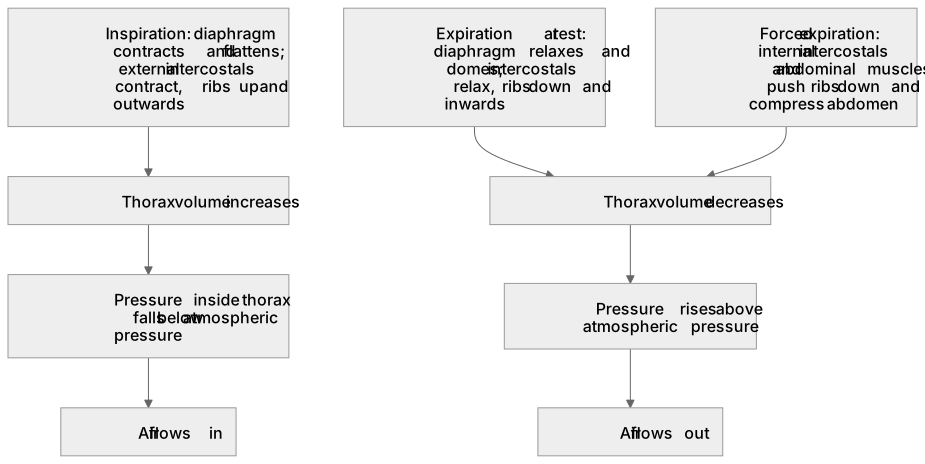
Ventilation moves air in and out of the lungs to maintain steep concentration gradients of oxygen and carbon dioxide at the alveoli. It works by pressure changes created by muscles altering the volume of the thorax. During inspiration, the diaphragm contracts and flattens while the external intercostal muscles contract, moving the ribs up and outwards. Thorax volume increases, pressure inside falls below atmospheric pressure, and air flows in. During expiration at rest, the diaphragm relaxes and domes upwards and the intercostals relax, so the ribs move down and inwards. Thorax volume decreases, pressure rises above atmospheric pressure, and air flows out. Forced expiration additionally uses the internal intercostal muscles and abdominal muscles to push the ribs down and compress the abdomen. Boyle's law links volume and pressure: as volume increases, pressure decreases.
What earns the marks
- Inspiration: diaphragm contracts and flattens; external intercostals contract, raising ribs up and outwards.
- Thorax volume increases, so pressure inside the thorax falls below atmospheric pressure and air enters.
- Expiration at rest: diaphragm relaxes and domes; intercostals relax, ribs move down and inwards.
- Thorax volume decreases, pressure rises above atmospheric pressure and air leaves.
- Forced expiration uses internal intercostals and abdominal muscles.
- Pressure changes drive airflow, consistent with Boyle's law (volume up, pressure down).
- Pleural membranes and fluid couple lung movement to thorax movement.
Common mistakes and how to put them right
Saying the lungs actively suck air in: the lungs are passive; muscles change thorax volume and pressure drives airflow. Correction: describe muscles and pressure changes.
Reversing the pressure relationship.
Put it right: State the direction of the pressure difference.
Confusing internal and external intercostals.
Put it right: Name each muscle with its action.
Forgetting that quiet expiration is largely passive.
Put it right: It results mainly from relaxation of muscles, not active contraction.
Exam tips
- Write ventilation answers as a chain: muscle action → volume change → pressure change → air movement.
- Always compare thoracic pressure with atmospheric pressure to explain airflow direction.
- Distinguish quiet breathing from forced breathing when describing expiration.
Try the lesson
The start of the Exchange surfaces: (d) the mechanism of ventilation in mammals lesson, made from checked teaching notes for this specification point.
Have a go first
During inhalation in a mammal, which action of the muscles directly increases the volume of the thorax?
Listen
Ventilation moves air in and out of the lungs to maintain steep concentration gradients of oxygen and carbon dioxide at the alveoli. It works by pressure changes created by muscles altering the volume of the thorax. During inspiration, the diaphragm contracts and flattens while the external intercostal muscles contract, moving the ribs up and outwards. Thorax volume increases, pressure inside falls below atmospheric pressure, and air flows in. During expiration at rest, the diaphragm relaxes and domes upwards and the intercostals relax, so the ribs move down and inwards. Thorax volume decreases, pressure rises above atmospheric pressure, and air flows out. Forced expiration additionally uses the internal intercostal muscles and abdominal muscles to push the ribs down and compress the abdomen. Boyle's law links volume and pressure: as volume increases, pressure decreases. A strong answer earns marks for these points. Inspiration: diaphragm contracts and flattens; external intercostals contract, raising ribs up and outwards. Thorax volume increases, so pressure inside the thorax falls below atmospheric pressure and air enters. Expiration at rest: diaphragm relaxes and domes; intercostals relax, ribs move down and inwards. Thorax volume decreases, pressure rises above atmospheric pressure and air leaves. A common slip: Saying the lungs actively suck air in: the lungs are passive; muscles change thorax volume and pressure drives airflow. Instead, describe muscles and pressure changes. Exam tip: Write ventilation answers as a chain: muscle action → volume change → pressure change → air movement.
See it
Key words
Say what each word means before you turn the card.
Mechanism of breathing
Try answering aloud or in your head before turning the card.
Pressure and volume relationships
Try answering aloud or in your head before turning the card.
Maintaining concentration gradients
Try answering aloud or in your head before turning the card.
Antagonistic muscle action
Try answering aloud or in your head before turning the card.
See every definition
- Mechanism of breathing
- Muscles alter the volume of the thorax, creating pressure changes that move air in and out of the lungs.
- Pressure and volume relationships
- Boyle's law links volume and pressure: as volume increases, pressure decreases.
- Maintaining concentration gradients
- Ventilation moves air in and out of the lungs to maintain steep concentration gradients of oxygen and carbon dioxide at the alveoli.
- Antagonistic muscle action
- External intercostals contract to raise the ribs in inspiration, while internal intercostals lower them in forced expiration.
Label the diagram
Some boxes have lost their names. Pick the right name for each number.
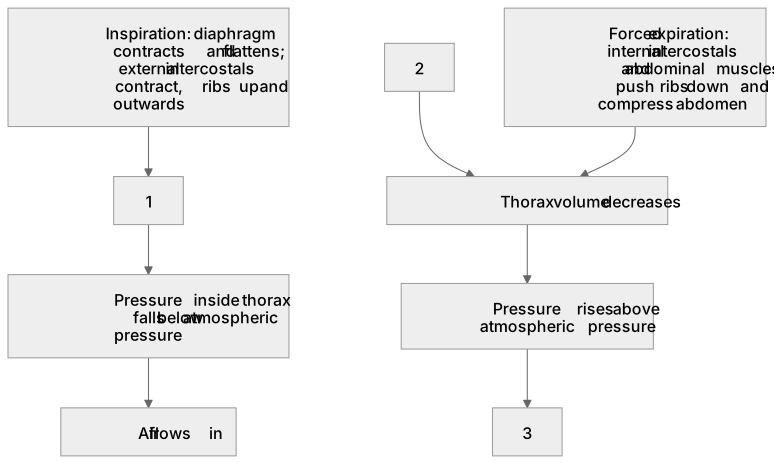
1Box 1
2Box 2
3Box 3
There is more to this lesson
The full lesson goes on to check your understanding and help you earn the marks. Create a free account to carry on, with your progress saved.
A week of Premium from your first lesson · Then the free plan continues · No card, no charge
Test your understanding of Exchange surfaces: (d) the mechanism of ventilation in mammals
Active recall beats re-reading. Take an instant quiz now to test what you’ve learned and lock it into long-term memory.
A week of Premium from your first lesson · Then the free plan continues · No card, no charge