OCR · A-Level · Biology
Course version: H420 · Version from Sept 2025
(e) the relationship between vital capacity, tidal volume, breathing rate…
Full specification wording
Exchange surfaces: (e) the relationship between vital capacity, tidal volume, breathing rate and oxygen uptake
Vital capacity is the maximum volume of air a person can forcibly exhale after a maximum inhalation, measured with a spirometer.
Checked against the OCR H420 specification (opens in a new tab) on .
- Point 5 of 7
- 4 key terms
Study notes
From the checked teaching notes for this specification point.
The idea
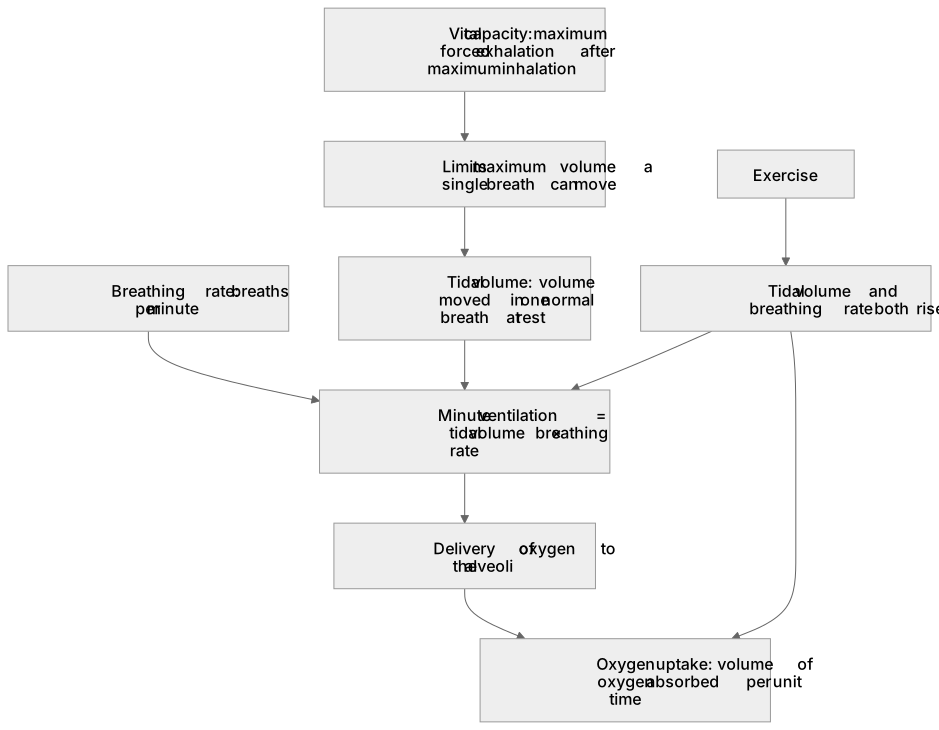
Vital capacity is the maximum volume of air a person can forcibly exhale after a maximum inhalation, measured with a spirometer. Tidal volume is the volume moved in or out during one normal breath at rest, typically about 0.5 dm³. Breathing rate is breaths per minute. Minute ventilation equals tidal volume multiplied by breathing rate, so a tidal volume of 0.5 dm³ at 12 breaths per minute gives 6 dm³ min⁻¹. Oxygen uptake is the volume of oxygen absorbed by the body per unit time, reflecting aerobic respiration demand. During exercise, tidal volume and breathing rate both rise, increasing minute ventilation and therefore the delivery of oxygen to the alveoli for uptake into the blood. Vital capacity sets the ceiling on how much a single forced breath can move, so it limits maximum achievable tidal volume.
What earns the marks
- Vital capacity is the maximum volume of air that can be forcibly exhaled after a maximum inhalation, measured by spirometer.
- Tidal volume is the volume of air moved into or out of the lungs in one normal breath at rest, roughly 0.5 dm³.
- Breathing rate is the number of breaths per minute; minute ventilation = tidal volume × breathing rate.
- Oxygen uptake is the volume of oxygen absorbed per unit time and rises with increased aerobic respiration demand.
- During exercise tidal volume and breathing rate increase, raising minute ventilation and oxygen delivery to alveoli.
- Vital capacity caps the maximum volume a single breath can move, so it limits maximum ventilation and hence maximum oxygen uptake.
Common mistakes and how to put them right
Confusing tidal volume with vital capacity.
Put it right: Tidal volume is one normal breath at rest, whereas vital capacity is the maximum forced exhalation after maximum inhalation.
Adding tidal volume and breathing rate instead of multiplying them.
Put it right: Minute ventilation is the product of tidal volume and breathing rate.
Assuming oxygen uptake equals minute ventilation.
Put it right: Only a fraction of inhaled air is oxygen, and uptake depends on diffusion and blood flow, not ventilation alone.
Exam tips
- Write the minute ventilation equation explicitly and substitute values with units before calculating.
- When comparing rest and exercise, state the direction of change in both tidal volume and breathing rate and link it to oxygen demand.
- Distinguish clearly between volume per breath (dm³) and volume per minute (dm³ min⁻¹) in your answers.
Try the lesson
The start of the Exchange surfaces: (e) the relationship between vital capacity, tidal volume, breathing rate and oxygen uptake lesson, made from checked teaching notes for this specification point.
Have a go first
A student at rest has a tidal volume of 0.5 dm³ and a breathing rate of 12 breaths per minute. What is the student's pulmonary ventilation rate?
Listen
Vital capacity is the maximum volume of air a person can forcibly exhale after a maximum inhalation, measured with a spirometer. Tidal volume is the volume moved in or out during one normal breath at rest, typically about 0.5 dm³. Breathing rate is breaths per minute. Minute ventilation equals tidal volume multiplied by breathing rate, so a tidal volume of 0.5 dm³ at 12 breaths per minute gives 6 dm³ min⁻¹. Oxygen uptake is the volume of oxygen absorbed by the body per unit time, reflecting aerobic respiration demand. During exercise, tidal volume and breathing rate both rise, increasing minute ventilation and therefore the delivery of oxygen to the alveoli for uptake into the blood. Vital capacity sets the ceiling on how much a single forced breath can move, so it limits maximum achievable tidal volume. A strong answer earns marks for these points. Vital capacity is the maximum volume of air that can be forcibly exhaled after a maximum inhalation, measured by spirometer. Tidal volume is the volume of air moved into or out of the lungs in one normal breath at rest, roughly 0.5 dm³. Breathing rate is the number of breaths per minute; minute ventilation = tidal volume × breathing rate. Oxygen uptake is the volume of oxygen absorbed per unit time and rises with increased aerobic respiration demand. Exam tip: Write the minute ventilation equation explicitly and substitute values with units before calculating.
See it
Key words
Say what each word means before you turn the card.
Vital capacity
Try answering aloud or in your head before turning the card.
Tidal volume
Try answering aloud or in your head before turning the card.
Breathing rate
Try answering aloud or in your head before turning the card.
Oxygen uptake
Try answering aloud or in your head before turning the card.
See every definition
- Vital capacity
- The maximum volume of air a person can forcibly exhale after a maximum inhalation, measured with a spirometer.
- Tidal volume
- The volume of air moved into or out of the lungs in one normal breath at rest, typically about 0.5 dm³.
- Breathing rate
- The number of breaths per minute.
- Oxygen uptake
- The volume of oxygen absorbed by the body per unit time, reflecting aerobic respiration demand.
Label the diagram
Some boxes have lost their names. Pick the right name for each number.
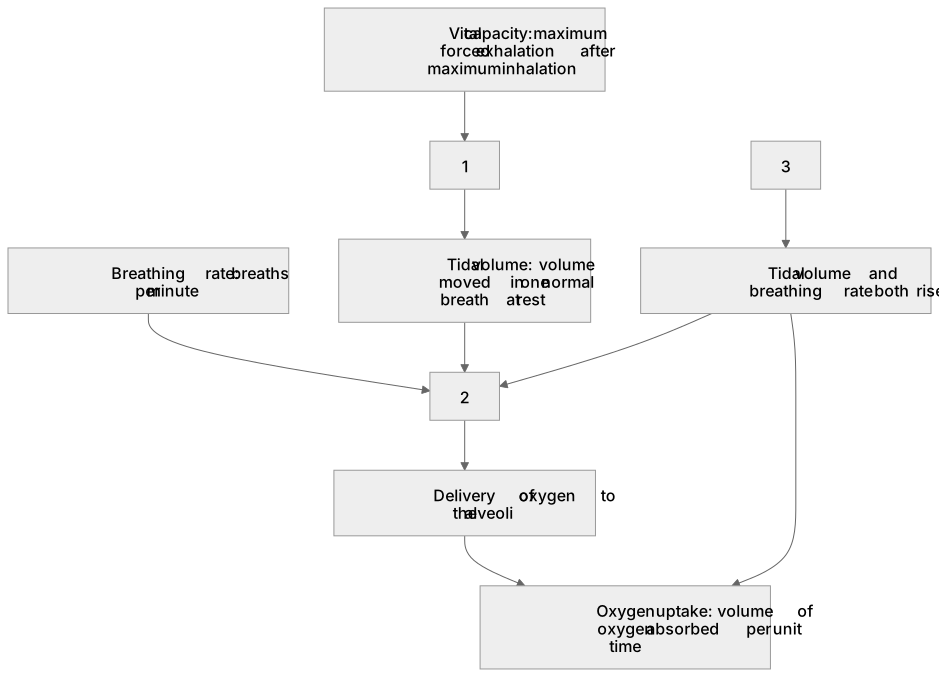
1Box 1
2Box 2
3Box 3
There is more to this lesson
The full lesson goes on to check your understanding and help you earn the marks. Create a free account to carry on, with your progress saved.
A week of Premium from your first lesson · Then the free plan continues · No card, no charge
Test your understanding of Exchange surfaces: (e) the relationship between vital capacity, tidal volume, breathing rate and oxygen uptake
Active recall beats re-reading. Take an instant quiz now to test what you’ve learned and lock it into long-term memory.
A week of Premium from your first lesson · Then the free plan continues · No card, no charge