OCR · A-Level · Biology
Course version: H420 · Version from Sept 2025
(f) the mechanisms of ventilation and gas exchange in bony fish and insects
Full specification wording
Exchange surfaces: (f) the mechanisms of ventilation and gas exchange in bony fish and insects
Bony fish ventilate gills by a buccal-opercular pump: the mouth (buccal cavity) opens and the operculum closes while the floor of the mouth lowers, drawing water in; then the mouth closes and the…
Checked against the OCR H420 specification (opens in a new tab) on .
- Point 6 of 7
- 3 key terms
Study notes
From the checked teaching notes for this specification point.
The idea
Bony fish ventilate gills by a buccal-opercular pump: the mouth (buccal cavity) opens and the operculum closes while the floor of the mouth lowers, drawing water in; then the mouth closes and the operculum opens while the buccal floor rises, forcing water across the gill filaments. Gas exchange occurs across gill lamellae, which have a large surface area, thin epithelium and a rich blood supply. A counter-current flow of water and blood across the lamellae maintains a concentration gradient along the whole length, maximising oxygen diffusion. Insects ventilate tracheae through spiracles along the abdomen and thorax; air moves in and out by diffusion and by abdominal pumping movements that change pressure. Tracheae branch into tracheoles with thin walls and fluid-filled tips that deliver oxygen directly to respiring tissues, so insects lack a circulatory carrier for oxygen.
What earns the marks
- Bony fish use a buccal-opercular pump: lowering the buccal floor with the operculum closed draws water in, then raising it with the operculum open forces water over the gills.
- Gill lamellae provide a large surface area, thin epithelium and rich blood supply for efficient gas exchange.
- Counter-current flow of water and blood across lamellae maintains a diffusion gradient along the whole gill, maximising oxygen uptake.
- Insects ventilate via spiracles and tracheae; abdominal pumping movements and diffusion move air through the tracheal system.
- Tracheoles have thin walls and fluid-filled tips delivering oxygen directly to tissues, so no respiratory pigment is needed for transport.
- Spiracles can close to reduce water loss, and the tracheal system delivers oxygen directly without a circulatory carrier.
Common mistakes and how to put them right
Describing fish gills as having parallel (concurrent) flow of water and blood.
Put it right: The flow is counter-current, which maintains the gradient along the whole lamella.
Stating that insects use blood to transport oxygen.
Put it right: Oxygen travels through tracheae and tracheoles directly to tissues.
Saying water is forced over the gills by the operculum alone.
Put it right: Both the buccal cavity floor and the operculum act together in the buccal-opercular pump.
Exam tips
- For fish, describe the sequence of mouth and operculum movements in order, naming the buccal-opercular pump.
- For counter-current exchange, explain why a gradient is maintained along the whole lamella rather than only at one end.
- For insects, link each tracheal feature (spiracles, tracheae, tracheoles) to its function in ventilation or gas exchange.
Try the lesson
The start of the Exchange surfaces: (f) the mechanisms of ventilation and gas exchange in bony fish and insects lesson, made from checked teaching notes for this specification point.
Have a go first
In a bony fish, what is the main role of the operculum during ventilation?
Listen
Bony fish ventilate gills by a buccal-opercular pump: the mouth (buccal cavity) opens and the operculum closes while the floor of the mouth lowers, drawing water in; then the mouth closes and the operculum opens while the buccal floor rises, forcing water across the gill filaments. Gas exchange occurs across gill lamellae, which have a large surface area, thin epithelium and a rich blood supply. A counter-current flow of water and blood across the lamellae maintains a concentration gradient along the whole length, maximising oxygen diffusion. Insects ventilate tracheae through spiracles along the abdomen and thorax; air moves in and out by diffusion and by abdominal pumping movements that change pressure. Tracheae branch into tracheoles with thin walls and fluid-filled tips that deliver oxygen directly to respiring tissues, so insects lack a circulatory carrier for oxygen. A strong answer earns marks for these points. Bony fish use a buccal-opercular pump: lowering the buccal floor with the operculum closed draws water in, then raising it with the operculum open forces water over the gills. Gill lamellae provide a large surface area, thin epithelium and rich blood supply for efficient gas exchange. Counter-current flow of water and blood across lamellae maintains a diffusion gradient along the whole gill, maximising oxygen uptake. Insects ventilate via spiracles and tracheae; abdominal pumping movements and diffusion move air through the tracheal system. Exam tip: For fish, describe the sequence of mouth and operculum movements in order, naming the buccal-opercular pump.
See it
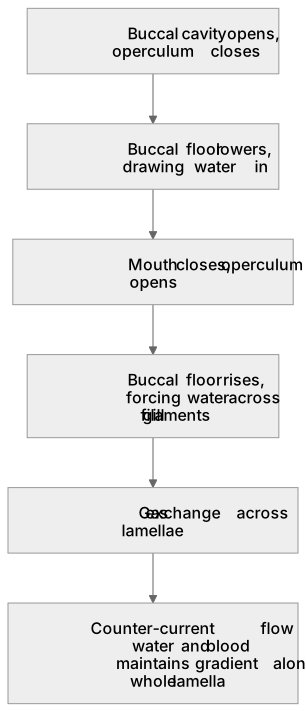
Put it in order
Put these steps in the order they happen.
- 1. Mouth closes, operculum opens
- 2. Buccal floor lowers, drawing water in
- 3. Buccal cavity opens, operculum closes
- 4. Counter-current flow of water and blood maintains gradient along whole lamella
- 5. Gas exchange across gill lamellae
- 6. Buccal floor rises, forcing water across gill filaments
Key words
Say what each word means before you turn the card.
Counter-current gas exchange in gills
Try answering aloud or in your head before turning the card.
Tracheal system ventilation in insects
Try answering aloud or in your head before turning the card.
Adaptations of exchange surfaces
Try answering aloud or in your head before turning the card.
See every definition
- Counter-current gas exchange in gills
- A flow of water and blood across the lamellae in opposite directions that maintains a concentration gradient along the whole length, maximising oxygen diffusion.
- Tracheal system ventilation in insects
- Air moves in and out of tracheae through spiracles along the abdomen and thorax by diffusion and by abdominal pumping movements that change pressure.
- Adaptations of exchange surfaces
- Gill lamellae have a large surface area, thin epithelium and a rich blood supply; tracheoles have thin walls and fluid-filled tips that deliver oxygen directly to respiring tissues.
Label the diagram
Some boxes have lost their names. Pick the right name for each number.
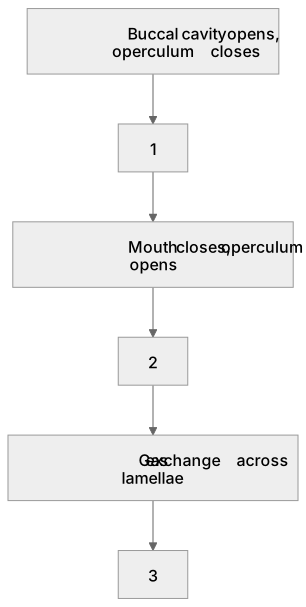
1Box 1
2Box 2
3Box 3
There is more to this lesson
The full lesson goes on to check your understanding and help you earn the marks. Create a free account to carry on, with your progress saved.
A week of Premium from your first lesson · Then the free plan continues · No card, no charge
Test your understanding of Exchange surfaces: (f) the mechanisms of ventilation and gas exchange in bony fish and insects
Active recall beats re-reading. Take an instant quiz now to test what you’ve learned and lock it into long-term memory.
A week of Premium from your first lesson · Then the free plan continues · No card, no charge