OCR · A-Level · Biology
Course version: H420 · Version from Sept 2025
Hormonal communication: (c) (i) the histology of the pancreas
The pancreas is a mixed gland: most of its volume is exocrine tissue, arranged as acini of enzyme-secreting cells draining into ducts, while small clusters of endocrine cells, the islets of…
Checked against the OCR H420 specification (opens in a new tab) on .
- Point 3 of 6
- 4 key terms
Study notes
From the checked teaching notes for this specification point.
The idea
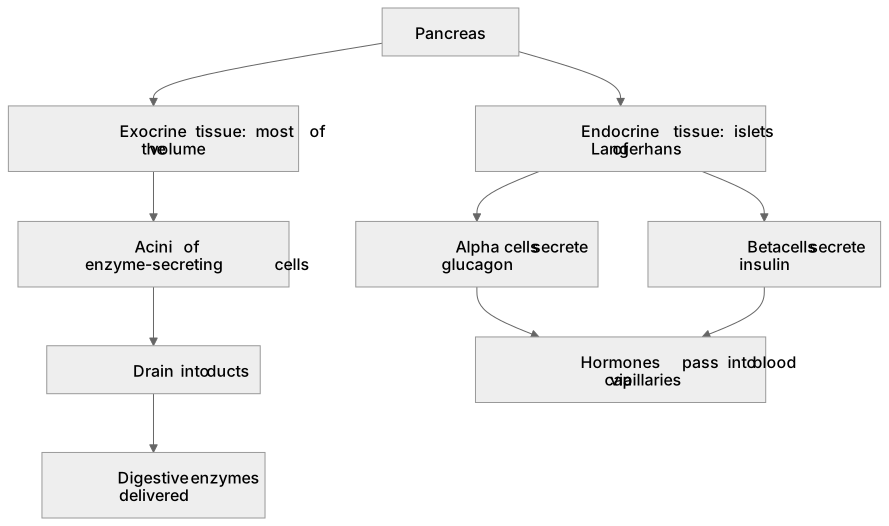
The pancreas is a mixed gland: most of its volume is exocrine tissue, arranged as acini of enzyme-secreting cells draining into ducts, while small clusters of endocrine cells, the islets of Langerhans, sit scattered among the acini. In an islet, alpha cells secrete glucagon and beta cells secrete insulin; these hormones pass straight into the blood, so islet cells lie close to capillaries rather than to ducts. Histology questions ask you to recognise these tissues in a stained section and to link structure to function. Acinar cells appear as groups with dark basal nuclei and granular apical cytoplasm; islet cells form paler, rounded groups with a rich capillary network. Distinguish exocrine from endocrine by the presence or absence of ducts and by the direction of secretion.
What earns the marks
- Exocrine tissue dominates the pancreas and consists of acini of enzyme-secreting cells that drain into ducts.
- Endocrine tissue is organised as islets of Langerhans scattered among the exocrine acini.
- Alpha cells of the islets secrete glucagon and beta cells secrete insulin.
- Islet cells secrete hormones directly into the blood via a close capillary network, not into ducts.
- Acinar cells show dark basal nuclei and granular apical cytoplasm, whereas islet cells form paler rounded clusters.
- Structure links to function: ducted acini deliver digestive enzymes, ductless islets deliver hormones to the bloodstream.
Common mistakes and how to put them right
Assuming the pancreas is purely endocrine.
Put it right by noting that exocrine acinar tissue makes up most of the gland and the islets are small scattered clusters.
Confusing which islet cell secretes which hormone.
Put it right by stating that alpha cells secrete glucagon and beta cells secrete insulin.
Claiming islet hormones travel through ducts.
Put it right by explaining that endocrine cells release hormones into capillaries, while only exocrine acini use ducts.
Exam tips
- Read the whole stem before choosing: identify whether the question asks about exocrine or endocrine tissue, then match the option to that tissue.
- Eliminate options that mix up alpha and beta cell secretions or that send hormones down ducts.
- When an image is shown, locate the paler rounded islet clusters among the darker acini before selecting your answer.
Try the lesson
The start of the Hormonal communication: (c) (i) the histology of the pancreas lesson, made from checked teaching notes for this specification point.
Have a go first
Which cells of the pancreatic islets secrete glucagon?
Listen
The pancreas is a mixed gland: most of its volume is exocrine tissue, arranged as acini of enzyme-secreting cells draining into ducts, while small clusters of endocrine cells, the islets of Langerhans, sit scattered among the acini. In an islet, alpha cells secrete glucagon and beta cells secrete insulin; these hormones pass straight into the blood, so islet cells lie close to capillaries rather than to ducts. Histology questions ask you to recognise these tissues in a stained section and to link structure to function. Acinar cells appear as groups with dark basal nuclei and granular apical cytoplasm; islet cells form paler, rounded groups with a rich capillary network. Distinguish exocrine from endocrine by the presence or absence of ducts and by the direction of secretion. A strong answer earns marks for these points. Exocrine tissue dominates the pancreas and consists of acini of enzyme-secreting cells that drain into ducts. Endocrine tissue is organised as islets of Langerhans scattered among the exocrine acini. Alpha cells of the islets secrete glucagon and beta cells secrete insulin. Islet cells secrete hormones directly into the blood via a close capillary network, not into ducts. A common slip: Assuming the pancreas is purely endocrine. Instead, noting that exocrine acinar tissue makes up most of the gland and the islets are small scattered clusters. Exam tip: Read the whole stem before choosing: identify whether the question asks about exocrine or endocrine tissue, then match the option to that tissue.
See it
Key words
Say what each word means before you turn the card.
Exocrine versus endocrine organisation of the pancreas
Try answering aloud or in your head before turning the card.
Islets of Langerhans and their cell types
Try answering aloud or in your head before turning the card.
Hormone secretion into the blood
Try answering aloud or in your head before turning the card.
Relating stained structure to function
Try answering aloud or in your head before turning the card.
See every definition
- Exocrine versus endocrine organisation of the pancreas
- Most of the gland is exocrine tissue arranged as acini of enzyme-secreting cells draining into ducts, while small clusters of endocrine cells, the islets of Langerhans, sit scattered among the acini.
- Islets of Langerhans and their cell types
- Small clusters of endocrine cells scattered among the acini, in which alpha cells secrete glucagon and beta cells secrete insulin.
- Hormone secretion into the blood
- Islet cells pass their hormones straight into the blood, so they lie close to capillaries rather than to ducts.
- Relating stained structure to function
- Acinar cells appear as groups with dark basal nuclei and granular apical cytoplasm, whereas islet cells form paler, rounded groups with a rich capillary network.
Label the diagram
Some boxes have lost their names. Pick the right name for each number.
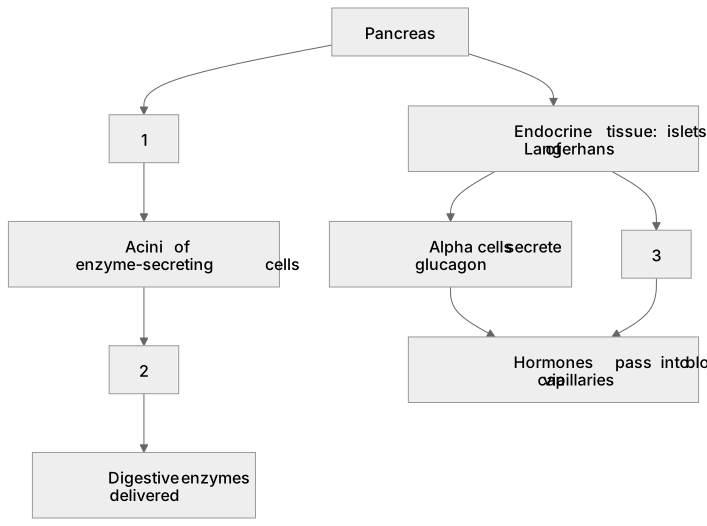
1Box 1
2Box 2
3Box 3
There is more to this lesson
The full lesson goes on to check your understanding and help you earn the marks. Create a free account to carry on, with your progress saved.
A week of Premium from your first lesson · Then the free plan continues · No card, no charge
Test your understanding of Hormonal communication: (c) (i) the histology of the pancreas
Active recall beats re-reading. Take an instant quiz now to test what you’ve learned and lock it into long-term memory.
A week of Premium from your first lesson · Then the free plan continues · No card, no charge