OCR · A-Level · Biology
Course version: H420 · Version from Sept 2025
(c) the reasons for, and differences between, conservation and preservation
Full specification wording
Populations and sustainability: (c) the reasons for, and differences between, conservation and preservation
Conservation and preservation are both ways of protecting ecosystems but differ in intent.
Checked against the OCR H420 specification (opens in a new tab) on .
- Point 3 of 5
- 4 key terms
Study notes
From the checked teaching notes for this specification point.
The idea
Conservation and preservation are both ways of protecting ecosystems but differ in intent. Conservation is the active, sustainable management of a resource so humans can keep using it: for example, rotational coppicing of woodland maintains habitat while yielding timber, and controlled fishing quotas keep a stock harvestable. Preservation is protection with minimal human interference, keeping an area in its existing state: for example, a nature reserve closed to logging and replanting. The reasons include maintaining biodiversity, protecting ecosystem services such as flood control and carbon storage, safeguarding genetic resources and meeting ethical or legal duties. Learners should classify a management example as conservation or preservation and justify the choice by whether sustainable use is intended.
What earns the marks
- Defines conservation as active, sustainable management allowing continued human use of a resource.
- Defines preservation as protection with minimal human interference, keeping an area in its existing state.
- Distinguishes the two by intent: conservation permits sustainable exploitation, whereas preservation excludes it.
- Gives reasons such as maintaining biodiversity, protecting ecosystem services, safeguarding genetic resources and ethical or legal duty.
- Classifies a given example, such as coppicing or a closed reserve, and justifies the classification.
Common mistakes and how to put them right
Treating conservation and preservation as synonyms.
Put it right by contrasting sustainable use with minimal interference.
Assuming preservation means doing nothing at all.
Put it right by noting that protection may still require excluding damaging activity.
Listing only 'saving animals' as a reason.
Put it right by including biodiversity, ecosystem services and ethical or legal reasons.
Exam tips
- Anchor each definition to the key distinction: sustainable use versus minimal human interference.
- When classifying an example, state the intended use and then name the approach.
- Give at least two distinct reasons rather than repeating biodiversity in different words.
Try the lesson
The start of the Populations and sustainability: (c) the reasons for, and differences between, conservation and preservation lesson, made from checked teaching notes for this specification point.
Have a go first
A wildlife trust manages a meadow by grazing it with cattle each year to maintain a rich diversity of wild flowers. Which term best describes this approach?
Listen
Conservation and preservation are both ways of protecting ecosystems but differ in intent. Conservation is the active, sustainable management of a resource so humans can keep using it: for example, rotational coppicing of woodland maintains habitat while yielding timber, and controlled fishing quotas keep a stock harvestable. Preservation is protection with minimal human interference, keeping an area in its existing state: for example, a nature reserve closed to logging and replanting. The reasons include maintaining biodiversity, protecting ecosystem services such as flood control and carbon storage, safeguarding genetic resources and meeting ethical or legal duties. Learners should classify a management example as conservation or preservation and justify the choice by whether sustainable use is intended. A strong answer earns marks for these points. Defines conservation as active, sustainable management allowing continued human use of a resource. Defines preservation as protection with minimal human interference, keeping an area in its existing state. Distinguishes the two by intent: conservation permits sustainable exploitation, whereas preservation excludes it. Gives reasons such as maintaining biodiversity, protecting ecosystem services, safeguarding genetic resources and ethical or legal duty. A common slip: Treating conservation and preservation as synonyms. Instead, contrasting sustainable use with minimal interference. Exam tip: Anchor each definition to the key distinction: sustainable use versus minimal human interference.
See it
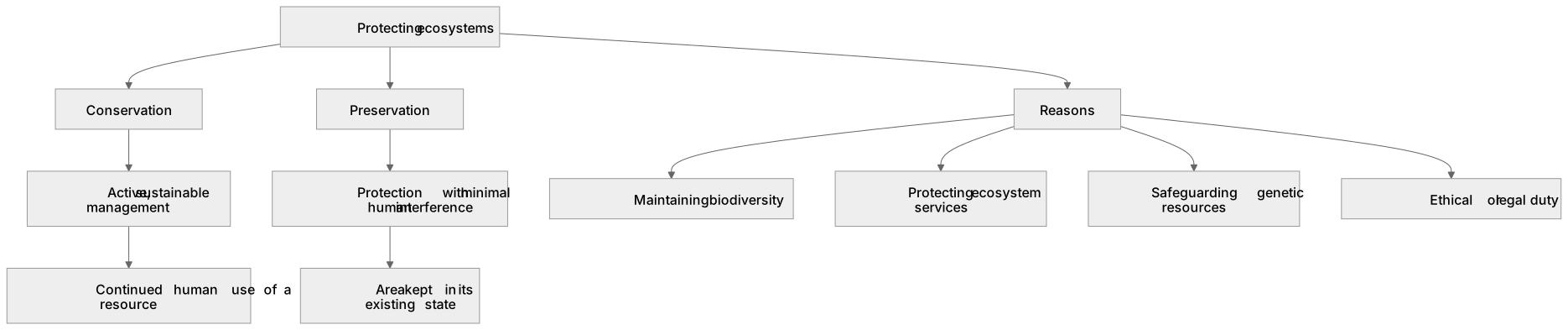
Key words
Say what each word means before you turn the card.
Conservation
Try answering aloud or in your head before turning the card.
Preservation
Try answering aloud or in your head before turning the card.
Reasons for protection
Try answering aloud or in your head before turning the card.
Classifying management examples
Try answering aloud or in your head before turning the card.
See every definition
- Conservation
- Active, sustainable management of a resource so humans can keep using it.
- Preservation
- Protection with minimal human interference, keeping an area in its existing state.
- Reasons for protection
- Maintaining biodiversity, protecting ecosystem services such as flood control and carbon storage, safeguarding genetic resources and meeting ethical or legal duties.
- Classifying management examples
- Deciding whether a management example is conservation or preservation and justifying the choice by whether sustainable use is intended.
Label the diagram
Some boxes have lost their names. Pick the right name for each number.
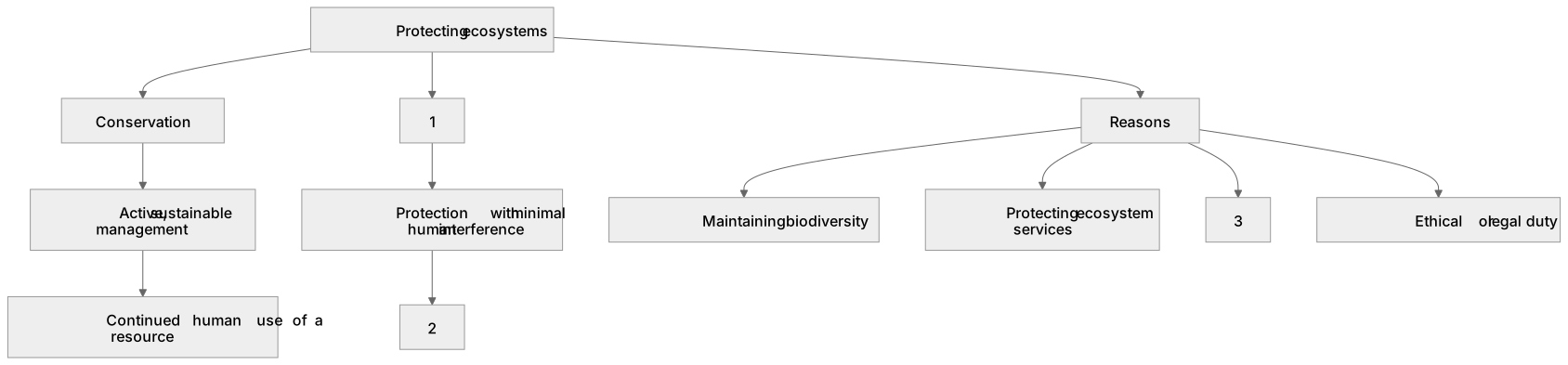
1Box 1
2Box 2
3Box 3
There is more to this lesson
The full lesson goes on to check your understanding and help you earn the marks. Create a free account to carry on, with your progress saved.
A week of Premium from your first lesson · Then the free plan continues · No card, no charge
Test your understanding of Populations and sustainability: (c) the reasons for, and differences between, conservation and preservation
Active recall beats re-reading. Take an instant quiz now to test what you’ve learned and lock it into long-term memory.
A week of Premium from your first lesson · Then the free plan continues · No card, no charge