OCR · A-Level · Biology
Course version: H420 · Version from Sept 2025
(ii) practical investigations into respiration rates in yeast, under…
Full specification wording
Respiration: (ii) practical investigations into respiration rates in yeast, under aerobic and anaerobic conditions
Respiration rate in yeast can be measured by the rate of carbon dioxide production or by the rate of oxygen uptake.
Checked against the OCR H420 specification (opens in a new tab) on .
- Point 10 of 13
- 4 key terms
Study notes
From the checked teaching notes for this specification point.
The idea
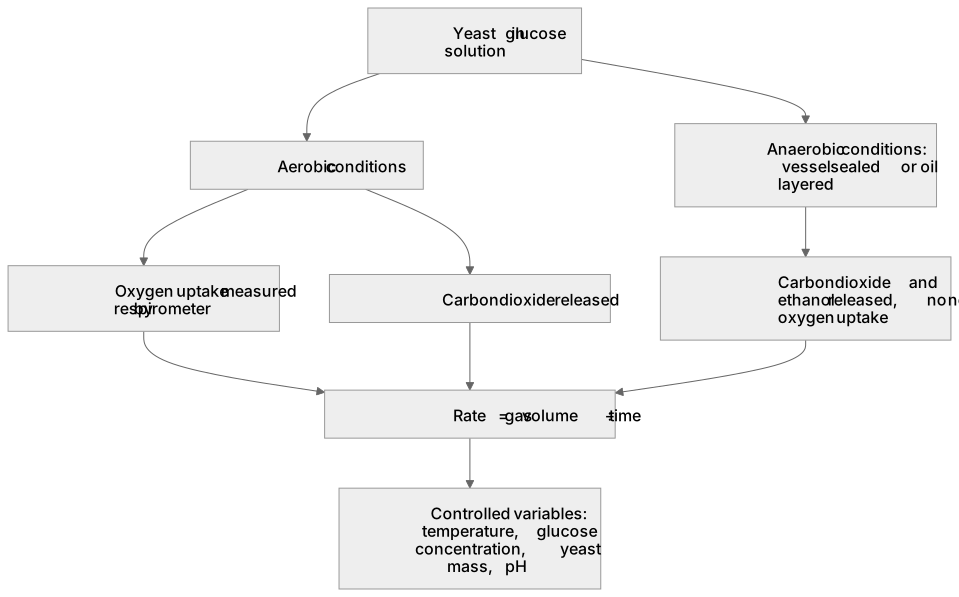
Respiration rate in yeast can be measured by the rate of carbon dioxide production or by the rate of oxygen uptake. Under aerobic conditions yeast respires aerobically, taking up oxygen and releasing carbon dioxide; under anaerobic conditions it ferments, releasing carbon dioxide and ethanol without net oxygen uptake. A common method suspends yeast in a glucose solution and collects gas in a syringe or gas jar, or uses a respirometer to measure oxygen uptake; a dye such as hydrogencarbonate indicator or limewater can detect carbon dioxide. Anaerobic conditions are created by sealing the vessel or layering oil over the culture. Rate is calculated by dividing the volume of gas evolved or taken up by the time taken, and controlled variables include temperature, glucose concentration, yeast mass and pH.
What earns the marks
- Respiration rate can be measured as the rate of carbon dioxide production or the rate of oxygen uptake over a measured time.
- A respirometer measures oxygen uptake, whereas gas collection or an indicator measures carbon dioxide release.
- Anaerobic conditions are produced by sealing the vessel or covering the culture with a layer of oil.
- Rate is calculated by dividing the gas volume by the time, and controlled variables include temperature, glucose concentration, yeast mass and pH.
- A water bath keeps temperature constant because respiration is enzyme-controlled, and repeats plus a control improve reliability.
Common mistakes and how to put them right
Measuring only carbon dioxide and assuming it proves aerobic respiration.
Put it right: Carbon dioxide is released in both aerobic and anaerobic respiration, so oxygen uptake must be measured to show aerobic activity.
Failing to control temperature.
Put it right: Temperature affects enzyme activity, so a water bath must keep it constant.
Forgetting to seal the vessel for anaerobic conditions.
Put it right: Oxygen must be excluded, for example by sealing or layering oil.
Recording a single reading.
Put it right: Repeats and a control are needed to improve reliability.
Exam tips
- State clearly what is measured (gas volume) and how rate is calculated (volume ÷ time).
- Identify the independent, dependent and controlled variables explicitly.
- Explain how anaerobic conditions are achieved and how a control is set up.
Try the lesson
The start of the Respiration: (ii) practical investigations into respiration rates in yeast, under aerobic and anaerobic conditions lesson, made from checked teaching notes for this specification point.
Have a go first
Which piece of apparatus is most suitable for measuring the volume of gas produced by respiring yeast over time?
Listen
Respiration rate in yeast can be measured by the rate of carbon dioxide production or by the rate of oxygen uptake. Under aerobic conditions yeast respires aerobically, taking up oxygen and releasing carbon dioxide; under anaerobic conditions it ferments, releasing carbon dioxide and ethanol without net oxygen uptake. A common method suspends yeast in a glucose solution and collects gas in a syringe or gas jar, or uses a respirometer to measure oxygen uptake; a dye such as hydrogencarbonate indicator or limewater can detect carbon dioxide. Anaerobic conditions are created by sealing the vessel or layering oil over the culture. Rate is calculated by dividing the volume of gas evolved or taken up by the time taken, and controlled variables include temperature, glucose concentration, yeast mass and pH. A strong answer earns marks for these points. Respiration rate can be measured as the rate of carbon dioxide production or the rate of oxygen uptake over a measured time. A respirometer measures oxygen uptake, whereas gas collection or an indicator measures carbon dioxide release. Anaerobic conditions are produced by sealing the vessel or covering the culture with a layer of oil. Rate is calculated by dividing the gas volume by the time, and controlled variables include temperature, glucose concentration, yeast mass and pH. A common slip: Measuring only carbon dioxide and assuming it proves aerobic respiration. Instead, carbon dioxide is released in both aerobic and anaerobic respiration, so oxygen uptake must be measured to show aerobic activity. Exam tip: State clearly what is measured (gas volume) and how rate is calculated (volume ÷ time).
See it
Key words
Say what each word means before you turn the card.
Respiration rate
Try answering aloud or in your head before turning the card.
Anaerobic conditions
Try answering aloud or in your head before turning the card.
Respirometer
Try answering aloud or in your head before turning the card.
Controlled variables
Try answering aloud or in your head before turning the card.
See every definition
- Respiration rate
- Calculated by dividing the volume of gas evolved or taken up by the time taken.
- Anaerobic conditions
- Created by sealing the vessel or layering oil over the culture, so that oxygen is excluded.
- Respirometer
- Used to measure oxygen uptake, whereas gas collection or an indicator measures carbon dioxide release.
- Controlled variables
- Include temperature, glucose concentration, yeast mass and pH, with a water bath keeping temperature constant because respiration is enzyme-controlled.
Label the diagram
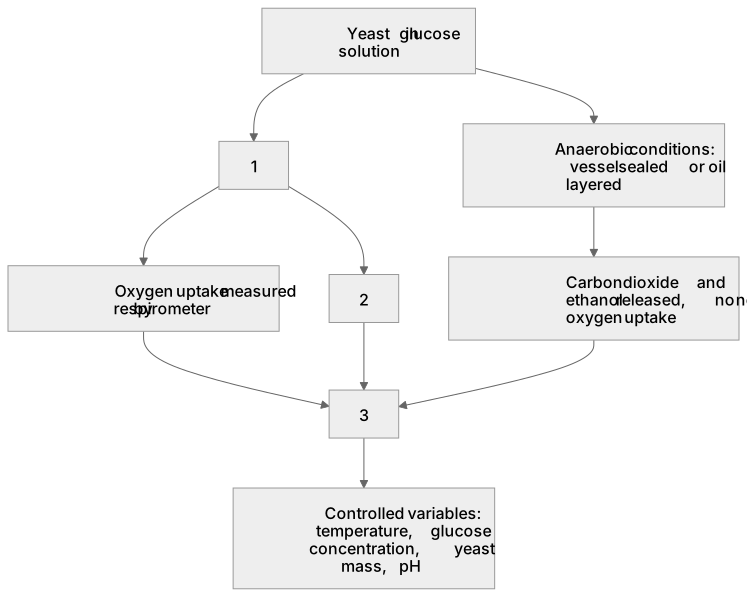
Some boxes have lost their names. Pick the right name for each number.
1Box 1
2Box 2
3Box 3
There is more to this lesson
The full lesson goes on to check your understanding and help you earn the marks. Create a free account to carry on, with your progress saved.
A week of Premium from your first lesson · Then the free plan continues · No card, no charge
Test your understanding of Respiration: (ii) practical investigations into respiration rates in yeast, under aerobic and anaerobic conditions
Active recall beats re-reading. Take an instant quiz now to test what you’ve learned and lock it into long-term memory.
A week of Premium from your first lesson · Then the free plan continues · No card, no charge