OCR · A-Level · Biology
Course version: H420 · Version from Sept 2025
(a) the need for transport systems in multicellular animals
Full specification wording
Transport in animals: (a) the need for transport systems in multicellular animals
Multicellular animals have a small surface area to volume ratio, so diffusion across the body surface alone cannot supply enough oxygen and nutrients to every cell or remove enough carbon dioxide…
Checked against the OCR H420 specification (opens in a new tab) on .
- Point 1 of 10
Study notes
From the checked teaching notes for this specification point.
The idea
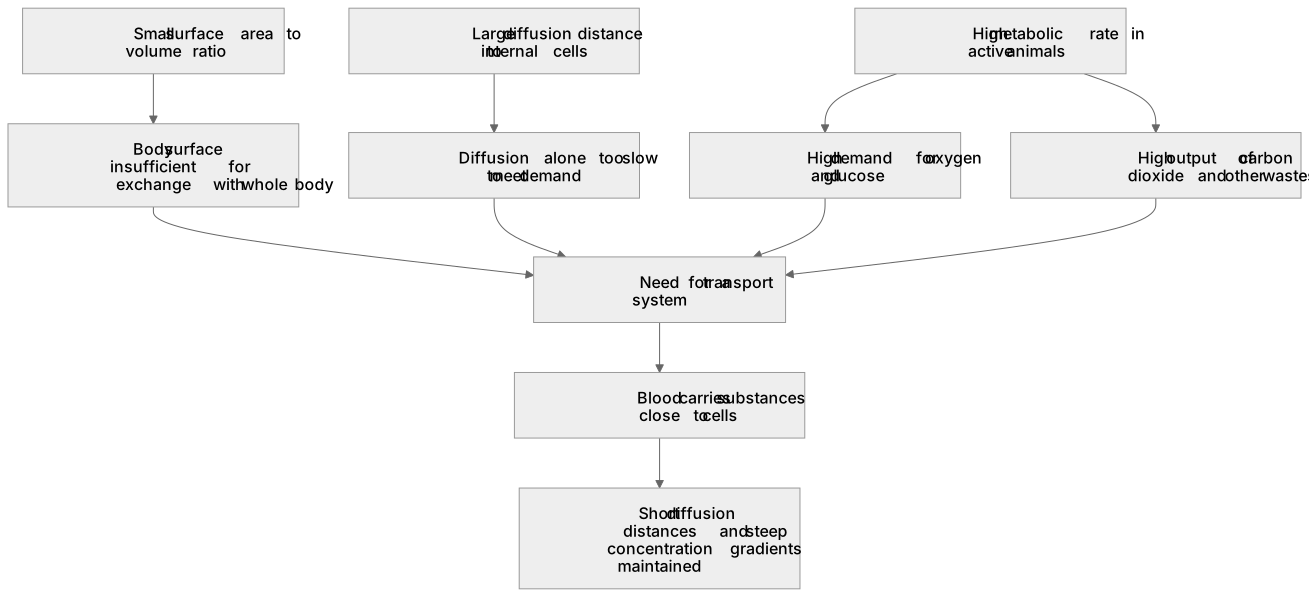
Multicellular animals have a small surface area to volume ratio, so diffusion across the body surface alone cannot supply enough oxygen and nutrients to every cell or remove enough carbon dioxide and other wastes quickly enough. Diffusion distance from the surface to deep tissues is large, and metabolic demand is high because many cells respire actively. A transport system, typically blood circulated by a heart through vessels, carries substances close to every cell so that short diffusion distances remain at exchange surfaces. Learners should be able to explain why large, active animals need a circulatory system, linking surface area to volume ratio, diffusion distance, metabolic rate and the need to maintain concentration gradients, and to apply this reasoning to unfamiliar organisms.
What earns the marks
- Multicellular animals have a small surface area to volume ratio, so the body surface is insufficient for exchange with the whole body.
- Diffusion distance from the body surface to internal cells is too great for effective diffusion alone.
- Active multicellular animals have high metabolic rates and therefore high demand for oxygen and glucose and high output of carbon dioxide and other wastes.
- A transport system carries substances in blood close to cells, keeping diffusion distances short and maintaining steep concentration gradients at exchange surfaces.
- Without a transport system, substances would not reach or leave deep tissues fast enough to sustain metabolism.
Common mistakes and how to put them right
Thinking that large animals have a large surface area to volume ratio.
Put it right: The ratio is small, which is the problem, so correct this by stating that volume increases faster than surface area.
Assuming diffusion stops entirely in large animals.
Put it right: Diffusion still occurs, but over the distances involved it is too slow to meet demand, so correct by describing it as insufficient rather than absent.
Confusing the need for transport with the need for a respiratory surface.
Put it right: The transport system moves substances around the body, while gas exchange surfaces such as lungs or gills are separate, so keep the two ideas distinct.
Exam tips
- Always link the answer to surface area to volume ratio, diffusion distance and metabolic demand rather than saying only that the animal is big.
- Use the phrase 'maintains a steep concentration gradient' to show why transport helps exchange surfaces keep working.
- Apply the reasoning to the organism named in the question, for example a large active mammal, rather than giving a generic statement.
Try the lesson
The start of the Transport in animals: (a) the need for transport systems in multicellular animals lesson, made from checked teaching notes for this specification point.
Have a go first
Which of the following is a direct consequence of a low surface area to volume ratio in a large animal?
Listen
Multicellular animals have a small surface area to volume ratio, so diffusion across the body surface alone cannot supply enough oxygen and nutrients to every cell or remove enough carbon dioxide and other wastes quickly enough. Diffusion distance from the surface to deep tissues is large, and metabolic demand is high because many cells respire actively. A transport system, typically blood circulated by a heart through vessels, carries substances close to every cell so that short diffusion distances remain at exchange surfaces. Learners should be able to explain why large, active animals need a circulatory system, linking surface area to volume ratio, diffusion distance, metabolic rate and the need to maintain concentration gradients, and to apply this reasoning to unfamiliar organisms. A strong answer earns marks for these points. Multicellular animals have a small surface area to volume ratio, so the body surface is insufficient for exchange with the whole body. Diffusion distance from the body surface to internal cells is too great for effective diffusion alone. Active multicellular animals have high metabolic rates and therefore high demand for oxygen and glucose and high output of carbon dioxide and other wastes. A transport system carries substances in blood close to cells, keeping diffusion distances short and maintaining steep concentration gradients at exchange surfaces. Exam tip: Always link the answer to surface area to volume ratio, diffusion distance and metabolic demand rather than saying only that the animal is big.
See it
Label the diagram
Some boxes have lost their names. Pick the right name for each number.
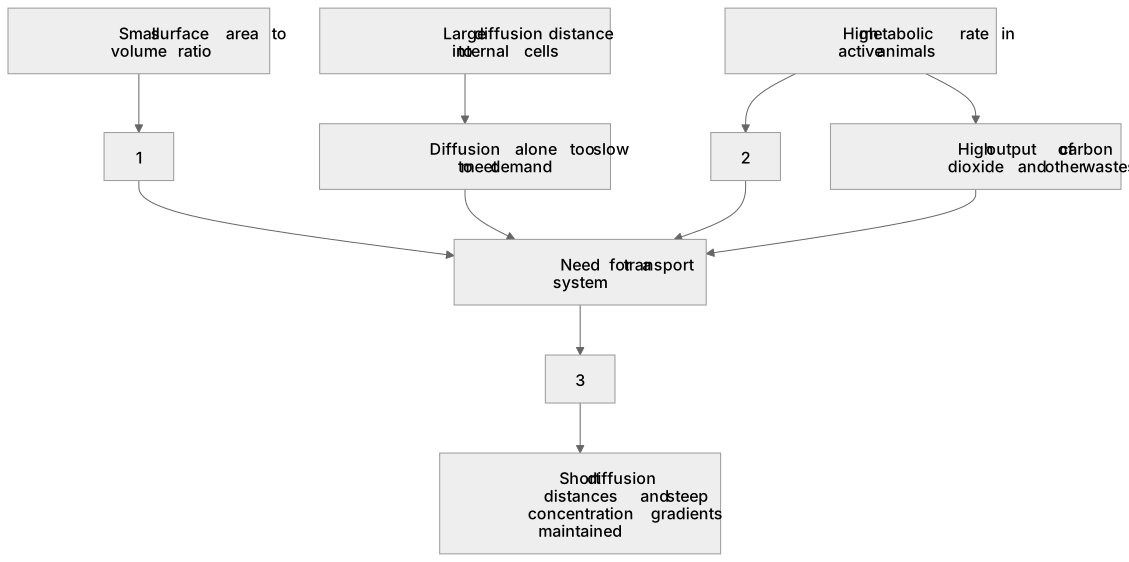
1Box 1
2Box 2
3Box 3
There is more to this lesson
The full lesson goes on to check your understanding and help you earn the marks. Create a free account to carry on, with your progress saved.
A week of Premium from your first lesson · Then the free plan continues · No card, no charge
Test your understanding of Transport in animals: (a) the need for transport systems in multicellular animals
Active recall beats re-reading. Take an instant quiz now to test what you’ve learned and lock it into long-term memory.
A week of Premium from your first lesson · Then the free plan continues · No card, no charge