OCR · A-Level · Biology
Course version: H420 · Version from Sept 2025
Transport in animals: (b) the different types of circulatory systems
Circulatory systems can be classified by whether blood stays within vessels and by how many circuits exist.
Checked against the OCR H420 specification (opens in a new tab) on .
- Point 2 of 10
- 4 key terms
Study notes
From the checked teaching notes for this specification point.
The idea
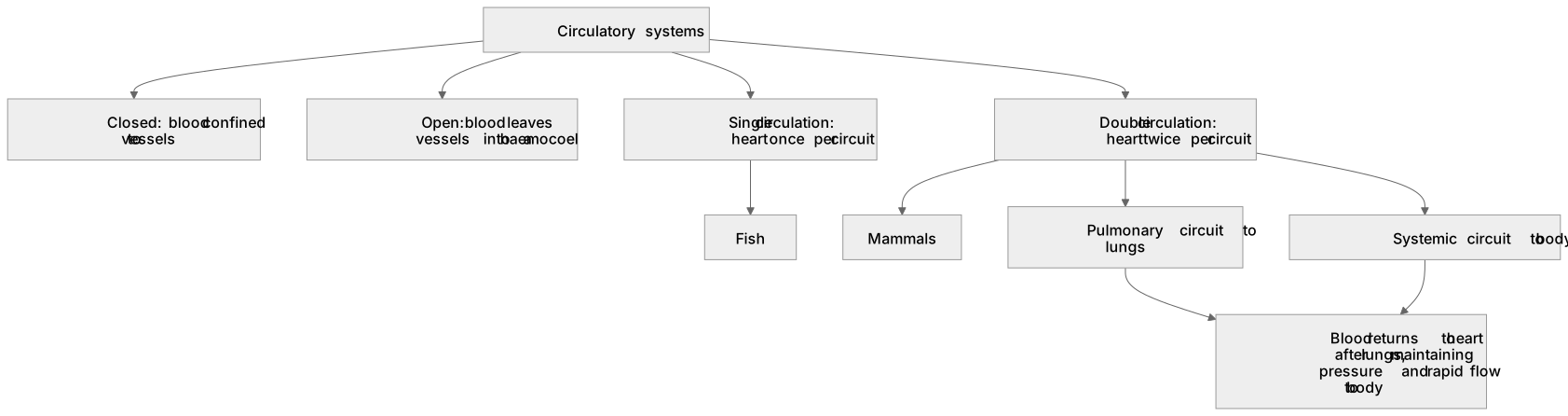
Circulatory systems can be classified by whether blood stays within vessels and by how many circuits exist. In a closed system blood is confined to vessels, whereas in an open system blood leaves vessels and bathes the tissues in a haemocoel, as in many insects. Systems also differ in the number of circuits: a single circulation has blood passing through the heart once per complete circuit, as in fish, while a double circulation passes through the heart twice, as in mammals, with a pulmonary circuit to the lungs and a systemic circuit to the body. Learners should compare these types, describe the advantages of a double circulation in maintaining pressure and rapid flow to the body, and recognise examples of each type.
What earns the marks
- A closed circulatory system keeps blood within vessels, allowing higher pressure and faster flow, whereas an open system lets blood leave vessels into a haemocoel at lower pressure.
- A single circulation, as in fish, has blood passing through the heart once per circuit, so blood loses pressure as it passes through the gills before reaching the body.
- A double circulation, as in mammals, has blood passing through the heart twice per circuit, with separate pulmonary and systemic circuits.
- A double circulation maintains higher pressure and faster flow to body tissues because blood returns to the heart after the lungs before being pumped to the body.
- Systems can be compared by vessel arrangement, number of heart chambers and number of circuits through the heart.
Common mistakes and how to put them right
Confusing open and closed systems with single and double circulation.
Put it right: These are two separate classifications, so describe each independently.
Thinking fish have a double circulation because blood passes through gills and body.
Put it right: Blood passes through the heart only once, so it is a single circulation.
Believing open systems have no vessels at all.
Put it right: Blood still leaves the heart through vessels before entering the haemocoel, so correct this by describing the open-ended arrangement.
Exam tips
- State the classification explicitly, for example 'closed and double', before giving the comparison.
- When comparing single and double circulation, focus on pressure and flow to the body as the key advantage.
- Name a named example organism for each type to secure the comparison mark.
Try the lesson
The start of the Transport in animals: (b) the different types of circulatory systems lesson, made from checked teaching notes for this specification point.
Have a go first
In an open circulatory system, how does the circulatory fluid relate to the body tissues?
Listen
Circulatory systems can be classified by whether blood stays within vessels and by how many circuits exist. In a closed system blood is confined to vessels, whereas in an open system blood leaves vessels and bathes the tissues in a haemocoel, as in many insects. Systems also differ in the number of circuits: a single circulation has blood passing through the heart once per complete circuit, as in fish, while a double circulation passes through the heart twice, as in mammals, with a pulmonary circuit to the lungs and a systemic circuit to the body. Learners should compare these types, describe the advantages of a double circulation in maintaining pressure and rapid flow to the body, and recognise examples of each type. A strong answer earns marks for these points. A closed circulatory system keeps blood within vessels, allowing higher pressure and faster flow, whereas an open system lets blood leave vessels into a haemocoel at lower pressure. A single circulation, as in fish, has blood passing through the heart once per circuit, so blood loses pressure as it passes through the gills before reaching the body. A double circulation, as in mammals, has blood passing through the heart twice per circuit, with separate pulmonary and systemic circuits. A double circulation maintains higher pressure and faster flow to body tissues because blood returns to the heart after the lungs before being pumped to the body. Exam tip: State the classification explicitly, for example 'closed and double', before giving the comparison.
See it
Key words
Say what each word means before you turn the card.
Open versus closed systems
Try answering aloud or in your head before turning the card.
Single versus double circulation
Try answering aloud or in your head before turning the card.
Pressure and flow maintenance
Try answering aloud or in your head before turning the card.
Pulmonary and systemic circuits
Try answering aloud or in your head before turning the card.
See every definition
- Open versus closed systems
- In a closed system blood is confined to vessels, whereas in an open system blood leaves vessels and bathes the tissues in a haemocoel.
- Single versus double circulation
- A single circulation has blood passing through the heart once per complete circuit, while a double circulation passes through the heart twice.
- Pressure and flow maintenance
- A double circulation maintains higher pressure and faster flow to body tissues because blood returns to the heart after the lungs before being pumped to the body.
- Pulmonary and systemic circuits
- A double circulation has a pulmonary circuit to the lungs and a systemic circuit to the body.
Label the diagram
Some boxes have lost their names. Pick the right name for each number.
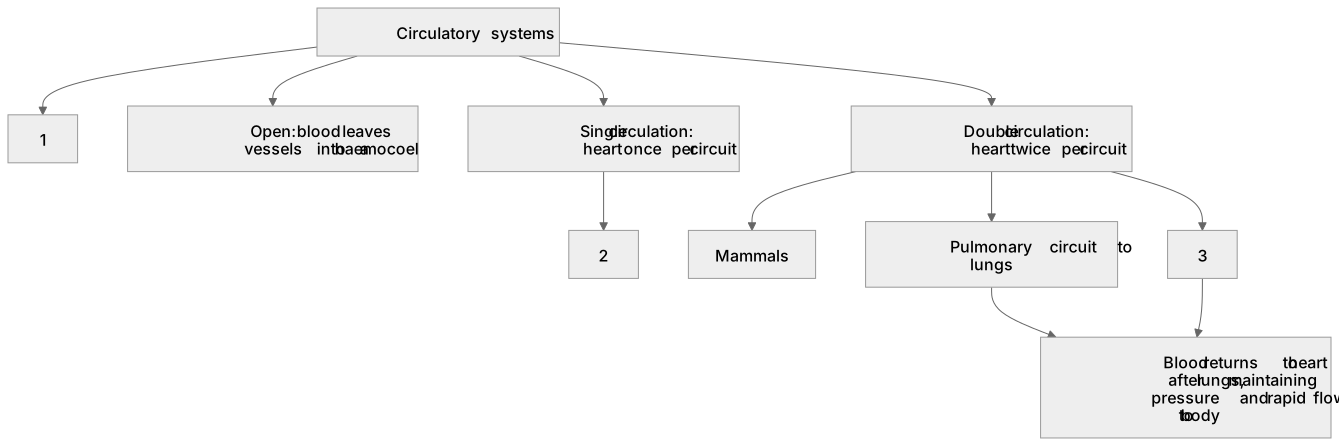
1Box 1
2Box 2
3Box 3
There is more to this lesson
The full lesson goes on to check your understanding and help you earn the marks. Create a free account to carry on, with your progress saved.
A week of Premium from your first lesson · Then the free plan continues · No card, no charge
Test your understanding of Transport in animals: (b) the different types of circulatory systems
Active recall beats re-reading. Take an instant quiz now to test what you’ve learned and lock it into long-term memory.
A week of Premium from your first lesson · Then the free plan continues · No card, no charge