OCR · A-Level · Biology
Course version: H420 · Version from Sept 2025
(i) the role of haemoglobin in transporting oxygen and carbon dioxide
Full specification wording
Transport in animals: (i) the role of haemoglobin in transporting oxygen and carbon dioxide
Haemoglobin is a quaternary protein with four haem groups, each containing an iron ion (Fe²⁺) that binds one oxygen molecule, so a fully loaded molecule carries four oxygen molecules.
Checked against the OCR H420 specification (opens in a new tab) on .
- Point 9 of 10
- 4 key terms
Study notes
From the checked teaching notes for this specification point.
The idea
Haemoglobin is a quaternary protein with four haem groups, each containing an iron ion (Fe²⁺) that binds one oxygen molecule, so a fully loaded molecule carries four oxygen molecules. In the lungs, a high partial pressure of oxygen (pO₂) causes oxygen to associate with haemoglobin, forming oxyhaemoglobin; in respiring tissues, a lower pO₂ causes oxygen to dissociate and be released. The affinity changes with pO₂, giving the S-shaped oxygen dissociation curve, and a high partial pressure of carbon dioxide lowers affinity further (the Bohr shift), increasing oxygen release where respiration is greatest. For carbon dioxide, most is transported as hydrogencarbonate ions (HCO₃⁻) formed in red blood cells by carbonic anhydrase, with some carried bound to haemoglobin as carbaminohaemoglobin and a small fraction dissolved in plasma.
What earns the marks
- States that haemoglobin has four haem groups, each with an iron ion (Fe²⁺) that binds one oxygen molecule, so four oxygen molecules are carried per molecule.
- Explains that oxygen associates with haemoglobin at high pO₂ in the lungs to form oxyhaemoglobin.
- Explains that oxygen dissociates from haemoglobin at lower pO₂ in respiring tissues and is released.
- Describes the S-shaped oxygen dissociation curve and the effect of a high pCO₂ lowering affinity (the Bohr shift).
- States that most carbon dioxide is transported as hydrogencarbonate ions (HCO₃⁻), formed with the enzyme carbonic anhydrase.
- States that some carbon dioxide is carried bound to haemoglobin as carbaminohaemoglobin and a small amount dissolves in plasma.
Common mistakes and how to put them right
Saying haemoglobin carries one oxygen molecule.
Put it right: Each of the four haem groups binds one oxygen molecule, so four are carried.
Claiming all carbon dioxide is carried as hydrogencarbonate.
Put it right: Some is bound to haemoglobin and a small fraction dissolves in plasma.
Reversing the Bohr shift.
Put it right: A high pCO₂ lowers haemoglobin's affinity for oxygen, increasing release in respiring tissues.
Exam tips
- Link each transport statement to the partial pressure conditions in lungs versus respiring tissues.
- Use the correct terms: association and dissociation for oxygen, and name the enzyme carbonic anhydrase for hydrogencarbonate formation.
- When describing the dissociation curve, refer to the S shape and explain the plateau and steep region in terms of affinity.
Try the lesson
The start of the Transport in animals: (i) the role of haemoglobin in transporting oxygen and carbon dioxide lesson, made from checked teaching notes for this specification point.
Have a go first
In which region of a haemoglobin molecule does oxygen bind?
Listen
Haemoglobin is a quaternary protein with four haem groups, each containing an iron ion (Fe²⁺) that binds one oxygen molecule, so a fully loaded molecule carries four oxygen molecules. In the lungs, a high partial pressure of oxygen (pO₂) causes oxygen to associate with haemoglobin, forming oxyhaemoglobin; in respiring tissues, a lower pO₂ causes oxygen to dissociate and be released. The affinity changes with pO₂, giving the S-shaped oxygen dissociation curve, and a high partial pressure of carbon dioxide lowers affinity further (the Bohr shift), increasing oxygen release where respiration is greatest. For carbon dioxide, most is transported as hydrogencarbonate ions (HCO₃⁻) formed in red blood cells by carbonic anhydrase, with some carried bound to haemoglobin as carbaminohaemoglobin and a small fraction dissolved in plasma. A strong answer earns marks for these points. States that haemoglobin has four haem groups, each with an iron ion (Fe²⁺) that binds one oxygen molecule, so four oxygen molecules are carried per molecule. Explains that oxygen associates with haemoglobin at high pO₂ in the lungs to form oxyhaemoglobin. Explains that oxygen dissociates from haemoglobin at lower pO₂ in respiring tissues and is released. Describes the S-shaped oxygen dissociation curve and the effect of a high pCO₂ lowering affinity (the Bohr shift). Exam tip: Link each transport statement to the partial pressure conditions in lungs versus respiring tissues.
See it
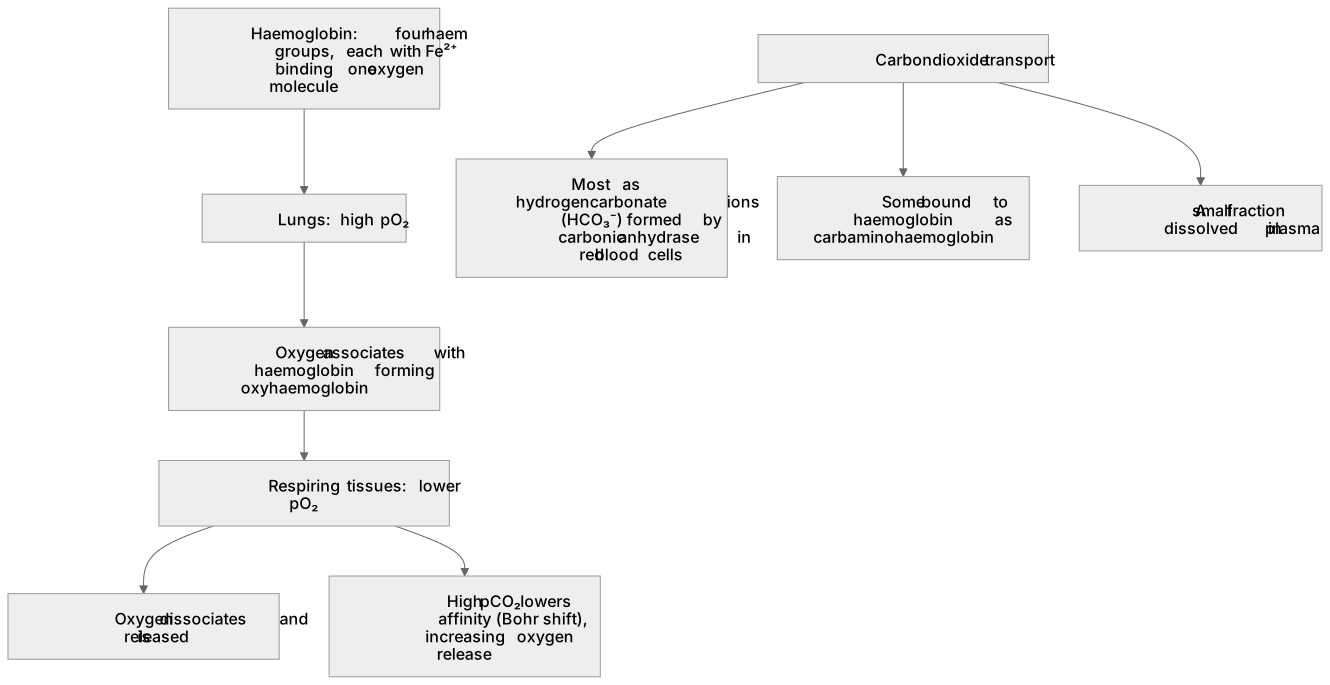
Key words
Say what each word means before you turn the card.
Structure of haemoglobin and oxygen binding
Try answering aloud or in your head before turning the card.
Association and dissociation of oxygen
Try answering aloud or in your head before turning the card.
Oxygen dissociation curve and the Bohr shift
Try answering aloud or in your head before turning the card.
Carbon dioxide transport forms
Try answering aloud or in your head before turning the card.
See every definition
- Structure of haemoglobin and oxygen binding
- A quaternary protein with four haem groups, each containing an iron ion (Fe²⁺) that binds one oxygen molecule, so a fully loaded molecule carries four oxygen molecules.
- Association and dissociation of oxygen
- At high pO₂ in the lungs oxygen associates with haemoglobin to form oxyhaemoglobin, while at lower pO₂ in respiring tissues oxygen dissociates and is released.
- Oxygen dissociation curve and the Bohr shift
- Affinity changes with pO₂ to give the S-shaped oxygen dissociation curve, and a high pCO₂ lowers affinity further, increasing oxygen release where respiration is greatest.
- Carbon dioxide transport forms
- Most is transported as hydrogencarbonate ions (HCO₃⁻) formed in red blood cells by carbonic anhydrase, some is bound to haemoglobin as carbaminohaemoglobin and a small fraction dissolves in plasma.
Label the diagram
Some boxes have lost their names. Pick the right name for each number.
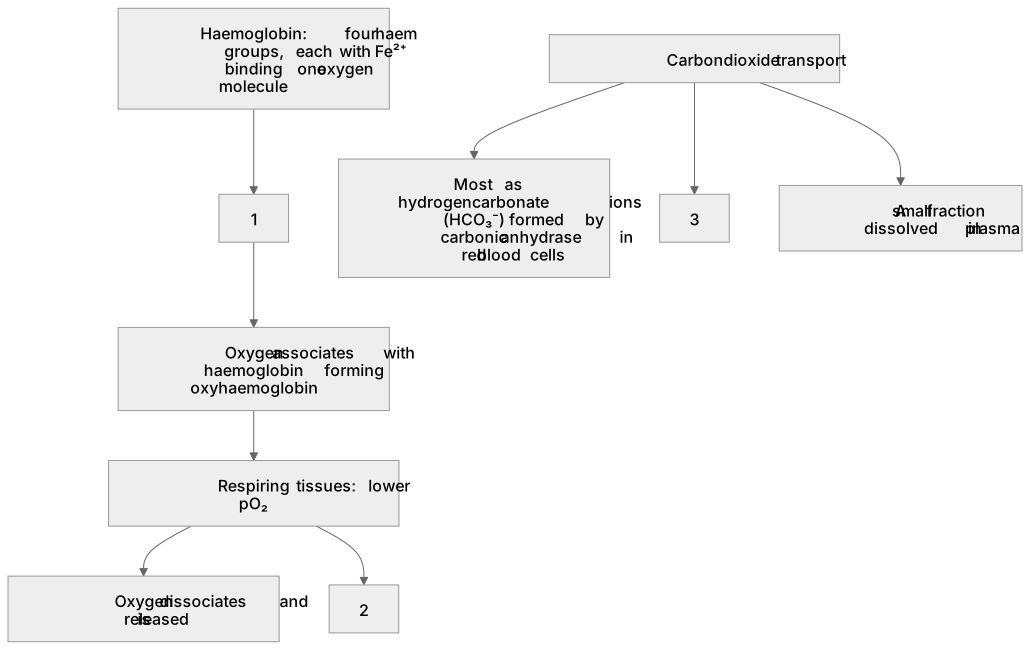
1Box 1
2Box 2
3Box 3
There is more to this lesson
The full lesson goes on to check your understanding and help you earn the marks. Create a free account to carry on, with your progress saved.
A week of Premium from your first lesson · Then the free plan continues · No card, no charge
Test your understanding of Transport in animals: (i) the role of haemoglobin in transporting oxygen and carbon dioxide
Active recall beats re-reading. Take an instant quiz now to test what you’ve learned and lock it into long-term memory.
A week of Premium from your first lesson · Then the free plan continues · No card, no charge