OCR · A-Level · Biology
Course version: H420 · Version from Sept 2025
(d) use of a light microscope at high power and low power, including use…
Full specification wording
Use of apparatus and techniques: (d) use of a light microscope at high power and low power, including use of a graticule
This technique requires you to set up and use a light microscope correctly at both low power and high power, and to use an eyepiece graticule for measurement.
Checked against the OCR H420 specification (opens in a new tab) on .
- Point 4 of 14
- 4 key terms
Study notes
From the checked teaching notes for this specification point.
The idea
This technique requires you to set up and use a light microscope correctly at both low power and high power, and to use an eyepiece graticule for measurement. Begin on low power to locate and focus the specimen, using the coarse focus, then switch to the high-power objective and refocus with the fine focus only. The eyepiece graticule is a scale in the eyepiece that must be calibrated for each objective using a stage micrometer of known scale; the calibration factor converts graticule units into actual lengths. Because the magnification changes between objectives, the graticule must be recalibrated at each power. Measurements are then taken by counting graticule divisions across the specimen and multiplying by the calibration factor, giving a real size in micrometres.
What earns the marks
- Describes focusing first on low power using the coarse focus to locate the specimen, then switching to high power and using only the fine focus.
- Explains that the eyepiece graticule is a scale in the eyepiece whose divisions must be calibrated against a stage micrometer of known scale.
- States that the graticule must be recalibrated for each objective because magnification differs between powers.
- Describes measuring a specimen by counting graticule divisions and multiplying by the calibration factor to give a real length.
- Recognises that the stage micrometer has a known scale and is used only for calibration, not for routine measurement of the specimen.
Common mistakes and how to put them right
Using the coarse focus on high power.
Put it right: Once on high power, adjust only with the fine focus to avoid damaging the slide or lens.
Assuming one graticule calibration applies to all objectives.
Put it right: Recalibrate the graticule for each objective because magnification changes.
Confusing the eyepiece graticule with the stage micrometer.
Put it right: The graticule is the measuring scale in the eyepiece, while the stage micrometer provides the known reference scale for calibration.
Exam tips
- State the order of operations clearly: low power first, then high power, with fine focus only at high power.
- When calculating real size, show the calibration factor and the number of graticule divisions used.
- Remember to specify that calibration is repeated for each objective used.
Try the lesson
The start of the Use of apparatus and techniques: (d) use of a light microscope at high power and low power, including use of a graticule lesson, made from checked teaching notes for this specification point.
Have a go first
A student is about to view a prepared slide with a light microscope. Which adjustment should be made first to bring the specimen into rough focus?
Listen
This technique requires you to set up and use a light microscope correctly at both low power and high power, and to use an eyepiece graticule for measurement. Begin on low power to locate and focus the specimen, using the coarse focus, then switch to the high-power objective and refocus with the fine focus only. The eyepiece graticule is a scale in the eyepiece that must be calibrated for each objective using a stage micrometer of known scale; the calibration factor converts graticule units into actual lengths. Because the magnification changes between objectives, the graticule must be recalibrated at each power. Measurements are then taken by counting graticule divisions across the specimen and multiplying by the calibration factor, giving a real size in micrometres. A strong answer earns marks for these points. Describes focusing first on low power using the coarse focus to locate the specimen, then switching to high power and using only the fine focus. Explains that the eyepiece graticule is a scale in the eyepiece whose divisions must be calibrated against a stage micrometer of known scale. States that the graticule must be recalibrated for each objective because magnification differs between powers. Describes measuring a specimen by counting graticule divisions and multiplying by the calibration factor to give a real length. A common slip: Using the coarse focus on high power. Instead, once on high power, adjust only with the fine focus to avoid damaging the slide or lens. Exam tip: State the order of operations clearly: low power first, then high power, with fine focus only at high power.
See it
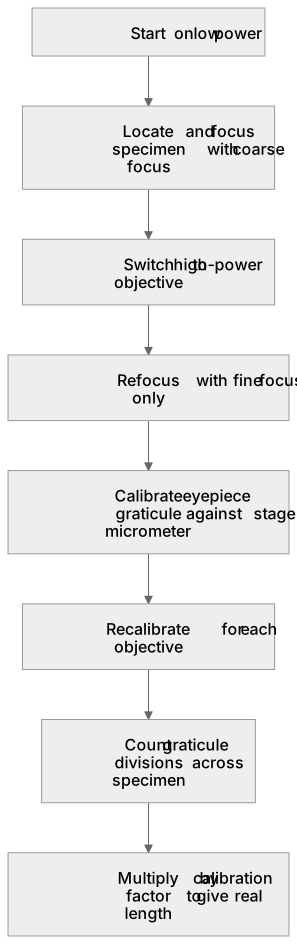
Put it in order
Put these steps in the order they happen.
- 1. Calibrate eyepiece graticule against stage micrometer
- 2. Multiply by calibration factor to give real length
- 3. Recalibrate for each objective
- 4. Start on low power
- 5. Locate and focus specimen with coarse focus
- 6. Count graticule divisions across specimen
- 7. Switch to high-power objective
- 8. Refocus with fine focus only
Key words
Say what each word means before you turn the card.
Correct microscope set-up and focusing sequence
Try answering aloud or in your head before turning the card.
Calibration of the eyepiece graticule
Try answering aloud or in your head before turning the card.
Measurement of specimen size
Try answering aloud or in your head before turning the card.
Relationship between magnification and calibration
Try answering aloud or in your head before turning the card.
See every definition
- Correct microscope set-up and focusing sequence
- Begin on low power to locate and focus the specimen using the coarse focus, then switch to the high-power objective and refocus with the fine focus only.
- Calibration of the eyepiece graticule
- The scale in the eyepiece must be calibrated for each objective using a stage micrometer of known scale, giving a calibration factor that converts graticule units into actual lengths.
- Measurement of specimen size
- Measurements are taken by counting graticule divisions across the specimen and multiplying by the calibration factor, giving a real size in micrometres.
- Relationship between magnification and calibration
- Because the magnification changes between objectives, the graticule must be recalibrated at each power.
Label the diagram
Some boxes have lost their names. Pick the right name for each number.
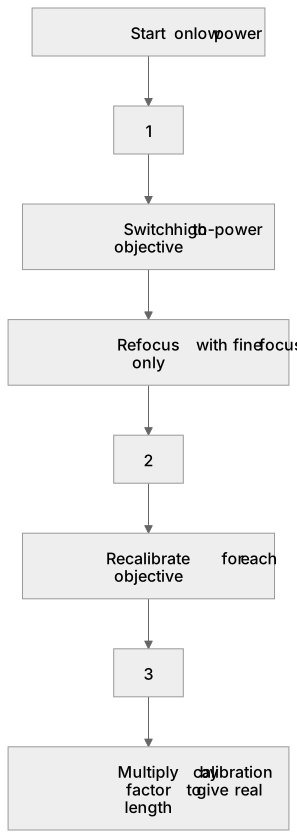
1Box 1
2Box 2
3Box 3
There is more to this lesson
The full lesson goes on to check your understanding and help you earn the marks. Create a free account to carry on, with your progress saved.
A week of Premium from your first lesson · Then the free plan continues · No card, no charge
Test your understanding of Use of apparatus and techniques: (d) use of a light microscope at high power and low power, including use of a graticule
Active recall beats re-reading. Take an instant quiz now to test what you’ve learned and lock it into long-term memory.
A week of Premium from your first lesson · Then the free plan continues · No card, no charge