AQA · GCSE · Business
Course version: 8132 · Version from Sept 2017
Understand the difference between assets and liabilities and that the…
Full specification wording
Analysing the financial performance of a business: understand the difference between assets and liabilities and that the statement of financial position is a snapshot in time
The statement of financial position lists what a business owns and owes on one chosen date, so it is a snapshot in time rather than a moving record.
Checked against the AQA 8132 specification (opens in a new tab) on .
- Point 6 of 9
- 4 key terms
Study notes
From the checked teaching notes for this specification point.
The idea
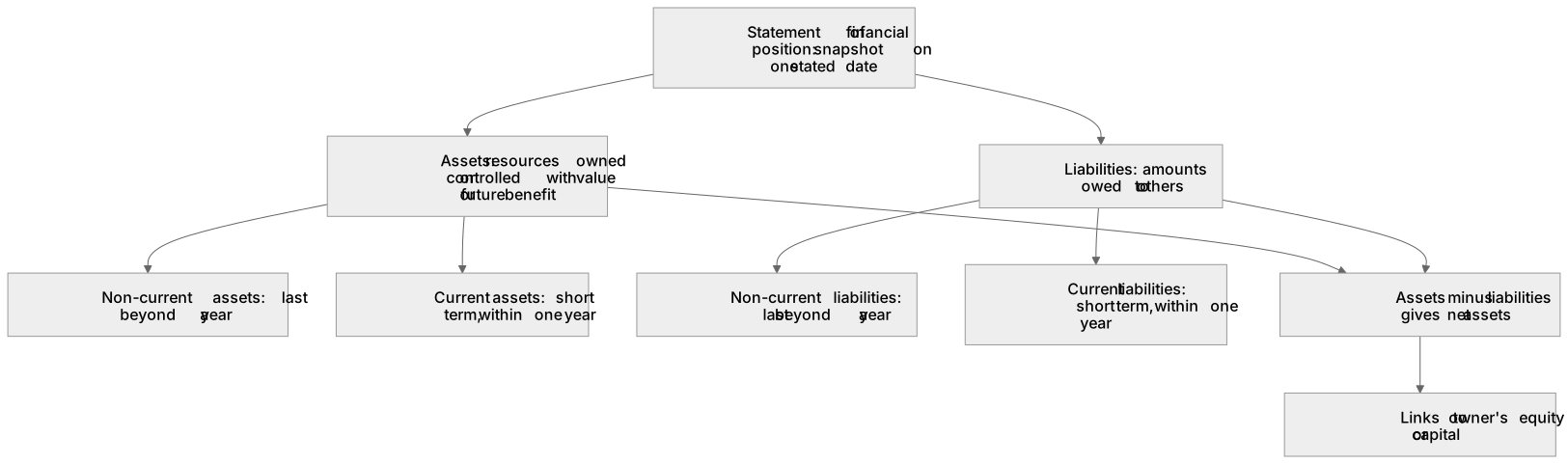
The statement of financial position lists what a business owns and owes on one chosen date, so it is a snapshot in time rather than a moving record. Assets are resources the business controls or owns that hold value or will bring future benefit, such as inventory, machinery, vehicles, cash at bank and money owed by customers (trade receivables). Liabilities are amounts the business owes to others, such as bank loans, overdrafts, unpaid supplier invoices (trade payables) and tax due. Non-current assets and liabilities last beyond a year; current ones are short term. Because the snapshot is dated, figures change the next day as stock is sold or a loan is repaid, so comparisons need the date stated.
What earns the marks
- Assets are resources owned or controlled by the business that carry value or future benefit, for example machinery, inventory, vehicles and cash.
- Liabilities are amounts the business owes to outside parties, for example bank loans, overdrafts, trade payables and tax due.
- Assets and liabilities are classified as non-current (long term, beyond one year) or current (short term, within one year).
- The statement of financial position records balances on a single stated date, so it is a snapshot rather than a period record.
- Because it is dated, the figures can change quickly, so a user must know the date before comparing two statements.
- The relationship assets minus liabilities gives net assets, which links to the owner's equity or capital section.
Common mistakes and how to put them right
Treating money owed by customers as a liability.
Put it right: The error is reversing the direction of the debt, and the correction is that trade receivables are a current asset while trade payables are a current liability.
Calling the statement of financial position a record of profit over the year.
Put it right: The error is confusing it with the income statement, and the correction is that it shows balances on one date, not trading over a period.
Assuming the snapshot stays accurate for months.
Put it right: The error is ignoring the date, and the correction is that cash, inventory and debts change daily, so the statement is only true at its stated date.
Exam tips
- Always name the date when describing a statement of financial position, because the snapshot idea is often the point being tested.
- When classifying an item, ask two questions: does the business own or control it, and is it due within one year?
- Use short worked examples, such as listing inventory as a current asset and a bank loan as a non-current liability, to show understanding clearly.
Try the lesson
The start of the Analysing the financial performance of a business: understand the difference between assets and liabilities and that the statement of financial position is a snapshot in time lesson, made from checked teaching notes for this specification point.
Have a go first
Which of the following items would be recorded as a liability in a business's statement of financial position?
Listen
The statement of financial position lists what a business owns and owes on one chosen date, so it is a snapshot in time rather than a moving record. Assets are resources the business controls or owns that hold value or will bring future benefit, such as inventory, machinery, vehicles, cash at bank and money owed by customers (trade receivables). Liabilities are amounts the business owes to others, such as bank loans, overdrafts, unpaid supplier invoices (trade payables) and tax due. Non-current assets and liabilities last beyond a year; current ones are short term. Because the snapshot is dated, figures change the next day as stock is sold or a loan is repaid, so comparisons need the date stated. A strong answer earns marks for these points. Assets are resources owned or controlled by the business that carry value or future benefit, for example machinery, inventory, vehicles and cash. Liabilities are amounts the business owes to outside parties, for example bank loans, overdrafts, trade payables and tax due. Assets and liabilities are classified as non-current (long term, beyond one year) or current (short term, within one year). The statement of financial position records balances on a single stated date, so it is a snapshot rather than a period record. Exam tip: Always name the date when describing a statement of financial position, because the snapshot idea is often the point being tested.
See it
Key words
Say what each word means before you turn the card.
Assets
Try answering aloud or in your head before turning the card.
Liabilities
Try answering aloud or in your head before turning the card.
Classification of assets and liabilities
Try answering aloud or in your head before turning the card.
Time specificity of financial data
Try answering aloud or in your head before turning the card.
See every definition
- Assets
- Resources the business controls or owns that hold value or will bring future benefit, such as inventory, machinery, vehicles, cash at bank and trade receivables.
- Liabilities
- Amounts the business owes to others, such as bank loans, overdrafts, unpaid supplier invoices and tax due.
- Classification of assets and liabilities
- Non-current assets and liabilities last beyond a year, while current ones are short term.
- Time specificity of financial data
- Because the snapshot is dated, figures change the next day as stock is sold or a loan is repaid, so comparisons need the date stated.
Label the diagram
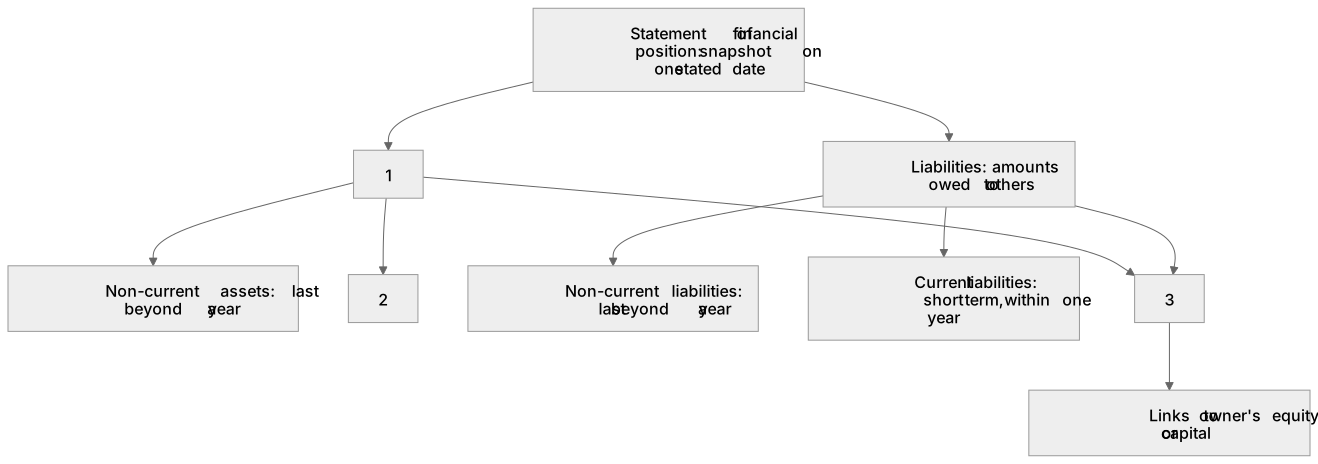
Some boxes have lost their names. Pick the right name for each number.
1Box 1
2Box 2
3Box 3
There is more to this lesson
The full lesson goes on to check your understanding and help you earn the marks. Create a free account to carry on, with your progress saved.
A week of Premium from your first lesson · Then the free plan continues · No card, no charge
Test your understanding of Analysing the financial performance of a business: understand the difference between assets and liabilities and that the statement of financial position is a snapshot in time
Active recall beats re-reading. Take an instant quiz now to test what you’ve learned and lock it into long-term memory.
A week of Premium from your first lesson · Then the free plan continues · No card, no charge