AQA · GCSE · Business
Course version: 8132 · Version from Sept 2017
Understand the importance of financial statements for assessing business…
Full specification wording
Analysing the financial performance of a business: understand the importance of financial statements for assessing business performance and helping make business decisions
Financial statements are formal records showing a business's financial activity and position.
Checked against the AQA 8132 specification (opens in a new tab) on .
- Point 4 of 9
- 4 key terms
Study notes
From the checked teaching notes for this specification point.
The idea
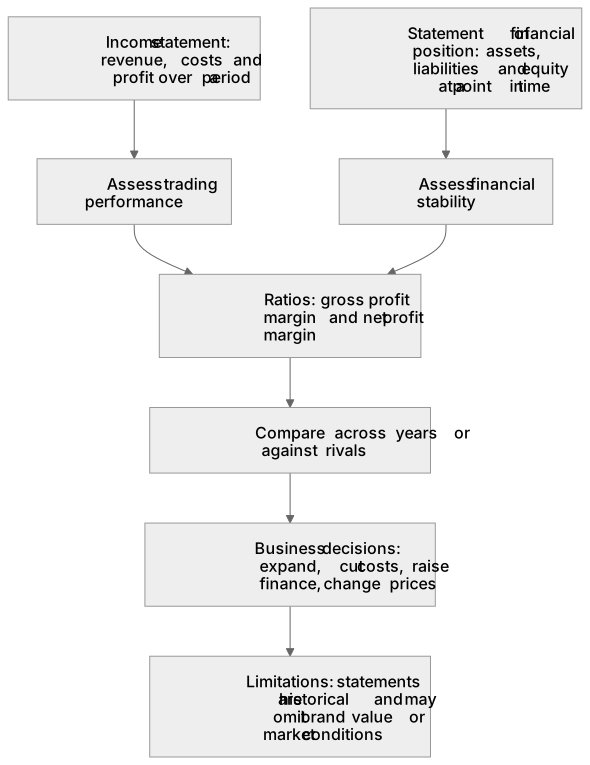
Financial statements are formal records showing a business's financial activity and position. The income statement reports revenue, costs and profit over a period, while the statement of financial position lists assets, liabilities and equity at a point in time. Together they let stakeholders assess performance by comparing figures across years or against rivals, supporting decisions like whether to expand, cut costs, raise finance or change prices. For example, a falling gross profit margin may prompt a review of supplier costs. Ratios such as gross profit margin and net profit margin make comparisons meaningful. However, statements are historical and may not capture brand value or market conditions, so they inform rather than replace judgement.
What earns the marks
- Explains that the income statement shows revenue, costs and profit over a period, allowing assessment of trading performance.
- Explains that the statement of financial position shows assets, liabilities and equity at a point in time, allowing assessment of financial stability.
- Uses ratios such as gross profit margin and net profit margin to compare performance over time or between businesses.
- Links financial statement analysis to specific business decisions, such as expansion, cost control, pricing, investment or raising finance.
- Recognises that financial statements are historical and may omit qualitative factors such as brand reputation or staff skills.
Common mistakes and how to put them right
Confusing the income statement with the statement of financial position.
Put it right: The income statement covers a period, while the statement of financial position is a snapshot at a date.
Treating profit as the same as cash.
Put it right: A profitable business can still run short of cash if customers owe money or stock is high.
Ignoring the limitations of financial statements, such as not showing brand value or market conditions, and assuming they give a complete picture.
Exam tips
- Use the formula triangle for ratios: gross profit margin = (gross profit ÷ revenue) × 100; net profit margin = (net profit ÷ revenue) × 100.
- When analysing, always compare figures to a previous year or a competitor to show you understand performance, not just state the number.
- Link every point to a decision, for example 'a fall in net profit margin may lead the business to reduce overheads or renegotiate supplier contracts'.
Try the lesson
The start of the Analysing the financial performance of a business: understand the importance of financial statements for assessing business performance and helping make business decisions lesson, made from checked teaching notes for this specification point.
Have a go first
Which statement best explains why a business owner uses financial statements to assess business performance?
Listen
Financial statements are formal records showing a business's financial activity and position. The income statement reports revenue, costs and profit over a period, while the statement of financial position lists assets, liabilities and equity at a point in time. Together they let stakeholders assess performance by comparing figures across years or against rivals, supporting decisions like whether to expand, cut costs, raise finance or change prices. For example, a falling gross profit margin may prompt a review of supplier costs. Ratios such as gross profit margin and net profit margin make comparisons meaningful. However, statements are historical and may not capture brand value or market conditions, so they inform rather than replace judgement. A strong answer earns marks for these points. Explains that the income statement shows revenue, costs and profit over a period, allowing assessment of trading performance. Explains that the statement of financial position shows assets, liabilities and equity at a point in time, allowing assessment of financial stability. Uses ratios such as gross profit margin and net profit margin to compare performance over time or between businesses. Links financial statement analysis to specific business decisions, such as expansion, cost control, pricing, investment or raising finance. Exam tip: Use the formula triangle for ratios: gross profit margin = (gross profit ÷ revenue) × 100; net profit margin = (net profit ÷ revenue) × 100.
See it
Key words
Say what each word means before you turn the card.
Financial performance measurement
Try answering aloud or in your head before turning the card.
Business decision making
Try answering aloud or in your head before turning the card.
Stakeholder use of financial information
Try answering aloud or in your head before turning the card.
Limitations of financial data
Try answering aloud or in your head before turning the card.
See every definition
- Financial performance measurement
- Using formal records of a business's financial activity and position to assess how the business has performed.
- Business decision making
- Using financial statements to support choices such as whether to expand, cut costs, raise finance or change prices.
- Stakeholder use of financial information
- Stakeholders assess performance by comparing figures across years or against rivals.
- Limitations of financial data
- Statements are historical and may not capture brand value or market conditions, so they inform rather than replace judgement.
Label the diagram
Some boxes have lost their names. Pick the right name for each number.
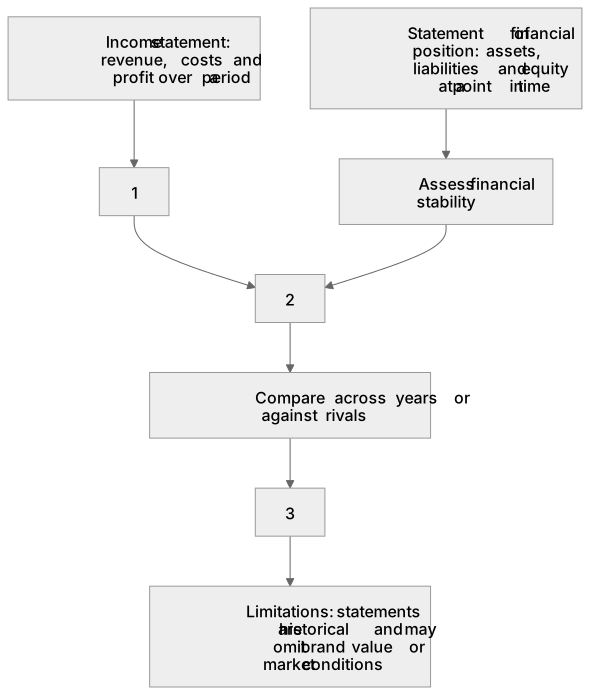
1Box 1
2Box 2
3Box 3
There is more to this lesson
The full lesson goes on to check your understanding and help you earn the marks. Create a free account to carry on, with your progress saved.
A week of Premium from your first lesson · Then the free plan continues · No card, no charge
Test your understanding of Analysing the financial performance of a business: understand the importance of financial statements for assessing business performance and helping make business decisions
Active recall beats re-reading. Take an instant quiz now to test what you’ve learned and lock it into long-term memory.
A week of Premium from your first lesson · Then the free plan continues · No card, no charge