AQA · GCSE · Business
Course version: 8132 · Version from Sept 2017
Business ownership: Public limited companies (plc)
A public limited company is an incorporated business with 'plc' after its name.
Checked against the AQA 8132 specification (opens in a new tab) on .
- Point 4 of 9
- 4 key terms
Study notes
From the checked teaching notes for this specification point.
The idea
A public limited company is an incorporated business with 'plc' after its name. It has a separate legal identity and its shareholders have limited liability. Unlike a private limited company, a plc can offer shares to the general public, usually through a stock exchange, so it can raise large amounts of capital. Shares can be bought and sold freely, which makes the business more attractive to investors, but it also means ownership and control can change quickly. A plc must publish its accounts and other information, so competitors and the public can see its financial position. Setting up is expensive and subject to more regulation than a private limited company.
For example: A growing chain could become 'Green Grocers plc', sell shares on the London Stock Exchange and use the funds to open stores nationwide, while original owners may lose some control.
What earns the marks
- States that a public limited company is incorporated and has a separate legal identity from its owners.
- Explains that shares can be advertised and sold to the general public, often through a stock exchange.
- Explains that shareholders have limited liability, so their personal assets are protected.
- Identifies that 'plc' must appear after the company name and that greater regulation and disclosure apply.
- Explains that a plc can raise larger amounts of capital than a private limited company because shares are available to the public.
- Explains that control can be lost or diluted because shares are freely traded and ownership can change.
- Applies the concept to a given business context, such as a firm expanding nationally while accepting public scrutiny.
Common mistakes and how to put them right
Confusing public limited companies with public sector organisations.
Put it right: A plc is privately owned by shareholders, not owned by the government.
Thinking that a plc is always larger than a private limited company.
Put it right: Size is not the defining feature; the ability to offer shares to the public is.
Believing that limited liability removes all risk.
Put it right: Shareholders can still lose the money they invested if the company fails.
Forgetting that a plc must publish accounts, which can reveal information to competitors.
Exam tips
- Link the ability to sell shares to the public to the scale of finance a plc can raise, using the case study context.
- For evaluation, compare the benefit of large-scale finance with the drawbacks of loss of control and public disclosure.
- Use the correct abbreviation 'plc' and avoid writing 'PLC' inconsistently unless the business name uses that style.
- Refer to the stock exchange by name only if it is relevant to the context, such as the London Stock Exchange.
Try the lesson
The start of the Business ownership: Public limited companies (plc) lesson, made from checked teaching notes for this specification point.
Have a go first
Which statement describes a public limited company (plc)?
Listen
A public limited company is an incorporated business with 'plc' after its name. It has a separate legal identity and its shareholders have limited liability. Unlike a private limited company, a plc can offer shares to the general public, usually through a stock exchange, so it can raise large amounts of capital. Shares can be bought and sold freely, which makes the business more attractive to investors, but it also means ownership and control can change quickly. A plc must publish its accounts and other information, so competitors and the public can see its financial position. Setting up is expensive and subject to more regulation than a private limited company. For example, a growing chain could become 'Green Grocers plc', sell shares on the London Stock Exchange and use the funds to open stores nationwide, while original owners may lose some control. A strong answer earns marks for these points. States that a public limited company is incorporated and has a separate legal identity from its owners. Explains that shares can be advertised and sold to the general public, often through a stock exchange. Explains that shareholders have limited liability, so their personal assets are protected. Identifies that 'plc' must appear after the company name and that greater regulation and disclosure apply. Exam tip: Link the ability to sell shares to the public to the scale of finance a plc can raise, using the case study context.
See it
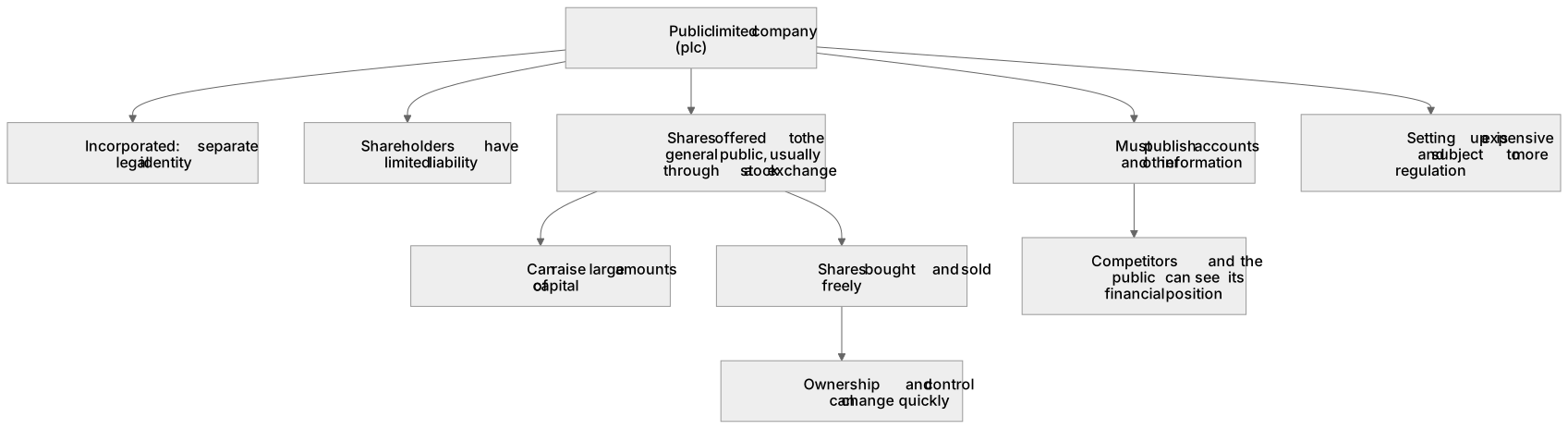
Key words
Say what each word means before you turn the card.
Public limited company (plc)
Try answering aloud or in your head before turning the card.
Limited liability
Try answering aloud or in your head before turning the card.
Separate legal identity
Try answering aloud or in your head before turning the card.
Public disclosure
Try answering aloud or in your head before turning the card.
See every definition
- Public limited company (plc)
- An incorporated business with 'plc' after its name that can offer shares to the general public, usually through a stock exchange.
- Limited liability
- Shareholders' personal assets are protected, although they can still lose the money they invested if the company fails.
- Separate legal identity
- The incorporated business is legally distinct from its owners.
- Public disclosure
- A plc must publish its accounts and other information, so competitors and the public can see its financial position.
Label the diagram
Some boxes have lost their names. Pick the right name for each number.
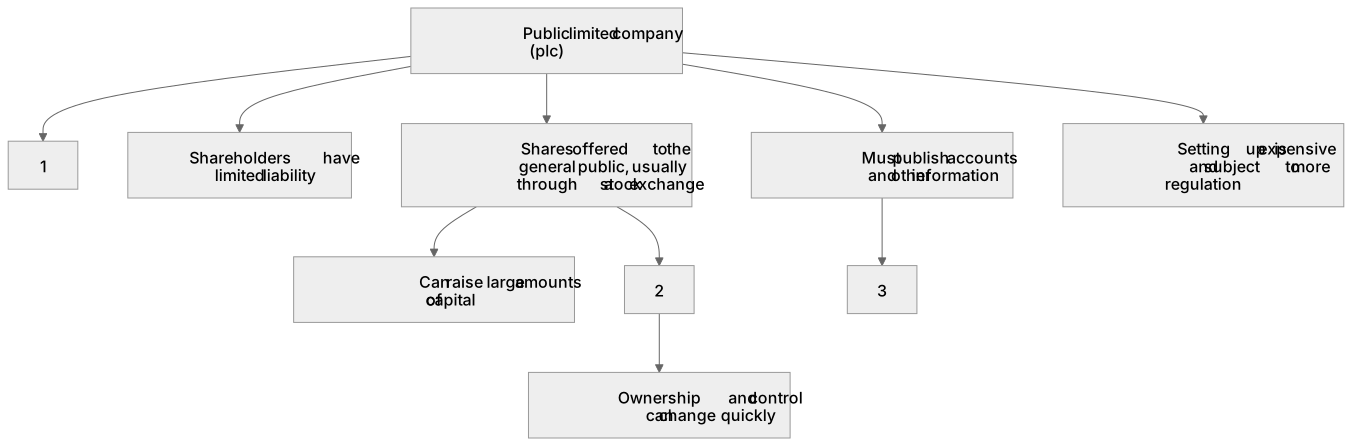
1Box 1
2Box 2
3Box 3
There is more to this lesson
The full lesson goes on to check your understanding and help you earn the marks. Create a free account to carry on, with your progress saved.
A week of Premium from your first lesson · Then the free plan continues · No card, no charge
Test your understanding of Business ownership: Public limited companies (plc)
Active recall beats re-reading. Take an instant quiz now to test what you’ve learned and lock it into long-term memory.
A week of Premium from your first lesson · Then the free plan continues · No card, no charge