AQA · GCSE · Business
Course version: 8132 · Version from Sept 2017
Students should be able to identify and analyse where there may be a…
Full specification wording
Ethical and environmental considerations: Students should be able to identify and analyse where there may be a possible trade-off between sustainability and profit.
Sustainability means operating without harming the environment or depleting resources, while profit is revenue minus costs.
Checked against the AQA 8132 specification (opens in a new tab) on .
- Point 11 of 13
- 3 key terms
Study notes
From the checked teaching notes for this specification point.
The idea
Sustainability means operating without harming the environment or depleting resources, while profit is revenue minus costs. A trade-off arises when a sustainability measure raises costs or lowers revenue, reducing short-term profit. For example, a café switching to recyclable cups may pay £0.10 more per cup; with 50,000 cups sold annually, costs rise by £5,000, cutting profit unless sales increase or other costs fall. Analysis may also show that sustainability can enhance profit through reputation, premium pricing or efficiency, so the trade-off is not inevitable.
What earns the marks
- Defines sustainability as reducing environmental harm or conserving resources, and profit as total revenue minus total costs.
- Identifies a specific business decision where sustainability and profit conflict, such as using recycled packaging, installing solar panels or sourcing Fairtrade materials.
- Calculates the effect on profit by comparing the additional cost or lost revenue with the original profit figure.
- Analyses the trade-off by explaining how the decision reduces short-term profit but may raise long-term profit through improved reputation, customer loyalty or cost savings.
- Evaluates the extent of the trade-off by considering factors such as business size, market segment and the time period over which profit is measured.
Common mistakes and how to put them right
Assuming sustainability always reduces profit.
Put it right: Analyse both costs and potential revenue gains, as some sustainable actions can lower bills or attract customers.
Confusing revenue with profit.
Put it right: Profit is revenue minus costs, so a change in revenue alone does not determine profit.
Ignoring the time scale.
Put it right: Distinguish between short-term costs and long-term benefits, as a trade-off may reverse over time.
Exam tips
- Use a numerical example to show the profit impact of a sustainability measure, such as calculating the extra cost per unit multiplied by output.
- Structure analysis by stating the decision, the immediate profit effect, and then a possible long-term effect on profit.
- When evaluating, state a clear judgement on whether the trade-off is acceptable, using the context of the business given in the question.
Try the lesson
The start of the Ethical and environmental considerations: Students should be able to identify and analyse where there may be a possible trade-off between sustainability and profit. lesson, made from checked teaching notes for this specification point.
Have a go first
A small bakery currently buys cheap packaging that cannot be recycled. The owner is considering switching to recyclable packaging, which costs more per box. What is the most likely trade-off of making this switch?
Listen
Sustainability means operating without harming the environment or depleting resources, while profit is revenue minus costs. A trade-off arises when a sustainability measure raises costs or lowers revenue, reducing short-term profit. For example, a café switching to recyclable cups may pay £0.10 more per cup; with 50,000 cups sold annually, costs rise by £5,000, cutting profit unless sales increase or other costs fall. Analysis may also show that sustainability can enhance profit through reputation, premium pricing or efficiency, so the trade-off is not inevitable. A strong answer earns marks for these points. Defines sustainability as reducing environmental harm or conserving resources, and profit as total revenue minus total costs. Identifies a specific business decision where sustainability and profit conflict, such as using recycled packaging, installing solar panels or sourcing Fairtrade materials. Calculates the effect on profit by comparing the additional cost or lost revenue with the original profit figure. Analyses the trade-off by explaining how the decision reduces short-term profit but may raise long-term profit through improved reputation, customer loyalty or cost savings. A common slip: Assuming sustainability always reduces profit. Instead, analyse both costs and potential revenue gains, as some sustainable actions can lower bills or attract customers. Exam tip: Use a numerical example to show the profit impact of a sustainability measure, such as calculating the extra cost per unit multiplied by output.
See it
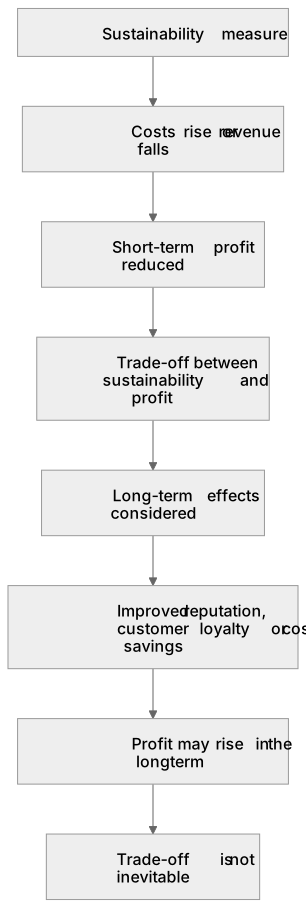
Put it in order
Put these steps in the order they happen.
- 1. Long-term effects considered
- 2. Trade-off is not inevitable
- 3. Improved reputation, customer loyalty or cost savings
- 4. Sustainability measure
- 5. Costs rise or revenue falls
- 6. Profit may rise in the long term
- 7. Short-term profit reduced
- 8. Trade-off between sustainability and profit
Key words
Say what each word means before you turn the card.
Sustainability
Try answering aloud or in your head before turning the card.
Trade-off
Try answering aloud or in your head before turning the card.
Short-term versus long-term
Try answering aloud or in your head before turning the card.
See every definition
- Sustainability
- Operating without harming the environment or depleting resources.
- Trade-off
- A situation arising when a sustainability measure raises costs or lowers revenue, reducing short-term profit.
- Short-term versus long-term
- Distinguishing between short-term costs and long-term benefits, as a trade-off may reverse over time.
Label the diagram
Some boxes have lost their names. Pick the right name for each number.
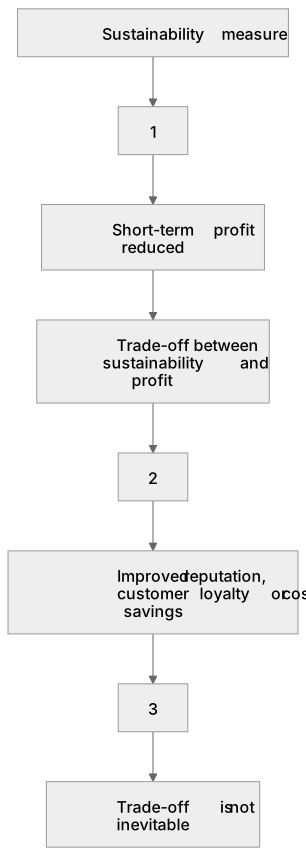
1Box 1
2Box 2
3Box 3
There is more to this lesson
The full lesson goes on to check your understanding and help you earn the marks. Create a free account to carry on, with your progress saved.
A week of Premium from your first lesson · Then the free plan continues · No card, no charge
Test your understanding of Ethical and environmental considerations: Students should be able to identify and analyse where there may be a possible trade-off between sustainability and profit.
Active recall beats re-reading. Take an instant quiz now to test what you’ve learned and lock it into long-term memory.
A week of Premium from your first lesson · Then the free plan continues · No card, no charge