AQA · GCSE · Business
Course version: 8132 · Version from Sept 2017
Discuss the advantages and disadvantages of methods of growth
Full specification wording
Expanding a business: discuss the advantages and disadvantages of methods of growth
Businesses can grow internally (organic growth) by increasing sales, opening new outlets or launching new products, or externally through mergers and takeovers, including horizontal, vertical and…
Checked against the AQA 8132 specification (opens in a new tab) on .
- Point 5 of 10
- 4 key terms
Study notes
From the checked teaching notes for this specification point.
The idea
Businesses can grow internally (organic growth) by increasing sales, opening new outlets or launching new products, or externally through mergers and takeovers, including horizontal, vertical and conglomerate integration. Organic growth is usually slower but lets the business keep control, its own culture and its existing expertise. External growth is faster and can quickly add market share, capacity or new skills, but it may be expensive, create integration problems, reduce motivation and risk diseconomies of scale. A horizontal merger joins competitors, a vertical merger joins a firm with a supplier or customer, and a conglomerate merger joins unrelated businesses. When discussing, weigh advantages such as speed, market power and cost savings against disadvantages such as debt, culture clashes and regulatory scrutiny, then judge which method suits the business and its objectives.
What earns the marks
- Identifies and defines at least two methods of growth, such as organic growth, horizontal integration, vertical integration, conglomerate merger or takeover.
- Explains an advantage of a chosen method, for example organic growth preserves control and culture, while a takeover gives rapid access to new markets or capacity.
- Explains a disadvantage of the same or another method, for example integration costs, culture clashes, job losses, debt or regulatory investigation.
- Applies the advantages and disadvantages to the context of the case study business rather than listing them generically.
- Reaches a supported judgement about which method of growth is most suitable, referring to the business's objectives, resources and market.
- Uses correct terminology for integration types, distinguishing horizontal, vertical (forward or backward) and conglomerate growth.
Common mistakes and how to put them right
Treating all external growth as a merger.
Put it right: A takeover buys control of another business, while a merger combines two businesses, often more equally.
Listing advantages and disadvantages without linking them to the case.
Put it right: Apply each point to the specific business, market or objective.
Assuming bigger is always better.
Put it right: Growth can bring diseconomies of scale, higher costs and integration problems that outweigh the benefits.
Exam tips
- Plan both sides before writing: at least one advantage and one disadvantage for each method you discuss, then decide.
- Use connectives such as however, therefore and this depends on to show analysis and evaluation rather than description.
- Finish with a clear judgement that answers the question directly and explains why your chosen method is preferable in the context given.
Try the lesson
The start of the Expanding a business: discuss the advantages and disadvantages of methods of growth lesson, made from checked teaching notes for this specification point.
Have a go first
Which of the following is an advantage of growing a business through organic growth?
Listen
Businesses can grow internally (organic growth) by increasing sales, opening new outlets or launching new products, or externally through mergers and takeovers, including horizontal, vertical and conglomerate integration. Organic growth is usually slower but lets the business keep control, its own culture and its existing expertise. External growth is faster and can quickly add market share, capacity or new skills, but it may be expensive, create integration problems, reduce motivation and risk diseconomies of scale. A horizontal merger joins competitors, a vertical merger joins a firm with a supplier or customer, and a conglomerate merger joins unrelated businesses. When discussing, weigh advantages such as speed, market power and cost savings against disadvantages such as debt, culture clashes and regulatory scrutiny, then judge which method suits the business and its objectives. A strong answer earns marks for these points. Identifies and defines at least two methods of growth, such as organic growth, horizontal integration, vertical integration, conglomerate merger or takeover. Explains an advantage of a chosen method, for example organic growth preserves control and culture, while a takeover gives rapid access to new markets or capacity. Explains a disadvantage of the same or another method, for example integration costs, culture clashes, job losses, debt or regulatory investigation. Applies the advantages and disadvantages to the context of the case study business rather than listing them generically. A common slip: Treating all external growth as a merger. Instead, a takeover buys control of another business, while a merger combines two businesses, often more equally. Exam tip: Plan both sides before writing: at least one advantage and one disadvantage for each method you discuss, then decide.
See it
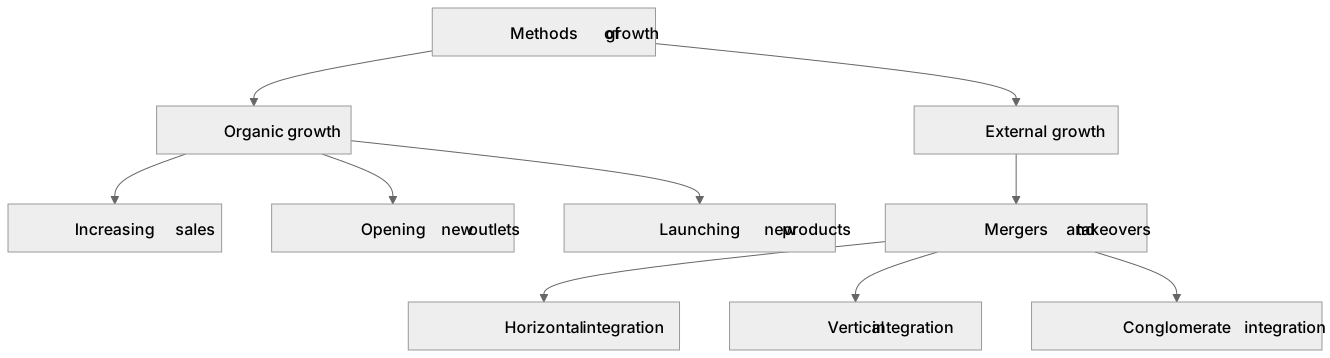
Key words
Say what each word means before you turn the card.
Organic growth
Try answering aloud or in your head before turning the card.
Mergers and takeovers
Try answering aloud or in your head before turning the card.
Horizontal, vertical and conglomerate integration
Try answering aloud or in your head before turning the card.
Diseconomies of scale
Try answering aloud or in your head before turning the card.
See every definition
- Organic growth
- Growing internally by increasing sales, opening new outlets or launching new products, which is usually slower but lets the business keep control, its own culture and its existing expertise.
- Mergers and takeovers
- External growth in which a takeover buys control of another business, while a merger combines two businesses, often more equally.
- Horizontal, vertical and conglomerate integration
- A horizontal merger joins competitors, a vertical merger joins a firm with a supplier or customer, and a conglomerate merger joins unrelated businesses.
- Diseconomies of scale
- Higher costs and integration problems that can come with growth and may outweigh the benefits.
Label the diagram
Some boxes have lost their names. Pick the right name for each number.
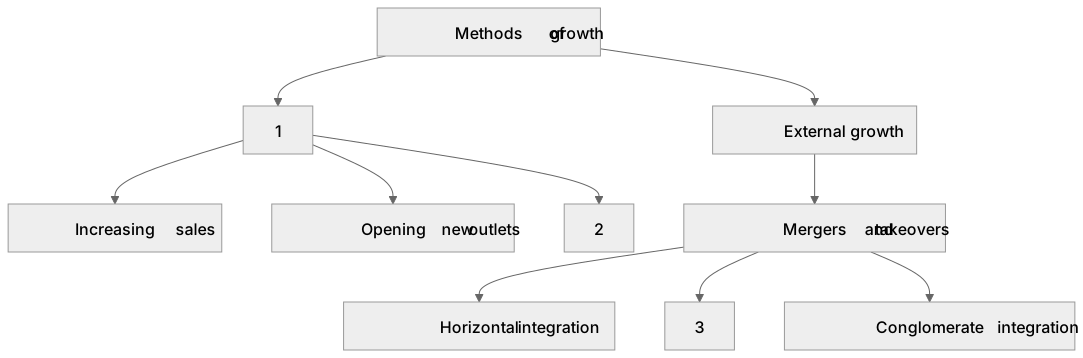
1Box 1
2Box 2
3Box 3
There is more to this lesson
The full lesson goes on to check your understanding and help you earn the marks. Create a free account to carry on, with your progress saved.
A week of Premium from your first lesson · Then the free plan continues · No card, no charge
Test your understanding of Expanding a business: discuss the advantages and disadvantages of methods of growth
Active recall beats re-reading. Take an instant quiz now to test what you’ve learned and lock it into long-term memory.
A week of Premium from your first lesson · Then the free plan continues · No card, no charge