AQA · GCSE · Business
Course version: 8132 · Version from Sept 2017
Understand the methods used by businesses when expanding (organic growth…
Full specification wording
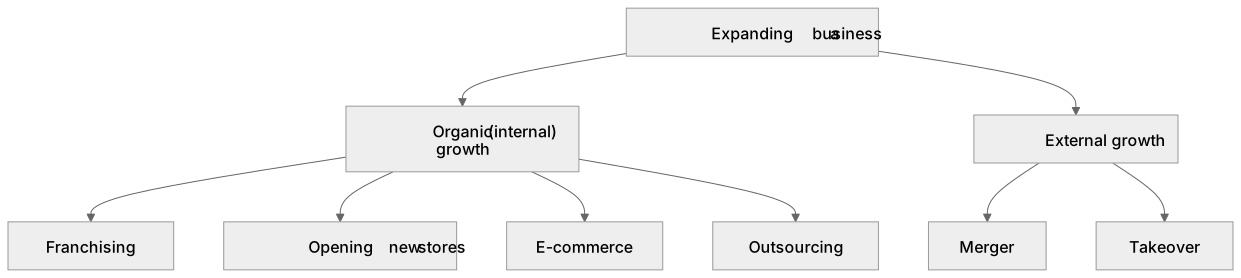
Expanding a business: understand the methods used by businesses when expanding (organic growth through franchising, opening new stores and expanding through e-commerce, outsourcing and external growth through mergers and takeovers)
Expansion means increasing the scale of a business's operations.
Checked against the AQA 8132 specification (opens in a new tab) on .
- Point 6 of 10
- 4 key terms
Study notes
From the checked teaching notes for this specification point.
The idea
Expansion means increasing the scale of a business's operations. Organic (internal) growth happens from within, funded by retained profit or loans. Franchising lets a franchisor license its brand and model to franchisees, who pay fees and royalties; the franchisor grows with less capital but loses some control. Opening new stores adds outlets in new locations, raising sales but also fixed costs such as rent and wages. E-commerce growth sells online, widening the market beyond a local catchment and often needing lower premises costs. Outsourcing contracts non-core tasks, such as IT or delivery, to specialist providers, cutting the need to employ and equip staff directly. External growth is quicker and comes through mergers (firms agree to combine) or takeovers (one firm buys another), giving instant market share, customers and capacity.
What earns the marks
- Organic growth is internal: the business funds expansion itself, for example by reinvesting retained profit or borrowing, and grows its own output, outlets or customer base.
- Opening new stores increases physical reach and sales potential but adds fixed costs such as rent, business rates and wages, and each site carries risk if demand is weaker than expected.
- E-commerce expansion sells through a website or online marketplace, widening the market beyond a local area and often reducing premises costs, though it brings delivery, website and cyber-security costs.
- Outsourcing contracts non-core activities, such as IT support, payroll or distribution, to specialist providers, which can cut costs and free capacity, but reduces direct control over quality and timing.
- Methods can be combined: a business might open stores organically while also taking over a rival, so evaluation should weigh speed, cost, control and risk rather than treat methods as mutually exclusive.
Common mistakes and how to put them right
Treating franchising as the franchisor buying shops.
Put it right: The franchisee invests in and runs the outlet, while the franchisor supplies the brand and model and receives fees and royalties.
Assuming e-commerce expansion removes premises costs entirely.
Put it right: Online growth often lowers high-street premises costs but creates distribution and technology costs.
Confusing a merger with a takeover.
Put it right: A merger is a combination agreed between businesses, whereas a takeover involves one business acquiring control of another.
Exam tips
- Name the method precisely, then explain how it works and give one benefit and one drawback, so each method is developed rather than listed.
- Use a short applied example, such as a café franchising its format or a retailer selling online, to show understanding of the method in context.
- When a question asks you to evaluate, compare at least two methods on cost, speed, control and risk, then reach a justified recommendation.
Try the lesson
The start of the Expanding a business: understand the methods used by businesses when expanding (organic growth through franchising, opening new stores and expanding through e-commerce, outsourcing and external growth through mergers and takeovers) lesson, made from checked teaching notes for this specification point.
Have a go first
A bakery chain wants to grow by selling the right to use its name and recipes to independent owners who will run their own branches. Which method of expansion is this?
Listen
Expansion means increasing the scale of a business's operations. Organic (internal) growth happens from within, funded by retained profit or loans. Franchising lets a franchisor license its brand and model to franchisees, who pay fees and royalties; the franchisor grows with less capital but loses some control. Opening new stores adds outlets in new locations, raising sales but also fixed costs such as rent and wages. E-commerce growth sells online, widening the market beyond a local catchment and often needing lower premises costs. Outsourcing contracts non-core tasks, such as IT or delivery, to specialist providers, cutting the need to employ and equip staff directly. External growth is quicker and comes through mergers (firms agree to combine) or takeovers (one firm buys another), giving instant market share, customers and capacity. A strong answer earns marks for these points. Organic growth is internal: the business funds expansion itself, for example by reinvesting retained profit or borrowing, and grows its own output, outlets or customer base. Franchising: the franchisor licenses its brand, products and operating model to franchisees, who usually pay an initial fee plus ongoing royalties; the franchisor expands with less of its own capital but keeps less day-to-day control. Opening new stores increases physical reach and sales potential but adds fixed costs such as rent, business rates and wages, and each site carries risk if demand is weaker than expected. E-commerce expansion sells through a website or online marketplace, widening the market beyond a local area and often reducing premises costs, though it brings delivery, website and cyber-security costs. A common slip: Treating franchising as the franchisor buying shops: the error is reversing the roles. Instead, the franchisee invests in and runs the outlet, while the franchisor supplies the brand and model and receives fees and royalties. Exam tip: Name the method precisely, then explain how it works and give one benefit and one drawback, so each method is developed rather than listed.
See it
Key words
Say what each word means before you turn the card.
Organic growth
Try answering aloud or in your head before turning the card.
Franchising
Try answering aloud or in your head before turning the card.
Outsourcing
Try answering aloud or in your head before turning the card.
Takeover
Try answering aloud or in your head before turning the card.
See every definition
- Organic growth
- Internal growth funded by retained profit or loans, where the business grows its own output, outlets or customer base.
- Franchising
- The franchisor licenses its brand, products and operating model to franchisees, who usually pay an initial fee plus ongoing royalties.
- Outsourcing
- Contracting non-core activities, such as IT support, payroll or distribution, to specialist providers.
- Takeover
- One business buys control of another, giving immediate market share, customers and capacity.
Label the diagram
Some boxes have lost their names. Pick the right name for each number.
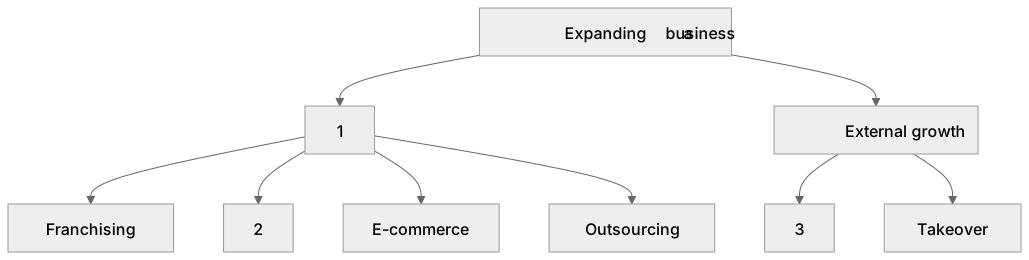
1Box 1
2Box 2
3Box 3
There is more to this lesson
The full lesson goes on to check your understanding and help you earn the marks. Create a free account to carry on, with your progress saved.
A week of Premium from your first lesson · Then the free plan continues · No card, no charge
Test your understanding of Expanding a business: understand the methods used by businesses when expanding (organic growth through franchising, opening new stores and expanding through e-commerce, outsourcing and external growth through mergers and takeovers)
Active recall beats re-reading. Take an instant quiz now to test what you’ve learned and lock it into long-term memory.
A week of Premium from your first lesson · Then the free plan continues · No card, no charge