AQA · GCSE · Business
Course version: 8132 · Version from Sept 2017
Good customer services: Benefits of good customer service, including:
Good customer service means meeting and exceeding what customers expect before, during and after a purchase.
Checked against the AQA 8132 specification (opens in a new tab) on .
- Point 7 of 19
- 4 key terms
Study notes
From the checked teaching notes for this specification point.
The idea
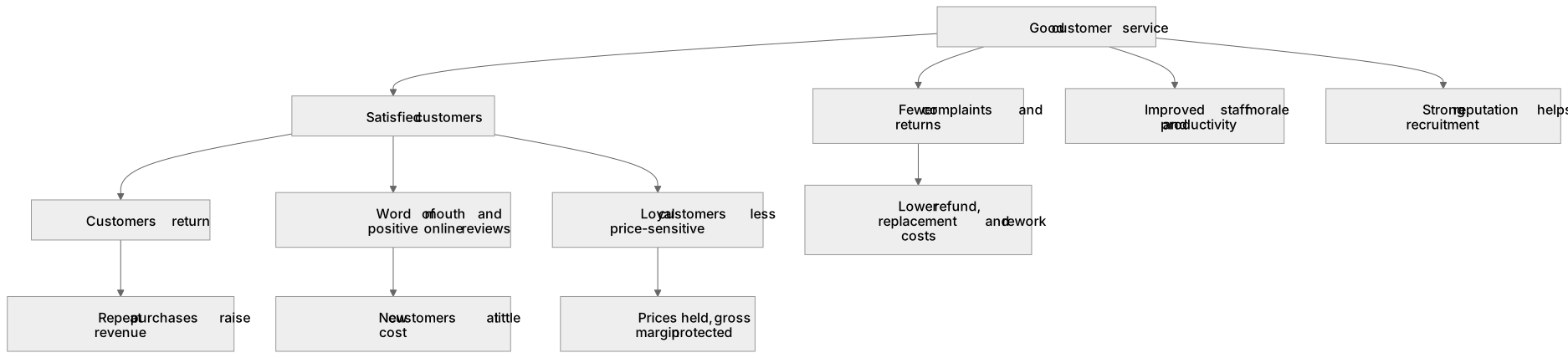
Good customer service means meeting and exceeding what customers expect before, during and after a purchase. Its benefits flow through the whole business. Satisfied customers return, so repeat custom raises revenue and makes sales more predictable. Positive word of mouth and online reviews attract new customers at little cost, lowering marketing spend per sale. Loyal customers are often less price-sensitive, so the business can hold prices and protect its gross margin. Staff face fewer complaints and returns, which cuts the cost of refunds, replacements and rework, and raises morale and productivity. A strong reputation also helps recruitment and can support premium pricing.
For example: A café that greets regulars by name, fixes errors quickly and replies to reviews builds a loyal base that keeps tills busy in quiet weeks.
What earns the marks
- Explains that good customer service raises customer satisfaction, so customers return and repeat purchases increase revenue.
- Explains that satisfied customers recommend the business by word of mouth and positive online reviews, attracting new customers and reducing the need for paid promotion.
- Explains that loyal customers are less price-sensitive, allowing the business to maintain or raise prices and protect profit margins.
- Explains that fewer complaints, refunds and returns lower the costs of replacements, rework and administration.
- Explains that good service improves staff morale and productivity and strengthens the business's reputation, helping recruitment and retention.
- Applies the benefits to a given business context, for example a small retailer using loyal regulars to survive seasonal slumps.
Common mistakes and how to put them right
Treating customer service as only politeness and ignoring its financial effects.
Put it right: Link each behaviour to a business outcome such as repeat sales, lower costs or a stronger reputation.
Assuming good service always raises costs and therefore always reduces profit.
Put it right: Weigh the extra spending against higher revenue and lower complaint-handling costs.
Listing benefits without applying them to the case-study business.
Put it right: Name the business and explain how the benefit would show up in its sales, costs or reputation.
Exam tips
- Use the chain of reasoning: good service leads to satisfied customers, which leads to repeat purchases, which leads to higher revenue.
- Anchor each benefit to a specific stakeholder, such as customers, staff or owners, so the answer shows understanding rather than a list.
- When a case study is given, quote one detail from it and explain how good service would change that detail.
Try the lesson
The start of the Good customer services: Benefits of good customer service, including: lesson, made from checked teaching notes for this specification point.
Have a go first
Which of the following is a benefit to a business of providing good customer service?
Listen
Good customer service means meeting and exceeding what customers expect before, during and after a purchase. Its benefits flow through the whole business. Satisfied customers return, so repeat custom raises revenue and makes sales more predictable. Positive word of mouth and online reviews attract new customers at little cost, lowering marketing spend per sale. Loyal customers are often less price-sensitive, so the business can hold prices and protect its gross margin. Staff face fewer complaints and returns, which cuts the cost of refunds, replacements and rework, and raises morale and productivity. A strong reputation also helps recruitment and can support premium pricing. For example, a café that greets regulars by name, fixes errors quickly and replies to reviews builds a loyal base that keeps tills busy in quiet weeks. A strong answer earns marks for these points. Explains that good customer service raises customer satisfaction, so customers return and repeat purchases increase revenue. Explains that satisfied customers recommend the business by word of mouth and positive online reviews, attracting new customers and reducing the need for paid promotion. Explains that loyal customers are less price-sensitive, allowing the business to maintain or raise prices and protect profit margins. Explains that fewer complaints, refunds and returns lower the costs of replacements, rework and administration. A common slip: Treating customer service as only politeness and ignoring its financial effects. Instead, link each behaviour to a business outcome such as repeat sales, lower costs or a stronger reputation. Exam tip: Use the chain of reasoning: good service leads to satisfied customers, which leads to repeat purchases, which leads to higher revenue.
See it
Key words
Say what each word means before you turn the card.
Customer satisfaction and loyalty
Try answering aloud or in your head before turning the card.
Repeat custom and revenue growth
Try answering aloud or in your head before turning the card.
Word-of-mouth promotion and reputation
Try answering aloud or in your head before turning the card.
Cost control through fewer complaints and returns
Try answering aloud or in your head before turning the card.
See every definition
- Customer satisfaction and loyalty
- Meeting and exceeding what customers expect before, during and after a purchase, so that satisfied customers return.
- Repeat custom and revenue growth
- Satisfied customers return, so repeat custom raises revenue and makes sales more predictable.
- Word-of-mouth promotion and reputation
- Positive word of mouth and online reviews attract new customers at little cost, lowering marketing spend per sale.
- Cost control through fewer complaints and returns
- Staff face fewer complaints and returns, which cuts the cost of refunds, replacements and rework, and raises morale and productivity.
Label the diagram
Some boxes have lost their names. Pick the right name for each number.
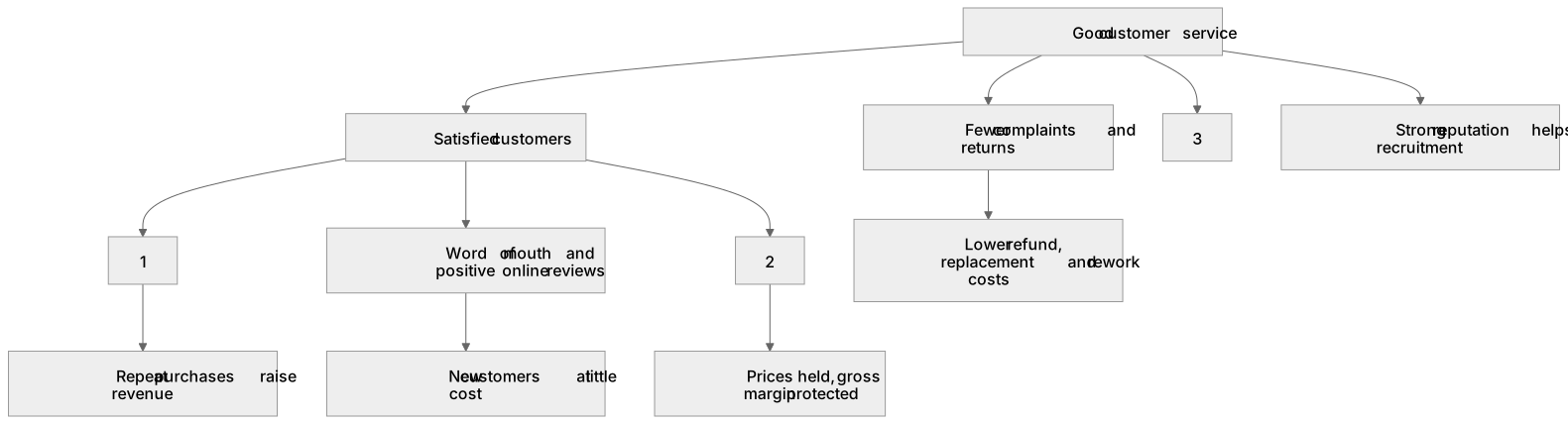
1Box 1
2Box 2
3Box 3
There is more to this lesson
The full lesson goes on to check your understanding and help you earn the marks. Create a free account to carry on, with your progress saved.
A week of Premium from your first lesson · Then the free plan continues · No card, no charge
Test your understanding of Good customer services: Benefits of good customer service, including:
Active recall beats re-reading. Take an instant quiz now to test what you’ve learned and lock it into long-term memory.
A week of Premium from your first lesson · Then the free plan continues · No card, no charge