AQA · GCSE · Business
Course version: 8132 · Version from Sept 2017
Students should be able to understand the importance of providing good…
Full specification wording
Good customer services: Students should be able to understand the importance of providing good service to customers and analyse the techniques businesses use to provide good customer service.
Good customer service means meeting or exceeding customer expectations before, during and after a sale.
Checked against the AQA 8132 specification (opens in a new tab) on .
- Point 6 of 19
- 4 key terms
Study notes
From the checked teaching notes for this specification point.
The idea
Good customer service means meeting or exceeding customer expectations before, during and after a sale. It matters because satisfied customers are more likely to return, recommend the business and overlook minor problems, which can raise sales and profit. Poor service can lead to complaints, lost custom and damage to reputation. Businesses use several techniques to provide good service, including recruiting and training staff in communication and product knowledge, setting clear service standards, responding quickly to enquiries and complaints, offering after-sales support such as help lines and servicing, and collecting customer feedback to identify improvements.
What earns the marks
- Explains that good customer service can increase customer satisfaction, loyalty and repeat purchases.
- Explains that good customer service can improve a business's reputation and lead to positive word-of-mouth recommendations.
- Explains that poor customer service can cause complaints, lost sales and reputational damage.
- Identifies techniques such as staff training, clear service standards, fast complaint handling, after-sales support and customer feedback.
- Analyses how a technique works, for example training staff improves product knowledge, which helps them answer queries accurately and reduces customer frustration.
- Applies techniques to a specific business context and considers possible costs or limitations, such as the expense of training or the difficulty of maintaining consistent service.
Common mistakes and how to put them right
Describing customer service only as being polite.
Put it right: Good customer service also includes product knowledge, speed of response, reliability and after-sales support.
Listing techniques without analysing them.
Put it right: Explain how each technique affects the customer and the business, using a cause-and-effect chain.
Ignoring the cost or difficulty of providing good service.
Put it right: Consider that training, extra staff and support systems use resources and may reduce short-term profit.
Exam tips
- For 'analyse' questions, use connectives such as 'because', 'which leads to' and 'as a result' to build a chain of reasoning.
- Link each technique to a specific effect on the customer, such as feeling valued or receiving a quick solution, and then to a business result, such as repeat custom.
- Use business terminology accurately, for example customer loyalty, reputation, complaint resolution and after-sales service.
Try the lesson
The start of the Good customer services: Students should be able to understand the importance of providing good service to customers and analyse the techniques businesses use to provide good customer service. lesson, made from checked teaching notes for this specification point.
Have a go first
Why is providing good customer service important for a business?
Listen
Good customer service means meeting or exceeding customer expectations before, during and after a sale. It matters because satisfied customers are more likely to return, recommend the business and overlook minor problems, which can raise sales and profit. Poor service can lead to complaints, lost custom and damage to reputation. Businesses use several techniques to provide good service, including recruiting and training staff in communication and product knowledge, setting clear service standards, responding quickly to enquiries and complaints, offering after-sales support such as help lines and servicing, and collecting customer feedback to identify improvements. A strong answer earns marks for these points. Explains that good customer service can increase customer satisfaction, loyalty and repeat purchases. Explains that good customer service can improve a business's reputation and lead to positive word-of-mouth recommendations. Explains that poor customer service can cause complaints, lost sales and reputational damage. Identifies techniques such as staff training, clear service standards, fast complaint handling, after-sales support and customer feedback. A common slip: Describing customer service only as being polite. Instead, good customer service also includes product knowledge, speed of response, reliability and after-sales support. Exam tip: For 'analyse' questions, use connectives such as 'because', 'which leads to' and 'as a result' to build a chain of reasoning.
See it
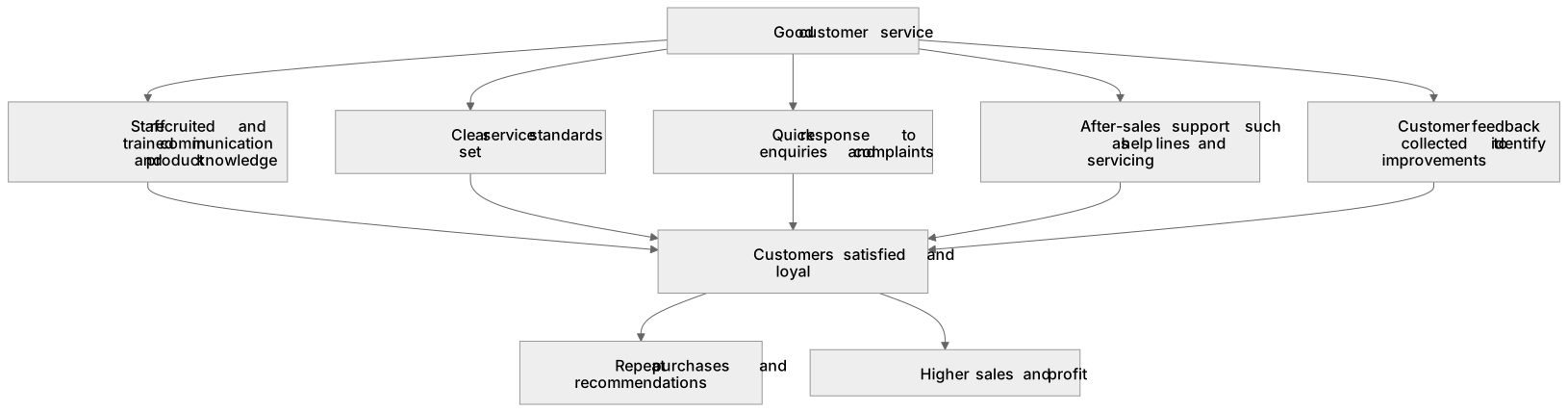
Key words
Say what each word means before you turn the card.
Importance of customer service
Try answering aloud or in your head before turning the card.
Techniques for good customer service
Try answering aloud or in your head before turning the card.
Customer satisfaction and loyalty
Try answering aloud or in your head before turning the card.
Business costs and benefits
Try answering aloud or in your head before turning the card.
See every definition
- Importance of customer service
- Satisfied customers are more likely to return, recommend the business and overlook minor problems, which can raise sales and profit, while poor service can lead to complaints, lost custom and damage to reputation.
- Techniques for good customer service
- Businesses recruit and train staff in communication and product knowledge, set clear service standards, respond quickly to enquiries and complaints, offer after-sales support and collect customer feedback to identify improvements.
- Customer satisfaction and loyalty
- Good customer service can increase customer satisfaction, loyalty and repeat purchases, and can improve a business's reputation and lead to positive word-of-mouth recommendations.
- Business costs and benefits
- Training, extra staff and support systems use resources and may reduce short-term profit, so the expense of training or the difficulty of maintaining consistent service must be considered.
Label the diagram
Some boxes have lost their names. Pick the right name for each number.
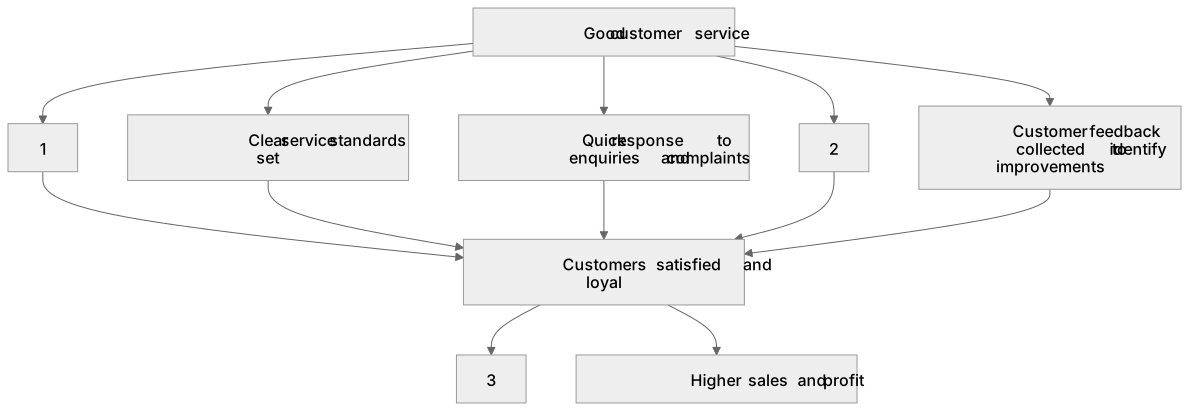
1Box 1
2Box 2
3Box 3
There is more to this lesson
The full lesson goes on to check your understanding and help you earn the marks. Create a free account to carry on, with your progress saved.
A week of Premium from your first lesson · Then the free plan continues · No card, no charge
Test your understanding of Good customer services: Students should be able to understand the importance of providing good service to customers and analyse the techniques businesses use to provide good customer service.
Active recall beats re-reading. Take an instant quiz now to test what you’ve learned and lock it into long-term memory.
A week of Premium from your first lesson · Then the free plan continues · No card, no charge