AQA · GCSE · Business
Course version: 8132 · Version from Sept 2017
Understand the difference between internal and external recruitment and…
Full specification wording
Recruitment and selection of employees: understand the difference between internal and external recruitment and the benefits and drawbacks of each approach
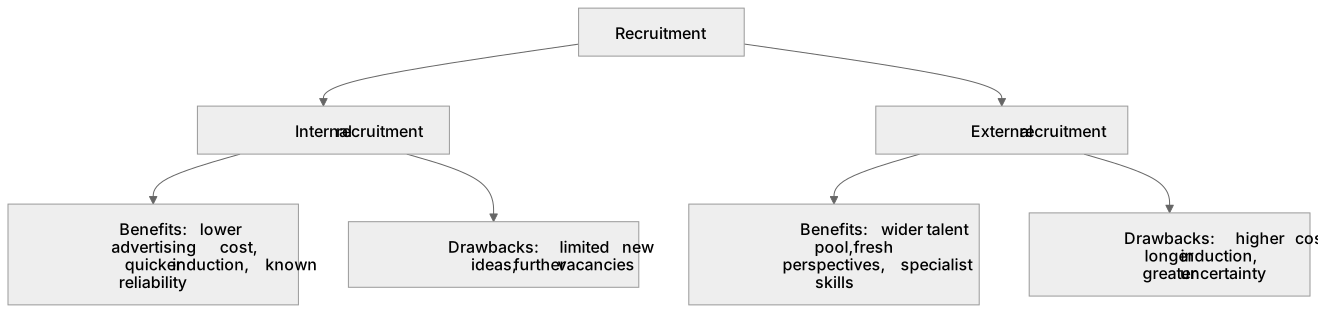
Internal recruitment fills a vacancy with an existing employee, perhaps through promotion or transfer.
Checked against the AQA 8132 specification (opens in a new tab) on .
- Point 4 of 8
- 4 key terms
Study notes
From the checked teaching notes for this specification point.
The idea
Internal recruitment fills a vacancy with an existing employee, perhaps through promotion or transfer. External recruitment attracts candidates from outside the business, such as via job centres, agencies or online adverts. Internal recruitment benefits include lower advertising cost, faster induction and known reliability; drawbacks include limited new ideas and further vacancies. External recruitment benefits include a wider talent pool, fresh perspectives and specialist skills; drawbacks include higher cost, longer induction and greater uncertainty. For example, a supermarket promoting a checkout supervisor internally saves on advertising but may need external recruitment for a specialist baker. Understanding these differences helps businesses choose the approach that best meets their needs.
What earns the marks
- Internal recruitment means filling a vacancy from within the existing workforce, for example by promotion or transfer.
- External recruitment means filling a vacancy with someone from outside the business, for example through job centres, recruitment agencies or online advertisements.
- Benefits of internal recruitment include lower advertising costs, quicker induction because the candidate knows the business, and evidence of existing performance.
- Drawbacks of internal recruitment include a limited pool of candidates, no fresh ideas from outside, and the creation of another vacancy to fill.
- Benefits of external recruitment include a wider choice of candidates, new ideas and skills, and the chance to bring in specialist expertise.
- Drawbacks of external recruitment include higher advertising and agency costs, longer induction periods, and greater uncertainty about how a candidate will perform.
Common mistakes and how to put them right
Thinking internal recruitment always costs nothing.
Put it right: Internal recruitment still involves costs such as covering the vacated post and possible training, though advertising costs are usually lower.
Assuming external recruitment always brings better candidates.
Put it right: External candidates may be less familiar with the business, so induction takes longer and performance is less certain.
Confusing internal recruitment with internal promotion only.
Put it right: Internal recruitment also includes transfers, temporary cover and reorganisation, not just promotion.
Exam tips
- Use a named business context when explaining benefits or drawbacks, such as a small café versus a large supermarket chain.
- Link each benefit or drawback to a consequence for the business, for example lower costs increase profit or longer induction delays productivity.
- When comparing, address both internal and external recruitment rather than describing only one approach.
Try the lesson
The start of the Recruitment and selection of employees: understand the difference between internal and external recruitment and the benefits and drawbacks of each approach lesson, made from checked teaching notes for this specification point.
Have a go first
Which of the following describes internal recruitment?
Listen
Internal recruitment fills a vacancy with an existing employee, perhaps through promotion or transfer. External recruitment attracts candidates from outside the business, such as via job centres, agencies or online adverts. Internal recruitment benefits include lower advertising cost, faster induction and known reliability; drawbacks include limited new ideas and further vacancies. External recruitment benefits include a wider talent pool, fresh perspectives and specialist skills; drawbacks include higher cost, longer induction and greater uncertainty. For example, a supermarket promoting a checkout supervisor internally saves on advertising but may need external recruitment for a specialist baker. Understanding these differences helps businesses choose the approach that best meets their needs. A strong answer earns marks for these points. Internal recruitment means filling a vacancy from within the existing workforce, for example by promotion or transfer. External recruitment means filling a vacancy with someone from outside the business, for example through job centres, recruitment agencies or online advertisements. Benefits of internal recruitment include lower advertising costs, quicker induction because the candidate knows the business, and evidence of existing performance. Drawbacks of internal recruitment include a limited pool of candidates, no fresh ideas from outside, and the creation of another vacancy to fill. A common slip: Thinking internal recruitment always costs nothing. Instead, internal recruitment still involves costs such as covering the vacated post and possible training, though advertising costs are usually lower. Exam tip: Use a named business context when explaining benefits or drawbacks, such as a small café versus a large supermarket chain.
See it
Key words
Say what each word means before you turn the card.
Internal recruitment
Try answering aloud or in your head before turning the card.
External recruitment
Try answering aloud or in your head before turning the card.
Cost and efficiency
Try answering aloud or in your head before turning the card.
Risk and uncertainty
Try answering aloud or in your head before turning the card.
See every definition
- Internal recruitment
- Filling a vacancy with an existing employee, perhaps through promotion or transfer.
- External recruitment
- Attracting candidates from outside the business, such as via job centres, agencies or online adverts.
- Cost and efficiency
- Lower advertising cost and faster induction are benefits of internal recruitment, while higher cost and longer induction are drawbacks of external recruitment.
- Risk and uncertainty
- Greater uncertainty about how a candidate will perform is a drawback of external recruitment.
Label the diagram
Some boxes have lost their names. Pick the right name for each number.
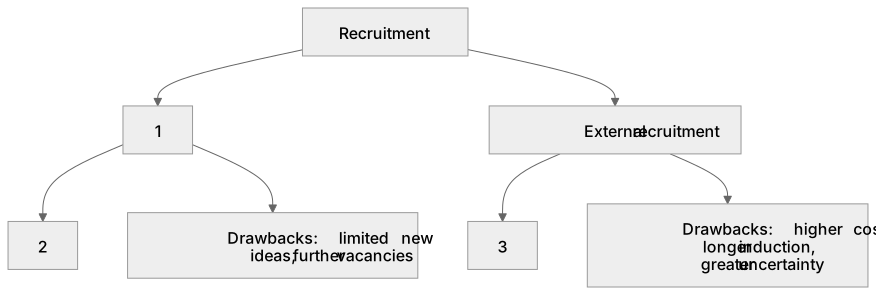
1Box 1
2Box 2
3Box 3
There is more to this lesson
The full lesson goes on to check your understanding and help you earn the marks. Create a free account to carry on, with your progress saved.
A week of Premium from your first lesson · Then the free plan continues · No card, no charge
Test your understanding of Recruitment and selection of employees: understand the difference between internal and external recruitment and the benefits and drawbacks of each approach
Active recall beats re-reading. Take an instant quiz now to test what you’ve learned and lock it into long-term memory.
A week of Premium from your first lesson · Then the free plan continues · No card, no charge