AQA · GCSE · Business
Course version: 8132 · Version from Sept 2017
Segmentation: age
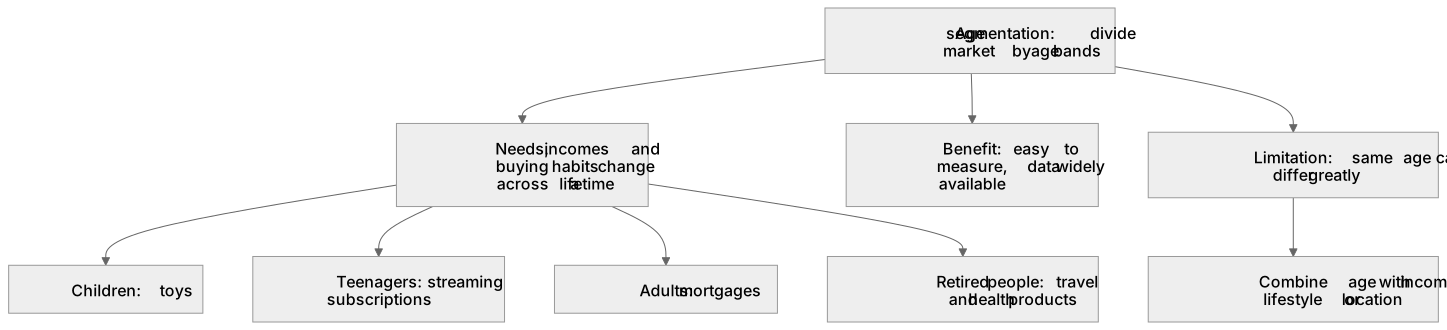
Age segmentation means dividing a market into groups defined by how old customers are, because needs, incomes and buying habits change across a lifetime.
Checked against the AQA 8132 specification (opens in a new tab) on .
- Point 3 of 5
- 3 key terms
Study notes
From the checked teaching notes for this specification point.
The idea
Age segmentation means dividing a market into groups defined by how old customers are, because needs, incomes and buying habits change across a lifetime. A business might target children with toys, teenagers with streaming subscriptions, adults with mortgages or retired people with travel and health products. Age bands are usually chosen to match the product: for example, a cinema may price under-16 and over-65 tickets differently because willingness to pay and leisure time vary. Age is easy to measure and data is widely available, so targeting is straightforward. However, people of the same age can differ greatly, so age alone may be a weak predictor of behaviour. Businesses often combine age with income, lifestyle or location to sharpen the segment and avoid stereotyping.
What earns the marks
- Defines age segmentation as splitting a market by customers' age or age bands.
- Explains that needs, tastes, income and spending patterns often change with age.
- Gives a relevant example of a product or service aimed at a particular age group.
- Explains a benefit, such as easier targeting or clearer marketing messages.
- Explains a limitation, such as people of the same age behaving differently.
- Shows how age can be combined with other segmentation variables to improve targeting.
Common mistakes and how to put them right
Treating everyone in an age band as identical.
Put it right by noting that age is only one influence on buying behaviour.
Confusing age segmentation with income segmentation.
Put it right by checking whether the grouping is based on years lived rather than earnings.
Assuming older customers always spend less.
Put it right by recognising that retired people may have savings and free time for leisure spending.
Exam tips
- Name the age band you are discussing so the application is specific.
- Link each benefit or drawback to the business context given in the case.
- Use the phrase 'because' to turn a simple point into an explained point.
Try the lesson
The start of the Segmentation: age lesson, made from checked teaching notes for this specification point.
Have a go first
Which of the following is an example of age segmentation?
Listen
Age segmentation means dividing a market into groups defined by how old customers are, because needs, incomes and buying habits change across a lifetime. A business might target children with toys, teenagers with streaming subscriptions, adults with mortgages or retired people with travel and health products. Age bands are usually chosen to match the product: for example, a cinema may price under-16 and over-65 tickets differently because willingness to pay and leisure time vary. Age is easy to measure and data is widely available, so targeting is straightforward. However, people of the same age can differ greatly, so age alone may be a weak predictor of behaviour. Businesses often combine age with income, lifestyle or location to sharpen the segment and avoid stereotyping. A strong answer earns marks for these points. Defines age segmentation as splitting a market by customers' age or age bands. Explains that needs, tastes, income and spending patterns often change with age. Gives a relevant example of a product or service aimed at a particular age group. Explains a benefit, such as easier targeting or clearer marketing messages. A common slip: Treating everyone in an age band as identical. Instead, noting that age is only one influence on buying behaviour. Exam tip: Name the age band you are discussing so the application is specific.
See it
Key words
Say what each word means before you turn the card.
Market segmentation
Try answering aloud or in your head before turning the card.
Customer needs
Try answering aloud or in your head before turning the card.
Target marketing
Try answering aloud or in your head before turning the card.
See every definition
- Market segmentation
- Dividing a market into groups, such as by age, so that a business can target customers whose needs differ.
- Customer needs
- The requirements of customers, which change across a lifetime along with incomes and buying habits.
- Target marketing
- Aiming a product or service at a particular group, such as children, teenagers, adults or retired people.
Label the diagram
Some boxes have lost their names. Pick the right name for each number.
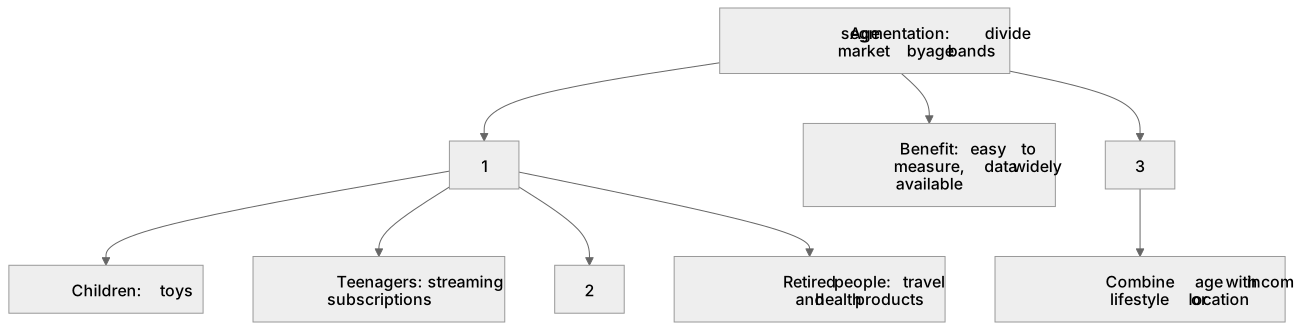
1Box 1
2Box 2
3Box 3
There is more to this lesson
The full lesson goes on to check your understanding and help you earn the marks. Create a free account to carry on, with your progress saved.
A week of Premium from your first lesson · Then the free plan continues · No card, no charge
Test your understanding of Segmentation: age
Active recall beats re-reading. Take an instant quiz now to test what you’ve learned and lock it into long-term memory.
A week of Premium from your first lesson · Then the free plan continues · No card, no charge