AQA · GCSE · Business
Course version: 8132 · Version from Sept 2017
Segmentation: gender
Gender is one basis for segmenting a market: buyers are grouped as male, female or, increasingly, as people who do not identify strictly with either.
Checked against the AQA 8132 specification (opens in a new tab) on .
- Point 2 of 5
- 4 key terms
Study notes
From the checked teaching notes for this specification point.
The idea
Gender is one basis for segmenting a market: buyers are grouped as male, female or, increasingly, as people who do not identify strictly with either. A business uses this split when men and women tend to want different products, styles, sizes or messages. The method is to collect sales or survey data by gender, compare what each group buys and values, then decide whether to target one group or both with different marketing mixes. For example, a razor brand may sell a male-targeted range and a female-targeted range with different colours, prices and advertising. Gender segmentation can raise relevance and sales, but it risks stereotyping and can miss buyers whose tastes do not match the label, so many firms now blend gender with age, income or lifestyle.
What earns the marks
- Defines gender segmentation as dividing a market by whether buyers are male, female or do not identify strictly with either.
- Explains that it is used when the groups want different products, features, sizes, prices or promotional messages.
- Shows how data on buying by gender is gathered and compared before a target is chosen.
- Applies it to an example, such as clothing, toiletries or sportswear ranges aimed at different gender groups.
- Evaluates the limitation that gender labels can stereotype and exclude some buyers, so firms may combine gender with other bases.
- Links gender segmentation to a marketing mix decision, for example a distinct product design or advertising channel for one group.
Common mistakes and how to put them right
Assuming all men or all women want the same product.
Put it right by saying gender is only one basis and tastes vary within each group.
Confusing gender segmentation with age or income segmentation.
Put it right by naming the exact characteristic used to divide the market.
Ignoring buyers who do not identify strictly as male or female.
Put it right by noting that some firms use broader or unisex targeting.
Exam tips
- Name the gender segment, state one need it has and match one marketing mix element to that need.
- Add a short evaluation sentence: gender segmentation can boost relevance but may stereotype, so it often works best alongside other bases.
- Use case study evidence about the product or customers rather than general claims about men and women.
Try the lesson
The start of the Segmentation: gender lesson, made from checked teaching notes for this specification point.
Have a go first
What does gender segmentation involve?
Listen
Gender is one basis for segmenting a market: buyers are grouped as male, female or, increasingly, as people who do not identify strictly with either. A business uses this split when men and women tend to want different products, styles, sizes or messages. The method is to collect sales or survey data by gender, compare what each group buys and values, then decide whether to target one group or both with different marketing mixes. For example, a razor brand may sell a male-targeted range and a female-targeted range with different colours, prices and advertising. Gender segmentation can raise relevance and sales, but it risks stereotyping and can miss buyers whose tastes do not match the label, so many firms now blend gender with age, income or lifestyle. A strong answer earns marks for these points. Defines gender segmentation as dividing a market by whether buyers are male, female or do not identify strictly with either. Explains that it is used when the groups want different products, features, sizes, prices or promotional messages. Shows how data on buying by gender is gathered and compared before a target is chosen. Applies it to an example, such as clothing, toiletries or sportswear ranges aimed at different gender groups. A common slip: Assuming all men or all women want the same product. Instead, saying gender is only one basis and tastes vary within each group. Exam tip: Name the gender segment, state one need it has and match one marketing mix element to that need.
See it
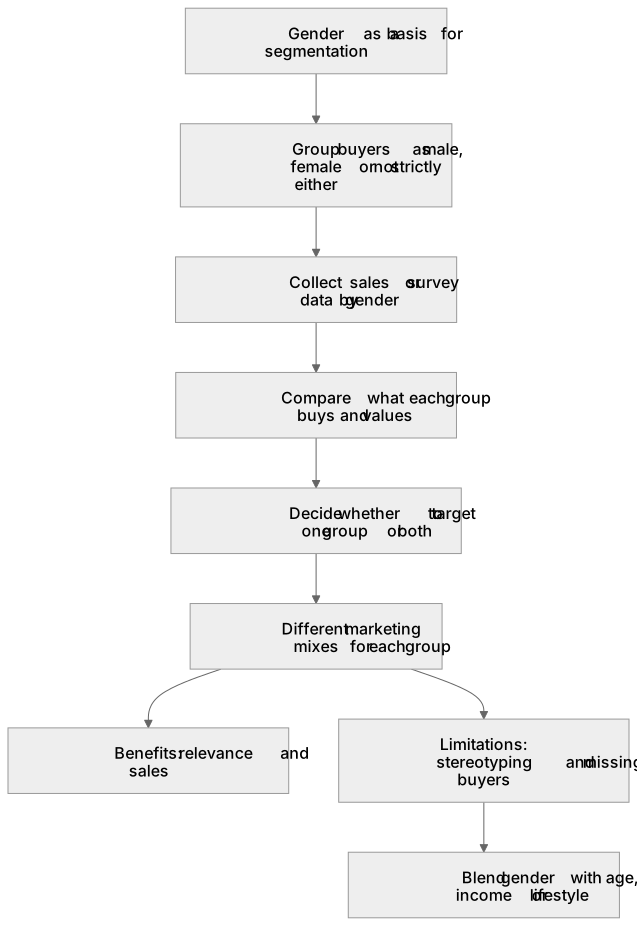
Key words
Say what each word means before you turn the card.
Gender segmentation
Try answering aloud or in your head before turning the card.
Target market choice
Try answering aloud or in your head before turning the card.
Marketing mix adaptation
Try answering aloud or in your head before turning the card.
Stereotyping and inclusivity
Try answering aloud or in your head before turning the card.
See every definition
- Gender segmentation
- Dividing a market by whether buyers are male, female or do not identify strictly with either.
- Target market choice
- Deciding whether to target one group or both with different marketing mixes after comparing what each group buys and values.
- Marketing mix adaptation
- Adapting elements such as products, styles, sizes or messages for a group when men and women tend to want different things.
- Stereotyping and inclusivity
- A risk that gender labels stereotype and can miss buyers whose tastes do not match the label, so many firms now blend gender with age, income or lifestyle.
Label the diagram
Some boxes have lost their names. Pick the right name for each number.
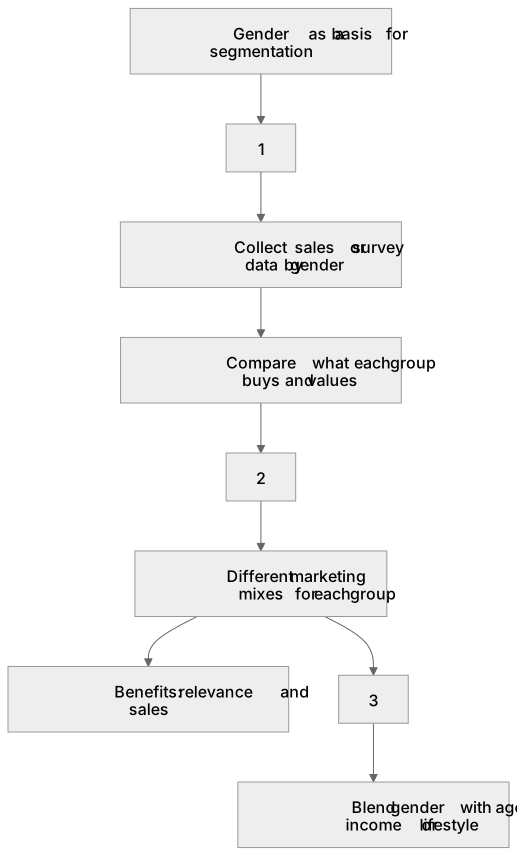
1Box 1
2Box 2
3Box 3
There is more to this lesson
The full lesson goes on to check your understanding and help you earn the marks. Create a free account to carry on, with your progress saved.
A week of Premium from your first lesson · Then the free plan continues · No card, no charge
Test your understanding of Segmentation: gender
Active recall beats re-reading. Take an instant quiz now to test what you’ve learned and lock it into long-term memory.
A week of Premium from your first lesson · Then the free plan continues · No card, no charge